How to Grow Garlic
Garlic is planted in fall, one clove at a time, and harvested the next summer when about half the leaves have browned. Set the biggest cloves pointed end up about 2 inches deep and 4 to 6 inches apart, cover the bed with straw where winters are cold, and keep the plants fed and watered in spring. Fall planting matters because cloves need roughly two months of cold before they will form a bulb.

Your dates for garlic
Set your ZIP code at the top of the page and we will work out when to plant garlic where you live, from the frost records of the nearest NOAA weather station. Your ZIP code is remembered on this device only.
Garlic at a glance
- Botanical name
- Allium sativum
- Light
- full sun (at least 6 hours; 8-10 hours preferred)
- Frost tolerance
- Hardy: takes a hard frost
- Hardiness zones
- 4-9
- Planting depth
- 2 inches
- Spacing
- 3–6 inches apart, rows 12–18 inches apart
When to plant garlic
| Zone | Sow outdoors | Fall planting |
|---|---|---|
| Zone 2a | Apr 7 to 21 | Sep 5 to 19 |
| Zone 3a | Apr 14 to 28 | Sep 14 to 28 |
| Zone 3b | Apr 5 to 19 | Sep 24 to Oct 8 |
| Zone 4a | Apr 1 to 15 | Sep 28 to Oct 12 |
| Zone 4b | Mar 27 to Apr 10 | Oct 1 to 15 |
| Zone 5a | Mar 22 to Apr 5 | Oct 4 to 18 |
| Zone 5b | Mar 20 to Apr 3 | Oct 10 to 24 |
| Zone 6a | Mar 18 to Apr 1 | Oct 17 to 31 |
| Zone 6b | Mar 12 to 26 | Oct 22 to Nov 5 |
| Zone 7a | Mar 5 to 19 | Oct 25 to Nov 8 |
| Zone 7b | Feb 22 to Mar 8 | Nov 1 to 15 |
| Zone 8a | Feb 15 to Mar 1 | Nov 7 to 21 |
| Zone 8b | Feb 3 to 17 | Nov 13 to 27 |
| Zone 9a | Jan 19 to Feb 2 | Nov 26 to Dec 10 |
| Zone 9b | Dec 20 to Jan 3 | Dec 9 to 23 |
Spring dates before the last frost assume the soil has thawed and is dry enough to work. After a late or wet spring, wait for that even if the date has passed.
When to plant garlicWhen to harvest garlic
Why garlic goes in the ground in fall
Garlic never sets fertile seed. You plant individual cloves, and each one grows into a single new bulb. That bulb only forms after the clove has spent about two months at 32 to 50°F, which is why University of Maryland Extension and almost every other extension service tells home gardeners to plant in fall. A fall clove grows roots before the ground freezes, sits through winter, and shoots up quickly when the soil warms. Lengthening days in late spring then switch the plant from making leaves to making a bulb.
That switch is the key to the whole crop. Leaf growth stops once bulbing begins, and the size of the bulb depends on how much leaf the plant built beforehand. Clemson Extension makes exactly this point: plant early enough that the plant is well grown before it starts to bulb. A spring-planted clove gets too little cold and too little time to build leaves, so it makes a small bulb.
The cycle follows garlic’s origins. Wild garlic comes from Central Asia, where winters are long and cold and summers hot and dry. It roots in fall, grows fast in spring, finishes its bulb before the summer drought and then rests. Your planting calendar copies that pattern.
Hardneck or softneck: choose for your climate
Two main groups of true garlic are grown in gardens, and climate should decide which you plant.
Hardneck garlic sends up a stiff flower stalk, the scape, with a single ring of 4 to 12 cloves around it. Wisconsin Extension notes that hardnecks do best where winters are long. They peel easily and many gardeners prize their flavor, but most keep only 3 to 4 months at room temperature. Within the hardnecks, Rocamboles store worst, Purple Stripes a little longer, and Porcelains longest (4 to 8 months).
Softneck garlic rarely makes a scape, so the soft stems can be braided. Bulbs hold 10 to 40 cloves in several layers and usually keep 6 to 8 months or longer. Softnecks are better suited to long seasons and mild winters. Artichoke types are the most adaptable and need less winter cold than the others. Silverskins keep the longest of all.
Variety recommendations from extension services, by region:
- Illinois and the Midwest: Illinois Extension prefers hardnecks because softnecks are less cold hardy. It suggests ‘Spanish Roja’, ‘Carpathian’, ‘Music’, ‘Georgian Crystal’, ‘Metechi’, ‘Persian Star’ and ‘German Extra Hardy’, and among softnecks ‘Inchelium Red’, ‘Early Red Italian’, ‘Idaho Silver’ and ‘Nootka Rose’. Wisconsin’s list for cold climates includes ‘Chesnock Red’, ‘German Extra Hardy’, ‘Music’, ‘Russian Red’ and ‘Spanish Roja’. It also notes that ‘Killarney Red’ tolerates wet conditions better than most.
- North Carolina: NC State lists ‘Music’ for its large cloves and cold tolerance.
- South Carolina and the Southeast: Clemson says Rocamboles should not be grown in South Carolina. It points to Creole garlics such as ‘Burgundy’ and ‘Ajo Rojo’, which grow easily in Southern heat and keep 7 to 8 months.
- Florida: UF/IFAS recommends softnecks such as Artichoke and Creole types.
Elephant garlic is not true garlic. It is a type of leek that makes a few very large, mild cloves. Grow it the same way.
Buying and preparing planting stock
Order certified disease-free garlic from a seed company or a reputable grower. Maryland Extension warns that grocery-store garlic can carry disease without showing symptoms. Wisconsin adds that ‘California Early’ and ‘California Late’, the types grown commercially around Gilroy, rarely adapt to cold winters. Illinois suggests ordering early, around June, because suppliers can sell out by planting time.
To plan quantities, Wisconsin counts about 50 cloves per pound. Utah State expects each bulb you harvest to hold 10 to 15 cloves, and Maryland puts the yield at 5 to 9 pounds of bulbs per 10-foot row.
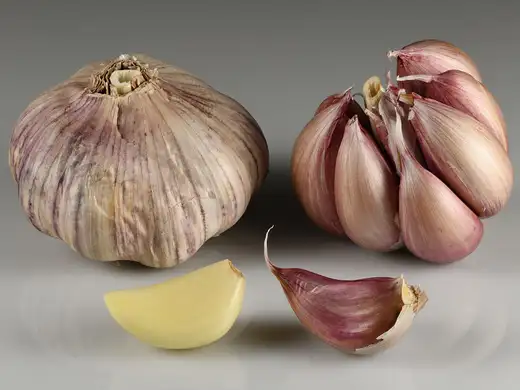
Break the bulbs into cloves just before planting and leave the papery skins on. Plant only the largest cloves, because clove size predicts bulb size, and cook the small ones. Some hardneck bulbs contain “doubles”, two cloves fused together. They produce two bulbs that squash each other flat, so cook those too.
Site and soil
Garlic needs full sun: at least 6 hours of direct light, and 8 to 10 is better. It wants loose, well-drained soil rich in organic matter. Heavy clay restricts bulb expansion, especially when it dries out, and compacted soil gives misshapen bulbs. Clemson aims for a soil pH of 6.2 to 6.5. Get a soil test and follow its recommendations.
On heavy or wet ground, use raised beds. Oregon State suggests beds 2 to 3 feet wide and at least 10 to 12 inches tall. Poorly drained soil is the main cause of bulb rot. If you add compost, Utah State caps it at about 1 inch spread over 100 square feet.
Planting depth and spacing
Set each clove upright, pointed tip up and flat root plate down. Clemson notes that upright cloves give straight necks, and Maryland says orientation matters most for hardnecks.
Sources disagree on depth, partly because of climate:
- Clemson (South Carolina): about 1 inch of soil over the clove
- Illinois and Maryland: 1 to 2 inches of cover
- Oregon State: 2 inches
- Utah State, Wisconsin and NC State: 2 to 3 inches
Wisconsin explains why to go deeper in the North: shallow cloves are easily damaged by winter freezing and by the freeze-thaw swings of early spring. In zones 4 to 6, plant 2 to 3 inches deep. In mild Southern winters, an inch or two is enough.
Spacing ranges from 3 to 4 inches (Utah State) to 6 inches (Wisconsin) and 6 to 8 inches (NC State). Rows can be 6 to 18 inches apart, and Clemson allows up to 24. Wider spacing gives bigger bulbs. Utah State warns that tight spacing only works if water and fertilizer are generous. A good compromise is 4 to 6 inches between cloves in rows about 12 to 15 inches apart. Illinois offers a trick: plant cloves closer together, then pull every other plant in spring as green garlic. Use the thinnings like scallions and leave the rest at about 5 inches apart.
When to plant
Use the dates for your zone above as your planting window. Extension services describe the target in different ways:
- Wisconsin: within a week or two after the first killing frost, so roots grow and the shoot emerges from the clove but does not break the soil surface before the first hard freeze.
- Illinois and NC State: 4 to 6 weeks before the ground freezes.
- Maryland: mid- to late October, so cloves grow roots and a few leaves before cold weather.
The when to plant garlic page goes through the timing in detail, including how allium leafminer can push planting later in the Northeast.
Mulch and winter protection
Where the ground freezes, mulch after planting. Wisconsin recommends 3 to 4 inches of clean straw and Clemson 4 to 6 inches. Mulch evens out soil temperature swings that tear young roots and lift cloves out of the ground, a problem called frost heaving.
In spring, Wisconsin pulls the mulch back once hard freezes are over so the soil can warm. It goes back on when the shoots are about 6 inches tall to hold down weeds and keep moisture in. Maryland notes a real tradeoff: some growers find that unmulched garlic starts growing sooner in spring and makes bigger bulbs. Avoid heavy, matting materials such as wet leaves, fine sawdust or fresh manure, which can keep soil cold and soggy.
Feeding
Garlic is a moderate to heavy feeder. Wisconsin’s rule is nitrogen at planting and again when shoots are 4 to 6 inches tall. Utah State gives amounts: ½ pound of 21-0-0 per 100 square feet in mid-April and ¼ pound in late May. Illinois uses 3 pounds of 10-10-10 per 100 feet of row if the soil has not been amended with compost. Oregon State feeds in early spring and lightly again just before bulbs swell, usually early May there.
In the South, garlic grows through winter and the schedule moves earlier. Clemson sidedresses in mid-November, early January, mid-February and early March for South Carolina. Don’t panic over yellow leaf tips: Wisconsin notes that many varieties get them even with good fertility, often from water stress, and they only matter if they appear early in the season.
Water and weeds
Garlic roots are shallow, so the plants dry out quickly. Steady moisture matters most while bulbs swell, which Wisconsin puts at about late May to mid-July. Drought then means smaller bulbs that mature early. Utah State waters until the soil is wet 12 inches down and uses drip lines where possible. In the Pacific Northwest, Oregon State waters only on sandy soils or in a dry May and June, soaking 2 feet deep every 8 to 10 days and tapering off in mid-June.
Once the leaves begin to yellow, stop watering. Wet soil at maturity stains the wrappers, invites rot, and slows curing.
Garlic competes poorly with weeds, especially in its first two months of growth. Hoe shallowly or pull weeds by hand, since the roots are close to the surface.
Scapes
Hardnecks send up a scape in late spring. Remove it just after it starts to curl. Wisconsin found that leaving scapes on cut yields by up to 30 percent in poorly fertilized soil but by less than 5 percent in well-fed soil. Clemson reports an average 30 percent loss in bulb size from unremoved scapes. Wisconsin also mentions circumstantial evidence that leaving scapes on until they turn woody may help storage. Young, curled scapes are tender and taste of mild garlic. Once they straighten or the flower opens, they turn woody.
Harvest and storage in brief
Dig when about half the leaves have turned brown. That is usually late June to July in the mid-Atlantic and Midwest, and May to June in North Carolina. Dig too early and the bulbs are small and keep poorly. Dig too late and the wrappers split open. Cure whole plants out of the sun with good airflow, then trim and store. The garlic harvest guide covers the signs, curing times and storage in full.
Regional notes
Cold North (zones 4 to 6, the upper Midwest, New England, the Northern Rockies). Hardnecks are the most reliable. Plant deep, mulch heavily, and time planting so cloves root without leafing out before a hard freeze.
Humid South (the Carolinas, Gulf states). NC State plants North Carolina garlic from late October into November, or as late as December in the southernmost areas, for a May to June harvest. Choose softnecks or Creoles and skip Rocamboles. Raised rows help in wet clay. Clemson’s sidedressing schedule runs through the winter months.
Arid West (the Great Basin and high deserts). Utah State plants from mid-September to early November. Water deeply, because dry spring soil sharply cuts bulb size.
Warm-winter areas (zones 9 to 10, Florida, the low desert). Garlic still goes in during fall or early winter: October around Phoenix per Arizona Extension, and late fall into early winter in Florida. Harvest comes in late spring. Choose Artichoke or Creole softnecks, which bulb with little winter chill.
Common problems and fixes
- Small bulbs: caused by spring planting, small cloves, crowding, weeds or dry soil in May and June. Plant large cloves in fall, space them properly and water while bulbs swell.
- Split or open bulbs: left in the ground too long. Start checking when the lower leaves brown. Softnecks are more forgiving than hardnecks here.
- White rot: a soilborne fungal disease. Prevention starts with certified disease-free stock.
- Allium leafminer: an invasive fly whose larvae tunnel through leaves into the bulb, now present in Pennsylvania and nearby states. Penn State advises planting late in fall so plants are too small for the fall egg-laying flight, then covering the crop with floating row cover in spring.
- Garlic bulb mite: feeds on the cloves. Start with clean, certified garlic.
- Thrips: tiny insects that turn leaves silvery and hide where leaf meets bulb. Utah State relies on natural enemies, mulch and hard sprays of water.
- Bulb rot and neck rot: from wet soil, bruising and poor curing. Plant in well-drained or raised beds, stop watering as plants mature, handle bulbs gently and cure them thoroughly.
- Frost heaving: cloves pushed out of the soil over winter. Plant deeper and mulch with straw.
No extension source recommends companion plants for garlic. Pairings you may read about elsewhere come from garden tradition, not tested results.
Questions
Can I plant garlic from the grocery store?
Extension services advise against it. Store garlic can carry disease without showing symptoms, and the softneck types grown commercially in California often do poorly in cold climates. Buy certified planting stock from a seed company or a local grower.
Can I plant garlic in spring?
You can, but the bulbs are usually small. Plant as soon as the soil can be worked, use softneck (Artichoke) types, and give the cloves about 8 weeks in the refrigerator first, as Illinois Extension advises, so they get the cold they need to form bulbs.
Should I cut off garlic scapes?
Yes, on hardneck garlic, once the scape starts to curl. Wisconsin found yield losses of up to 30 percent from leaving scapes on in poorly fertilized soil but under 5 percent in well-fed soil. The scapes are good to eat.
How deep should I plant garlic cloves?
Recommendations run from about 1 inch of soil over the clove (Clemson, for South Carolina) to 2 to 3 inches (Utah State, Wisconsin, NC State). Go toward the deeper end where winters are cold, since shallow cloves are more easily injured by freezing and frost heaving.
Why are my garlic bulbs so small?
The usual causes are spring planting, small cloves, crowding, weed competition, or dry soil while the bulbs are swelling. Big bulbs need big leafy plants before bulbing starts, so fall planting, good fertility and steady moisture in spring all matter.
How many cloves are in a pound of garlic?
Wisconsin Extension puts it at about 50 cloves per pound. Large hardneck bulbs run about 6 to 7 bulbs per pound with 6 to 7 cloves each, according to Maryland Extension.
Sources
- Garlic primer: planting, growing and harvesting · Oregon State University Extension Service
- Plant Garlic Late to Avoid Allium Leafminer · Penn State Extension
- How to Grow Garlic in Your Garden · Utah State University Extension
- Growing Garlic in a Home Garden · University of Maryland Extension
- Garlic, Allium sativum · University of Wisconsin-Madison Extension (Wisconsin Horticulture)
- Growing Garlic (info sheet) · University of Illinois Extension
- Onion, Leek, Shallot, & Garlic (HGIC) · Clemson Cooperative Extension Home & Garden Information Center
- Allium sativum (Plant Toolbox) · NC State Extension
- Rhode Island Planting Calendar for Fruits and Vegetables · University of Rhode Island Cooperative Extension
- Garlic · University of Florida IFAS Gardening Solutions
- Vegetable Planting Calendar for Maricopa County (AZ1005) · University of Arizona Cooperative Extension