How to Grow Sweet Potatoes
Sweet potatoes grow from rooted sprouts called slips. Plant them about two weeks after your last frost, once the soil at planting depth stays above 65°F, on raised ridges or beds in full sun. Water steadily for the first month, then about an inch a week, and stop watering 2 to 3 weeks before harvest. Dig about 90 to 120 days after planting, before cold soil sets in. In northern gardens, choose a fast variety such as 'Beauregard' or 'Covington' and warm the bed with black plastic.

Your dates for sweet potatoes
Set your ZIP code at the top of the page and we will work out when to plant sweet potatoes where you live, from the frost records of the nearest NOAA weather station. Your ZIP code is remembered on this device only.
Sweet Potatoes at a glance
- Botanical name
- Ipomoea batatas
- Light
- full sun
- Frost tolerance
- Tender: killed by frost
- Soil temperature to plant
- At least 65°F
- Days to harvest
- 90–120 days from transplanting
- Planting depth
- 3 inches
- Spacing
- 8–12 inches apart, rows 36–48 inches apart
When to plant sweet potatoes
When to plant sweet potatoesWhen to harvest sweet potatoes
What kind of plant you’re growing
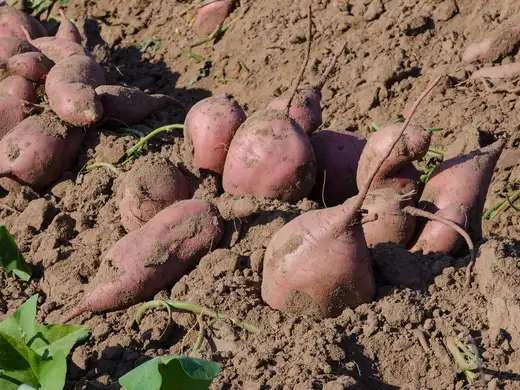
A sweet potato is not a potato. It belongs to the morning glory family, and NC State notes it is only distantly related to the Irish potato. The part you eat is a true storage root, not a tuber (Clemson). The moist, orange-fleshed types sold as “yams” are sweet potatoes too. True yams belong to a different plant family and are grown mostly in the tropics (Utah State).
Sweet potatoes are tropical perennials from Mexico, Central America and northern South America, and US gardeners grow them as warm-season annuals. They do best with hot days, warm nights and a long frost-free season. Clemson and UGA give 90 to 120 days from planting to harvest. Utah State puts root maturity at 4 to 5 months. University of Arizona’s low-desert calendar allows 120 to 160 days. They can’t handle cold. Utah State says damage starts below 50°F, and Texas A&M says plants survive a light frost only while the soil stays above 55°F.
Slips: buy them or grow your own
Sweet potatoes aren’t grown from seed or from whole roots in the ground. You plant slips, which are sprouts pulled from a stored root and allowed to grow their own roots. You can buy them or produce them at home.
Buying slips. UF/IFAS recommends starting with certified clean slips, especially in Florida, where the sweet potato weevil is a serious pest. Look for a healthy slip with 4 or 5 leaves and a good root system (Utah State). Clemson warns not to plant any slip with dark black rot spots on the lower stem. NDSU found that slips shipped across the country often arrive wilted, sometimes without roots, and suffer transplant shock. In its trials, UNH potted up any slips it couldn’t plant within 2 days and kept them moist until planting.
Growing your own in water. Clemson’s jar method takes about 3½ weeks:
- Push three or four toothpicks into the middle of a healthy, medium-sized root and rest it in a quart jar so the bottom half sits in water.
- Keep it warm, in indirect light. Top up the water as needed and change it weekly so it doesn’t turn cloudy with bacteria.
- Sprouts appear in about 2 weeks. When they’re 6 inches or longer, twist them off at the base.
- Stand the sprouts in fresh water. They root in about 10 days, and then they’re slips.
NDSU describes the same approach, plus a soil-tray option. Lay the root on its side in about 4 inches of moist seed-starting mix, half buried, in a warm place. Twist off sprouts once they reach 4 to 6 inches, root them in water, then pot them up. NDSU says homegrown slips go into the garden with healthy roots and much less shock than shipped ones.
Hotbed for larger numbers. Utah State sets roots about an inch apart in a hotbed and covers them with 2 inches of sand or light soil. Add another 1 to 2 inches when shoots appear, and keep the bed at 70 to 80°F, moist but never waterlogged. Slips are ready in about 6 weeks, when they’re rooted and 6 to 8 inches tall. Penn State suggests sprouting at 75 to 85°F with 80 to 90 percent humidity.
Which roots to sprout? Sources disagree. Texas A&M and NDSU both start slips from sweet potatoes bought at the market. Clemson says most grocery roots were treated to stop sprouting and recommends last year’s home harvest or organically grown roots, which sprout more readily.
Varieties by region
These are the varieties recommended by extension services for their own regions.
- Southeast: Clemson calls ‘Beauregard’ the quickest to make harvestable roots, at 90 to 100 days. Its list for South Carolina also includes ‘Covington’, ‘Centennial’ (resistant to root-knot nematodes and wireworms), ‘Jewel’, ‘Regal’ and ‘Vardaman’, a compact bush type. UGA recommends ‘Beauregard’, ‘Centennial’, ‘Jewel’, ‘Porto Rico’ and ‘Yellow Jersey’ for Georgia. UGA and Utah State both say ‘Centennial’ tolerates clay.
- Florida: UF/IFAS suggests ‘Centennial’, ‘Beauregard’, ‘Vardaman’, ‘Porto Rico’ and the dry-fleshed boniato.
- Texas: Texas A&M reports ‘Beauregard’, ‘Centennial’, ‘Jewel’ and ‘Vardaman’ as the most commonly planted, with ‘Beauregard’ the most popular.
- Intermountain West: Utah State says most varieties do well in Utah, including ‘Beauregard’, ‘Centennial’, ‘Georgia Jet’, ‘Jewel’ and the bush types ‘Bush Porto Rico’ and ‘Vardaman Bush’.
- North and Northeast: NDSU tells North Dakota gardeners to find the earliest variety they can, such as ‘Beauregard’, ‘Covington’ or ‘Georgia Jet’, because others may not mature before frost. Penn State lists ‘Beauregard’, ‘Covington’, ‘Orleans’ and ‘Averre’ as performing well under black plastic in Pennsylvania. In multi-year trials at the University of New Hampshire (zone 5b), ‘Beauregard’ and ‘Covington’ were the best combination of yield and flavor. ‘Centennial’ and ‘Vardaman’ made slender roots that never sized up there, and ‘Georgia Jet’ cracked badly in moist conditions.
Avoid the ornamental sweet potato vines sold for hanging baskets. NC State notes that cultivars bred for showy foliage rarely make good roots.
Site and soil
Choose the sunniest spot you have. UGA asks for 8 to 10 hours of sun. Loose, well-drained sandy loam is ideal. Clemson and UGA both note that roots grown in heavy clay come out small and misshapen. Work in compost to loosen clay, or plant ‘Centennial’. Texas A&M accepts a pH of 5 to 7.5, and UGA aims for 6.0 to 6.5.
Grow sweet potatoes on raised ridges or beds about 8 to 10 inches high (Utah State, Texas A&M). Raised soil drains better, gives the roots room to swell and warms faster in spring. Texas A&M spaces beds 3 to 4 feet apart. One exception from Clemson: in very sandy soil, which drains well on its own, skip the ridges.
Planting
Plant when the soil at planting depth is above 65°F (Clemson, Texas A&M, Penn State). UGA sets a higher bar of 70°F. Texas A&M’s rule of thumb is to wait 2 weeks after the last frost. Check the dates for your zone above, and in cool springs wait for the soil rather than the calendar.
Set slips 3 to 4 inches deep (Clemson). Clemson waters them in with a high-phosphorus starter fertilizer. Spacing advice varies:
- Clemson: 8 to 12 inches in rows 3 feet apart
- Utah State: 12 inches in rows 36 to 48 inches apart
- Penn State: 12 to 18 inches in rows 3 to 4 feet apart
- UGA: 3 feet between plants, leaving room for the vines to run
UF/IFAS notes that bush types save garden space. Clemson describes ‘Vardaman’ as a compact bush type, and UGA calls ‘Porto Rico’ a compact bunch type.
Water
Newly set slips are very sensitive to drought for about the first month (Texas A&M), so water regularly until they’re clearly growing. After that, give at least 1 inch a week, enough to wet the soil 6 inches down (Clemson, UGA). Texas A&M puts the season total at 10 to 20 inches. Water in the morning so the leaves dry before night (Clemson).
Late in the season, the rule reverses. Heavy rain or watering after a long dry spell splits the roots. Texas A&M says to stop watering 2 to 3 weeks before harvest, and UGA says 3 to 4 weeks. Utah State notes that sweet potatoes benefit from a dry stretch before harvest. Established plants are fairly drought tolerant (Utah State, NC State).
Fertilizer
Go light. UGA warns that overfed plants grow mostly leaves. Fertilize from a soil test. Texas A&M notes that many soils need only nitrogen, though sandy soils in high-rainfall East Texas may also lack potassium. Without a soil test, Clemson and UGA work 5-10-10 into the soil before planting at 30 pounds per 1,000 square feet. They side-dress with 4 pounds per 100 feet of row just before the vines close over the row. Utah State side-dresses with nitrogen in midsummer.
Weeds
Keep the bed clean until the vines cover the ground, after which they shade out most weeds. Texas A&M says keeping weeds out for the first 40 days after planting has the biggest effect on yield and quality. Cultivate shallowly, because deep hoeing damages roots and slows the vines (Clemson, Utah State). Mulch helps, and black plastic does double duty in cool climates.
Regional differences
Deep South and Gulf Coast: This is the crop’s home ground. Clemson does not recommend a fall planting in South Carolina, so plant once, in late spring. In Florida, choose clean slips and rotate planting sites because of the sweet potato weevil. Use vine-tip cuttings from established plants for a second planting and a longer harvest (UF/IFAS). Where frost is rare, the planting window is long. South Florida’s planting window covers most of the year. Use the dates for your zone above.
Texas and the southern Plains: Hot days and warm nights are ideal, according to Texas A&M, which explains why Texas is the fifth-largest US producer. Texas A&M’s timing rule works in both directions. Plant when soil tops 65°F, and make sure you’re at least 150 days ahead of the point in fall when the soil cools to 55°F.
Arid West: Utah State says sweet potatoes do well in Utah if they get ample water after planting and through the season. Mulch saves water and keeps weeds down. Black plastic lets you plant up to 10 days earlier than in bare soil, and floating row covers add frost protection. In the low desert around Phoenix, University of Arizona’s calendar runs slip planting from spring into early summer and allows a long season to harvest.
Cold north (Dakotas, upper Midwest, New England): NDSU calls North Dakota one of the shortest, coldest and driest seasons in the country, where many harvests are small. Its successful growers follow a pattern: earliest varieties, homegrown slips, a raised bed covered in black plastic with slips set 18 to 24 inches apart through holes, and row covers for a few weeks after planting and again in early fall. Penn State reports a 130 to 170 day frost-free season across Pennsylvania and recommends black plastic and row covers. UNH set its trial plantings once the soil was consistently above 60°F. It dug them as late as it could while the soil stayed above 60°F, and the best varieties gave about 2½ pounds per slip.
Rotation and companions
Rotate. Clemson says a two-year gap between sweet potato crops reduces disease, and following with corn the next year helps cut root-knot nematodes. NC State warns that flea beetles and thrips build up when sweet potatoes go in the same spot every year. Extension sources offer no companion-planting data for sweet potatoes, so any “good neighbor” lists you find are garden tradition.
Common problems and fixes
- Wireworms and root-knot nematodes: Clemson and UGA call these the main home-garden pests. Rotate with corn or another unrelated crop and choose resistant varieties such as ‘Centennial’, ‘Covington’, ‘Jewel’ or ‘Regal’ (Clemson).
- Sweet potato weevil: UF/IFAS calls this a serious problem in Florida. Start with clean slips and move the planting each year.
- Black rot and scurf: Sunken lesions on slips and roots, or black spots on the skin. Don’t plant spotted slips, rotate, and don’t overwater (Clemson, Utah State).
- Cutworms: These cut young slips off at the soil line. Clear weeds and debris where they hide (Utah State).
- Deer: NDSU and NC State both note that deer eat the vines. Row covers early in the season help.
- Cracked roots: Uneven water, especially late. Water evenly, then stop before harvest.
- Small or slender roots: Common causes are heavy clay, a season too short for the variety, or too much fertilizer. Fix the soil, choose a faster variety, and cut back on feeding.
Harvest, curing and flavor
Dig about 90 to 120 days after planting, when the leaves start yellowing. Clemson suggests checking that about 30 percent of the roots are over 3½ inches across. Finish before the soil turns cold, because Clemson says cool soil lowers quality and storage life. The skins are very thin, so dig and handle gently. Then cure them. Clemson and Penn State cure at about 85°F and high humidity for about a week, which heals wounds and turns some starch to sugar. Store cured roots above 50°F, never in the refrigerator.
Flavor keeps improving after harvest. In the UNH trials, sugar content rose steadily for about 21 days after digging, and the researchers advise waiting at least three weeks before eating. Expect 1 to 2 pounds of roots per plant, and plant 5 to 10 slips per person (Utah State). For timing, curing and storage details, see when to harvest sweet potatoes.
Questions
Can I grow sweet potatoes from a store-bought sweet potato?
Often, yes, but results vary. Texas A&M and NDSU both describe sprouting slips from a market sweet potato. Clemson warns that many grocery roots are treated to keep them from sprouting, so it recommends roots from last year's garden or organically grown ones.
How long do sweet potatoes take to grow?
Most varieties need about 90 to 120 days from slip to harvest, according to Clemson and UGA. Utah State says 4 to 5 months. University of Arizona's low-desert calendar allows 120 to 160 days.
How far apart should I plant sweet potato slips?
Clemson spaces slips 8 to 12 inches apart in rows 3 feet apart, and Utah State uses 12 inches in rows 36 to 48 inches apart. UGA gives vines much more room, about 3 feet between plants.
Do sweet potatoes need a lot of fertilizer?
No. Too much fertilizer produces vines instead of roots. Fertilize from a soil test. Texas A&M notes that many soils need only nitrogen.
Can I grow sweet potatoes in the North?
Yes, with a short-season variety, homegrown or well-rooted slips, a raised bed covered in black plastic, and row covers early and late. NDSU and Penn State recommend 'Beauregard' and 'Covington', and both did best in University of New Hampshire trials.
Why did my sweet potatoes crack?
Heavy rain or watering after a dry spell, especially in the last few weeks before harvest, makes the roots split. Water evenly early on and stop watering 2 to 3 weeks before digging.
Sources
- Best Sweet Potato Varieties for Pennsylvania · Penn State Extension
- Dakota Gardener: Growing Sweet Potatoes in the North · NDSU Extension
- Varieties, cultural practices, and post-harvest management of sweetpotatoes for New England · University of New Hampshire Cooperative Extension
- Home Garden Sweet Potatoes (Circular 1014) · University of Georgia Cooperative Extension
- Sweetpotato (HGIC 1322) · Clemson Cooperative Extension, Home & Garden Information Center
- How to Grow Sweet Potatoes in Your Garden · Utah State University Extension
- Easy Gardening: Sweet Potatoes (EHT-026) · Texas A&M AgriLife Extension Service
- Florida Vegetable Gardening Guide (SP 103/VH021) · UF/IFAS Extension
- Vegetable Planting Calendar for Maricopa County (AZ1005) · University of Arizona Cooperative Extension
- Ipomoea batatas · NC State Extension Gardener Plant Toolbox