How to Grow St. Augustinegrass
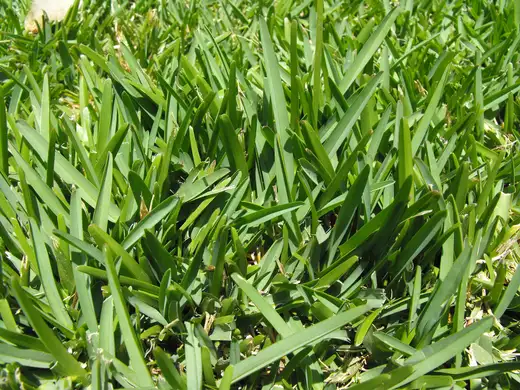
St. Augustinegrass is the coarse, blue-green lawn grass of the Gulf Coast and Florida. It is the most shade-tolerant warm-season grass, but it is cold-sensitive and cannot be grown from seed. Lay sod or set plugs while the grass is actively growing, from mid-spring into early summer in most of the South, then mow standard varieties tall, at 3.5-4 inches, and watch sunny, dry spots for chinch bugs.

Your dates for st. augustinegrass
Set your ZIP code at the top of the page and we will work out when to plant st. augustinegrass where you live, from the frost records of the nearest NOAA weather station. Your ZIP code is remembered on this device only.
St. Augustinegrass at a glance
- Botanical name
- Stenotaphrum secundatum
- Light
- full sun to partial shade; the most shade-tolerant warm-season lawn grass but still needs about 4-6 hours of sun
- Frost tolerance
- Tender: killed by frost
- Spacing
- 6–24 inches apart, rows 6–12 inches apart
When to plant st. augustinegrass
| Zone | Plant out |
|---|---|
| Zone 2a | Jun 23 to Jul 28 |
| Zone 3a | Jun 30 to Aug 4 |
| Zone 3b | Jun 21 to Jul 26 |
| Zone 4a | Jun 17 to Jul 22 |
| Zone 4b | Jun 12 to Jul 17 |
| Zone 5a | Jun 7 to Jul 12 |
| Zone 5b | Jun 5 to Jul 10 |
| Zone 6a | Jun 3 to Jul 8 |
| Zone 6b | May 28 to Jul 2 |
| Zone 7a | May 21 to Jun 25 |
| Zone 7b | May 10 to Jun 14 |
| Zone 8a | May 3 to Jun 7 |
| Zone 8b | Apr 21 to May 26 |
| Zone 9a | Apr 6 to May 11 |
| Zone 9b | Mar 7 to Apr 11 |
St. Augustinegrass is a warm-season grass for the South and the transition zone. In colder zones most varieties do not survive the winter, so the dates there apply only to the most cold-tolerant varieties.
When to plant st. augustinegrass
Where St. Augustinegrass grows
St. Augustinegrass is believed to be native to the coasts of the Gulf of Mexico and the Mediterranean, and it remains a grass of warm, humid coastal climates. UF/IFAS calls it the most common lawn grass in Florida. Texas A&M says it is best adapted in Southeast Texas and grows in most of the state, but severe winters can kill it in the northern third. Clemson says it is well suited to the South Carolina coastal plain but very susceptible to winter injury west of Columbia, and some winter injury has been documented along the state’s northern coast. NC State says it does best in warm, humid areas without long or severe cold spells.
Cold tolerance varies by cultivar. Raleigh, released by NC State in 1980, is the cold-hardy choice. NC State calls it best suited to the eastern piedmont and coastal plain of North Carolina, and UF/IFAS uses it in north Florida. Floratam, the most widely used cultivar in Florida, has the poorest cold tolerance, and Texas A&M considers it best adapted to southern Texas and the Gulf Coast.
Sod, plugs or sprigs
There is no St. Augustinegrass seed. It spreads by long aboveground runners (stolons), and every planting method uses pieces of those runners.
Sod is the fastest route to a finished lawn and leaves no bare soil for weeds. Lay it on bare, moist soil in a staggered, brick-like pattern with tight seams, then roll and water it thoroughly. UF/IFAS expects the roots to “peg” into the soil in 14-21 days and the lawn to be fully established in three to four weeks.
Plugs are sold in garden centers or cut from sod. UF/IFAS spaces them 6-24 inches apart, and NC State 12-24 inches. Closer spacing fills in faster and leaves less room for weeds. Tamp them in and water thoroughly.
Sprigs are cheaper still but slowest. UF/IFAS lays them end to end in furrows 6-12 inches apart, covering the stolons but leaving the leaf blades exposed, then keeps the soil moist until new shoots and roots grow.
When to plant St. Augustinegrass
Plant while the grass is actively growing and no freeze is forecast. The dates for your zone above start roughly five to ten weeks after your average last spring frost. That matches NC State, which replants in May or once daytime temperatures stay above 60°F, and Virginia Tech, which plants warm-season sod and plugs in May after the soil warms. In California, UC IPM lays warm-season sod in mid to late spring and sets plugs and sprigs from late spring into summer.
Where frost is rare it can go in almost any time. UF/IFAS considers late fall, winter or spring best in south Florida. In central and north Florida, it advises skipping both the cold winter months and the hot, dry summer months.
Watering and early care
UF/IFAS gives a step-down schedule for new sod or plugs:
- For the first 7-10 days, water several times a day in short runs of 5-10 minutes.
- For the next 7-10 days, water once a day with ¼-½ inch.
- After that, water two or three times a week with ¼-½ inch, then switch to watering as needed once the lawn is established.
Hold off mowing until the sod resists a gentle tug, usually 14-21 days. Hold off fertilizer for 30-60 days, since sod is usually fed before harvest.
Mowing height
St. Augustinegrass is cut tall. UF/IFAS mows standard cultivars such as Bitterblue and Floratam at 3.5-4 inches, semi-dwarf Palmetto at 3-4 inches, and dwarf types such as Seville at 2-2.5 inches. Clemson gives 3-4 inches for standard cultivars and about 2.5 inches for dwarfs. It uses the higher setting in shade or stress and the lower one in full sun. Repeated low mowing weakens roots, raises the risk of scalping and invites pests. Mowing too high or too seldom, on the other hand, builds thatch and keeps the lower canopy wet, which favors disease. A rotary mower works, but sharpen the blade monthly in the growing season. Torn, browned tips are the sign it is dull.
Fertilizing and watering
Don’t fertilize too early in spring. UF/IFAS warns that in north Florida late frosts can damage grass pushed into early growth. NC State waits until May or two weeks after green-up, whichever is later, and stops after mid-September. It caps the year at 4 lb of nitrogen per 1,000 sq ft. UF/IFAS spreads feeding over two to six applications depending on region, and year-round in south Florida. Clemson expects monthly feeding on sandy soils and every six weeks on clay. Yellowing on high-pH soils may be iron deficiency rather than a lack of nitrogen, and an iron spray can fix it.
Water when leaf blades fold, wilt or turn blue-gray, or footprints linger. UF/IFAS applies ½-¾ inch at a time, Clemson ¾-1 inch, letting the lawn dry before the next watering. NC State figures about 1 inch a week during active growth. Texas A&M notes it is less drought tolerant than bermudagrass or zoysiagrass, so lawns in Central and West Texas need more irrigation. UF/IFAS says heavy watering and fertilizing build thatch, and that excess nitrogen encourages large patch.
Shade and traffic
Shade is its strength. Clemson and Texas A&M call it the most shade-tolerant warm-season lawn grass, though it still needs 4-6 hours of sun. Shade tolerance differs by cultivar. UF/IFAS says Floratam fails with less than 6 hours of sun, while Seville performs well in shade. Traffic is its weakness. UF/IFAS and Texas A&M say it does not hold up to repeated foot or vehicle traffic.
Common problems
- Southern chinch bugs. These are the main insect pest. They cause yellow to brown patches that start in hot, sunny, dry spots. Floratam’s original resistance has largely broken down, and UF/IFAS reports some chinch bug populations resistant to pyrethroid insecticides.
- Large patch. Brown circular patches appear in cool, wet spring and fall weather. NC State calls St. Augustinegrass extremely susceptible and says excess nitrogen, poor drainage, overwatering, thatch and low mowing all favor it.
- Gray leaf spot. Leaf spots with gray centers develop in the summer rainy season, mostly on new growth. Raleigh is highly susceptible, and Floratam is also prone.
- Take-all root rot and nematodes. These root problems show up as thin, weak turf. Raising the mowing height and watering deeply but less often help (UF/IFAS).
- Herbicide injury. St. Augustinegrass is sensitive to some common lawn herbicides, including 2,4-D, so read labels carefully (NC State).
- Winter kill. Expect losses in severe winters at the northern edge of its range.
Questions
Can you grow St. Augustinegrass from seed?
No. No seed is available, so it is planted as sod, plugs or sprigs. Sod gives a finished lawn fastest; plugs and sprigs are cheaper but leave bare soil to fill.
When is the best time to lay St. Augustine sod?
While the grass is actively growing and no freeze is forecast. NC State plants in May or once daytime temperatures stay above 60°F. UF/IFAS prefers late fall through spring in south Florida and says to avoid the cold winter and hot, dry summer months in central and north Florida.
How short should St. Augustinegrass be cut?
UF/IFAS mows standard varieties such as Floratam and Bitterblue at 3.5-4 inches and dwarf varieties at 2-2.5 inches. Clemson gives 3-4 inches for standard types. Mowing lower stresses the lawn, and mowing too high or too seldom builds thatch.
How much shade can St. Augustinegrass take?
More than any other warm-season lawn grass, but it still needs about 4-6 hours of sun (Clemson). Floratam is the exception; UF/IFAS says it does not persist with less than 6 hours of sun a day.
What causes yellow, dry-looking patches in St. Augustine in summer?
Often southern chinch bugs, which UF/IFAS calls its main insect pest. Damage usually starts in sunny, water-stressed spots along sidewalks and buildings. NC State suggests treating when you find 20 or more per 1,000 sq ft, using a bottomless coffee can filled with water to float them out.
Sources
- St. Augustinegrass for Florida Lawns (ENH5/LH010) · University of Florida IFAS Extension (EDIS)
- Establishing Your Florida Lawn (ENH-03/LH013) · University of Florida IFAS Extension (EDIS)
- St. Augustinegrass (HGIC 1211) · Clemson Cooperative Extension Home & Garden Information Center
- St. Augustinegrass Lawn Maintenance Calendar · NC State Extension
- Turfgrass Selection for Texas (L-5519) · Texas A&M AgriLife Extension
- Turfgrass: Sod · UC Statewide IPM Program, UC ANR
- Turfgrass: Plugs and sprigs · UC Statewide IPM Program, UC ANR
- Turf Management in Hawaii (2017) · University of Hawaii CTAHR Master Gardeners
- Chapter 10: Turfgrass Management in Tennessee (Master Gardener Handbook) · University of Tennessee Extension
- Chapter 11: Lawns (Virginia Cooperative Extension Master Gardener Handbook) · Virginia Cooperative Extension / Virginia Tech