How to Grow Saffron
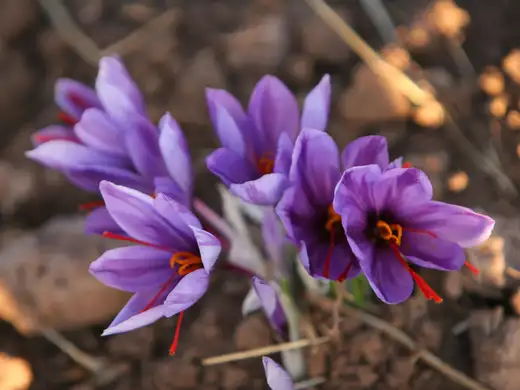
Saffron comes from the three red stigmas of Crocus sativus, a fall-blooming crocus grown from corms. Plant firm corms 3-6 inches deep and 3-4 inches apart in sunny, well-drained soil in late summer, ideally August to early September. They sprout in about a month and bloom for roughly two weeks in late October and early November.

Your dates for saffron
Set your ZIP code at the top of the page and we will work out when to plant saffron where you live, from the frost records of the nearest NOAA weather station. Your ZIP code is remembered on this device only.
Saffron at a glance
- Botanical name
- Crocus sativus
- Light
- full sun (6+ hours)
- Frost tolerance
- Hardy: takes a hard frost
- Hardiness zones
- 4-8 (UVM saffron research center). NC State lists 5-8, and UVM Extension calls it hardy to zone 6 but surviving in zones 5 and 4.
- Planting depth
- 4 inches
- Spacing
- 3–4 inches apart
- Containers
- Yes
When to plant saffron
| Zone | Fall planting |
|---|---|
| Zone 2a * | Jul 11 to Aug 8 |
| Zone 3a * | Jul 20 to Aug 17 |
| Zone 3b * | Jul 30 to Aug 27 |
| Zone 4a | Aug 3 to 31 |
| Zone 4b | Aug 6 to Sep 3 |
| Zone 5a | Aug 9 to Sep 6 |
| Zone 5b | Aug 15 to Sep 12 |
| Zone 6a | Aug 22 to Sep 19 |
| Zone 6b | Aug 27 to Sep 24 |
| Zone 7a | Aug 30 to Sep 27 |
| Zone 7b | Sep 6 to Oct 4 |
| Zone 8a | Sep 12 to Oct 10 |
| Zone 8b | Sep 18 to Oct 16 |
| Zone 9a * | Oct 1 to 29 |
| Zone 9b * | Oct 14 to Nov 11 |
* Outside zones 4 to 8, the hardiness range our sources give for saffron. Plants there may not survive the winter or get enough winter chill, and are usually grown as annuals or in pots.
How saffron crocus grows
Saffron crocus runs on the opposite schedule from spring crocuses. Corms go into the ground in late summer. Grassy leaves appear in September or October, and lavender flowers open in late October and early November, each holding three long red stigmas. The leaves stay green all winter, then die back as the plant goes dormant in June or July.
The plant is sterile and unknown in the wild. NC State describes it as the product of about 3,500 years of selection by people. It makes no usable seed, so every saffron plant comes from a corm. In spring each parent corm forms several new corms, which become the next fall’s flowers. A bed gradually thickens on its own.
Be sure you buy the right plant. Autumn crocus, also sold as meadow saffron (Colchicum autumnale), also blooms purple in fall. NC State’s plant database rates it highly toxic: all parts, especially the bulb, can be fatal if eaten. Only Crocus sativus gives saffron.
Where it grows
Hardiness ratings differ by source. The University of Vermont’s saffron research center lists zones 4-8. UVM Extension says it is hardy to zone 6 but readily survives in zones 5 and even 4, and NC State gives zones 5-8. In Vermont trials it overwintered without insulation. UVM Extension actually discourages mulching because mulch can attract rodents.
None of these sources covers zones 9-11, so saffron’s performance in warm-winter areas such as Florida, the Gulf Coast and low-desert Arizona is untested by extension research.
Planting
Timing. Order corms in late spring. UVM notes suppliers still ship in August or September, at planting time. Plant as soon as they arrive, ideally in August or early September (see the dates for your zone above). Timing matters, because corms held until spring sprout in storage and then die. Illinois Extension suggests planting in September.
Corms. Choose plump, firm corms. UVM Extension says to throw out any that are shriveled, soft or show signs of disease.
Site and soil. Choose full sun, at least 6 hours a day, and light to medium soil rich in organic matter. Drainage matters most: corms rot in standing water. UVM’s research center says compost improves both saffron yield and the size of the new corms. Raised beds are an easy way to guarantee drainage on heavy soil.
Depth. Sources disagree here too:
- Illinois Extension: 2-4 inches.
- UVM Extension: about 3 inches.
- NC State: 4 inches.
- UVM research center: about 6 inches. It notes that depths of 3-12 inches are used worldwide, with the best reported yields at 6-8 inches, and that deeper planting protects corms from winter cold and summer heat. Corms set 8 inches or deeper may form fewer new corms.
UVM chose 6 inches in light, well-drained sandy loam, partly for cold protection. That is a reasonable target in cold zones with similar soil.
Spacing. Set corms 3-4 inches apart, 6-12 per square foot (UVM). NC State uses 4 inches. UVM notes that long-lived plantings in Iran and Spain use 5-7 corms per square foot, while Italian growers who replant every year or two use 10-13.
UVM’s raised-bed recipe starts with 4 inches of topsoil. Corms go on that layer, under 2 inches of topsoil and then 4 inches of compost-rich potting mix, which mulches weeds, feeds the plants and insulates the corms.
Water. Water in after planting. Outdoors, rain is usually enough after that (UVM). In a high tunnel or greenhouse, keep the soil moist but not saturated. Sprouts appear in about 30 days.
Containers
UVM grows saffron in pots at least 11-12 inches square and in milk crates lined with permeable weed cloth. In winter, set containers on the ground, not on benches, and insulate their sides so the corms don’t get too cold.
Protecting corms and leaves
Squirrels, voles, mice, chipmunks and rabbits dig up and eat corms. UVM Extension recommends lining the planting area with hardware cloth and laying it over the corms, and UVM’s raised beds have hardware cloth on the bottom. Deer browse the winter and spring leaves, so cover beds with deer netting where deer are a problem. Leave the foliage alone until it yellows in early summer, because those leaves feed the new corms for next year.
Harvest and drying
The whole bloom runs only about two weeks, and NC State notes the flowers close at night, so check the bed every morning. Pick on a dry day, after dew or frost has dried. UVM’s research center picks flowers just before they open, and UVM Extension suggests early to midmorning. Pinch off each flower. Back indoors, separate the three red stigmas from the purple petals and yellow stamens. Illinois Extension uses tweezers.
Dry the stigmas completely. UVM’s research center uses an oven or dehydrator at about 200°F, and UVM Extension air-dries them on paper-lined trays. Illinois notes they lose about 80 percent of their weight as they dry. Store dried saffron in a tightly closed glass or metal jar in a dark, dry place. Wait about a month before using it, because the flavor needs that time to develop.
Keep expectations realistic. UVM Extension puts one gram at 150-170 flowers. Illinois calculates about 150 corms and 450 stigmas per gram. Illinois also notes that about 60 percent of corms may bloom the first year and that corms may produce two flowers the second.
Dividing and long-term care
The corms multiply every year. UVM’s research center says plantings are often left in place for 4-5 years. After several years, dig the corms while they are dormant in summer, separate the daughter corms from the mother corms, and replant them to relieve crowding. Some growers dig and replant every year instead.
Problems and fixes
- Corms rot. The soil is wet or poorly drained. Replant in a raised bed or sandy, compost-rich soil.
- Corms disappear, or holes appear in the bed. Rodents. Line the bed with hardware cloth and skip winter mulch.
- Leaves chewed to the ground. Deer. Put up netting from fall through spring.
- Moldy or spotted flowers. NC State says fungal disease is more likely when bloom coincides with wet weather. Pick promptly on dry mornings.
- Corms die without blooming. They were stored too long or planted in spring. Plant in late summer, right after delivery.
- Few flowers. Young or small corms, or a crowded old bed. First-year bloom is often partial, and old beds need dividing.
Questions
When should I plant saffron corms?
In late summer, as soon as the corms arrive, ideally in August or early September (University of Vermont). Do not hold corms until spring, because they sprout in storage and then die.
How many saffron flowers make a gram?
About 150-170 flowers make one gram of dried saffron, and roughly 4,000 make an ounce (UVM Extension). A small bed gives enough for home cooking, not a commercial crop.
Is saffron crocus hardy in cold climates?
UVM's saffron research center rates it for zones 4-8. UVM Extension calls it hardy to zone 6 but surviving in zones 5 and 4, and NC State lists zones 5-8.
Does saffron flower the first year?
Usually, if corms go in by early September. Illinois Extension notes that only about 60 percent of corms may flower the first fall, and that corms often produce more flowers in later years.
Is autumn crocus the same as saffron?
No. Autumn crocus or meadow saffron (Colchicum autumnale) is a different plant, and NC State warns it is highly toxic and can be fatal if eaten. Buy corms labeled Crocus sativus.
Sources
- Saffron Cultivation: Descriptions of Planting Methods · University of Vermont, North American Center for Saffron Research and Development
- Should we grow saffron crocus in Illinois? · University of Illinois Extension
- Colchicum autumnale (Autumn Crocus) · NC State Extension Gardener Plant Toolbox
- Saffron Production for Home Gardeners: Planting Depth and Density for Saffron Corms · University of Vermont, North American Center for Saffron Research and Development
- Saffron: world's most expensive spice · University of Vermont Extension
- Crocus sativus (Saffron) · NC State Extension Gardener Plant Toolbox