How to Grow Raspberries
Plant certified virus-free raspberry canes as early in spring as the soil can be worked, in full sun and soil that drains fast. Everbearing types can fruit the first fall, and summer-bearing types fruit the next June or July. Raspberries thrive where summers are moderate. In the hot Southeast and the low deserts they are a hard crop, and blackberries are usually the better choice.

Your dates for raspberries
Set your ZIP code at the top of the page and we will work out when to plant raspberries where you live, from the frost records of the nearest NOAA weather station. Your ZIP code is remembered on this device only.
Raspberries at a glance
- Botanical name
- Rubus idaeus (red); Rubus occidentalis (black)
- Light
- full sun (6-8+ hours); light afternoon shade helps in hot regions
- Frost tolerance
- Hardy: takes a hard frost
- Hardiness zones
- 4-8
- Planting depth
- 2 inches
- Spacing
- 24–36 inches apart, rows 96–120 inches apart
- Containers
- Yes, at least 20 gallons
When to plant raspberries
| Zone | Plant out |
|---|---|
| Zone 2a | Apr 7 to 21 |
| Zone 3a | Apr 14 to 28 |
| Zone 3b | Apr 5 to 19 |
| Zone 4a | Apr 1 to 15 |
| Zone 4b | Mar 27 to Apr 10 |
| Zone 5a | Mar 22 to Apr 5 |
| Zone 5b | Mar 20 to Apr 3 |
| Zone 6a | Mar 18 to Apr 1 |
| Zone 6b | Mar 12 to 26 |
| Zone 7a | Mar 5 to 19 |
| Zone 7b | Feb 22 to Mar 8 |
| Zone 8a | Feb 15 to Mar 1 |
| Zone 8b | Feb 3 to 17 |
| Zone 9a | Jan 19 to Feb 2 |
| Zone 9b | Dec 20 to Jan 3 |
Spring dates before the last frost assume the soil has thawed and is dry enough to work. After a late or wet spring, wait for that even if the date has passed.
How raspberries grow
Raspberry roots and crowns are perennial, but each cane lives only two years. In the first year it grows as a primocane. In the second it fruits as a floricane and then dies. Summer-bearing raspberries fruit only on those second-year canes. Everbearing types also fruit on the top of first-year canes from about August until frost. Red and yellow raspberries spread by root suckers and are grown as a narrow hedgerow. Black and purple raspberries send up canes from the crown, so each plant is kept as a separate clump.
Where raspberries do well, and where they struggle
Cool summers suit raspberries best. Red raspberries are the hardiest type: University of Tennessee Extension says properly acclimated plants survive about -20°F, while black raspberries are hardy only to about -5°F. Heat is the bigger limit for most gardeners. Tennessee calls raspberries a more challenging crop than blackberries and suggests elevations above about 2,000 feet in the Southeast. UF/IFAS does not generally recommend them for southeastern home gardens. In Arizona, University of Arizona Extension recommends fall-bearing types for the mid to high elevations of the north, and it warns against planting where walls reflect heat. In warmer parts of Maryland, raspberries benefit from light shade in late afternoon.
Choose a cultivar rated for your zone. Oregon State lists summer-bearing ‘Boyne’ (zones 3-7), ‘Prelude’ and ‘AC Eden’ (4-8), ‘Meeker’ and ‘Willamette’ (5-8), and ‘Cascade Delight’ (6-9). Its everbearing picks include ‘Heritage’, ‘Caroline’ and ‘Joan J’ (all 4-8) and ‘Polana’ (3-8), with black ‘Jewel’ (5-8) and purple ‘Royalty’ (4-8). For Tennessee, UT names ‘Dormanred’ as widely adapted across the Southeast and notes some heat resistance in ‘Nova’. Maryland lists its own release ‘Jaclyn’ for heat tolerance. Oregon State points out that an everbearing cultivar grown for the fall crop only can be grown in any of Oregon’s growing regions, including the cold ones, because no cane has to survive the winter.
Site and soil
Raspberry roots suffocate and rot in waterlogged soil, so drainage comes first. Oregon State wants the soil 2 to 3 feet above the water table and builds mounded beds at least 1 to 1.5 feet high on heavy ground. Aim for a pH of 5.6 to 6.5, and test the soil a year ahead so lime or sulfur has time to work.
Avoid ground that grew strawberries, potatoes, tomatoes, peppers or eggplant in the past several years. These crops host verticillium wilt, which hits black raspberries especially hard. Oregon State says five years and Arizona four. Plant away from blackberries, and at least 300 feet from wild brambles (Maryland). Buy certified virus-free plants rather than digging suckers from an old patch.
Planting
Plant bare-root canes as early in spring as the soil can be worked, usually several weeks before the last frost; see the dates for your zone above. Potted tissue-culture plants are often not hardened to cold and should wait until after the last frost. In California, UC IPM plants caneberries from mid-January to March.
- Spread the roots in a shallow hole so the highest root is 1 to 2 inches below the surface.
- Space red raspberries 2 to 2.5 feet apart and black or purple ones 3 to 4 feet apart, with 8 to 10 feet between rows (Oregon State).
- Cut the canes back to about 6 inches and water often until new growth is well under way.
Trellis and pruning
Summer-bearing raspberries need a permanent trellis with wires near the top, about 5.5 to 6 feet high, and a lower set at about knee height. Everbearing and black raspberries do well on a simple T-trellis with a cross arm about 1.5 feet wide.
Summer-bearing reds: Keep the hedgerow 6 to 12 inches wide by hoeing out suckers that come up outside it. After harvest, cut the canes that fruited at ground level. In late winter, remove weak canes and tie the rest to the wires. Oregon State advises against tipping these canes in summer, because unbranched canes yield best the next year.
Everbearing reds: Keep the row 12 to 18 inches wide. For a single fall crop, cut all canes to the ground in late winter, which is the simplest option. For two crops, cut off only the dead upper part that fruited last fall, then remove the whole cane once it fruits again in early summer.
Black and purple: Pinch off the top 3 to 6 inches of new canes when they reach about 3 feet, going over the patch several times in early summer. Oregon State says this tipping raises yield four- to fivefold. In winter, shorten the side branches to 1.5 to 2.5 feet.
Water and feeding
Established plants need 1 to 1.5 inches of water a week, wetting the soil 6 to 12 inches deep. Drip line or a soaker hose keeps foliage and fruit dry. Mulch helps, but keep it off the crowns.
Nitrogen is the main need. Oregon State splits the year’s fertilizer into a dose when new canes start growing in spring and a second one 1½ to 2 months later. Everbearers can take a third, smaller feeding in midsummer to carry the fall crop. Canes taller than 10 feet with long gaps between leaves mean too much nitrogen.
Raspberries are very sensitive to glyphosate, so spray weeds near the patch with care, or pull them by hand.
Harvest
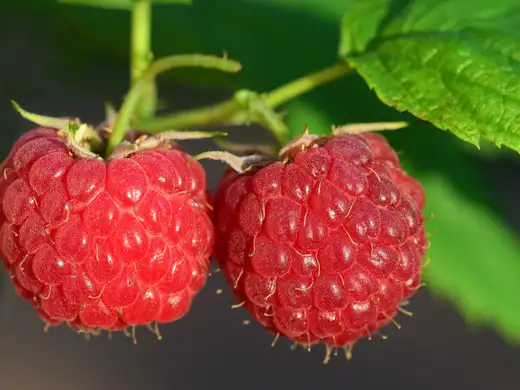
Ripe raspberries are fully colored and slip off easily, leaving the white core on the plant. Pick every three to four days, avoid picking wet fruit, and use shallow containers so the bottom layer is not crushed. Refrigerate right away and rinse just before eating. Chilled berries keep about a week. Oregon State expects 18 to 27 pounds per 10 feet of mature summer-bearing row, and somewhat less from everbearing and black types.
Common problems
- Phytophthora root rot: canes wilt and die in midsummer on wet, heavy soil. Raise the beds, and choose tolerant cultivars where root rot has been a problem.
- Raspberry bushy dwarf virus: crumbly fruit on otherwise normal plants. Replant certified stock in a new location.
- Spotted-wing drosophila: larvae in ripe berries, worst on late everbearing crops. Pick often, or use fine exclusion netting.
- White drupelets: sun and heat damage in hot, dry weather. Shade cloth helps.
- Frost: open flowers are injured at about 30°F, and fall frost ends the everbearing crop.
Questions
What is the difference between summer-bearing and everbearing raspberries?
Summer-bearing (floricane) raspberries fruit once, in June and July, on canes that grew the year before. Everbearing (primocane) raspberries fruit from about August until frost on the tips of new canes, and can give a smaller early-summer crop on the same canes the next year.
How do I prune everbearing raspberries?
For one large fall crop, cut every cane to just above the ground in late winter. For two crops, remove only the dead tip that fruited last fall, then take out the whole cane after it fruits again in early summer.
Why are my raspberries crumbly?
Crumbly fruit that falls apart is a classic sign of raspberry bushy dwarf virus, which bees spread in pollen. There is no cure. Replant certified plants in a new spot.
Can raspberries grow in the South?
With difficulty. UF/IFAS does not generally recommend them for southeastern home gardens, and Tennessee Extension says they do best above about 2,000 feet there. Heat weakens the canes and makes the fruit more perishable.
How long does a raspberry patch last?
Oregon State gives red raspberries 10 to 15 years and black raspberries 5 to 10, depending on pests and growing conditions.
Sources
- Growing Raspberries in Your Home Garden (EC 1306) · Oregon State University Extension Service
- Growing Raspberries and Blackberries in the Home Garden · University of Maryland Extension
- Selecting Caneberries for Residential Production in Tennessee (W 895-B) · University of Tennessee Extension
- Brambles (Backyard Gardener #75) · University of Arizona Cooperative Extension, Yavapai County
- Planting Caneberries · UC Statewide IPM Program, University of California ANR
- Blackberries - Gardening Solutions · University of Florida IFAS Extension
- Rubus idaeus (Plant Toolbox) · NC State Extension Gardener Plant Toolbox