How to Grow Peppers
Set pepper transplants out only after frost is over and the soil has thoroughly warmed to at least 60°F, because peppers stall in cool weather. Give them full sun, even moisture at least 6 inches deep and light feeding. The first fruit is ready about 8 to 10 weeks after transplanting; red, yellow or orange peppers need several more weeks on the plant.

Your dates for peppers
Set your ZIP code at the top of the page and we will work out when to plant peppers where you live, from the frost records of the nearest NOAA weather station. Your ZIP code is remembered on this device only.
Peppers at a glance
- Botanical name
- Capsicum annuum
- Light
- full sun (at least 6 hours)
- Frost tolerance
- Tender: killed by frost
- Soil temperature to plant
- At least 60°F (best 65–75°F)
- Germination
- 8–13 days
- Days to harvest
- 90–120 days from seed; 65–85 days from transplanting
- Planting depth
- 0.5 inches
- Spacing
- 12–18 inches apart, rows 18–36 inches apart
- Containers
- Yes, at least 5 gallons
When to plant peppers
| Zone | Start indoors | Plant out | Sow outdoors | Fall planting |
|---|---|---|---|---|
| Zone 2a | Apr 1 to 29 | Jun 17 to Jul 1 | Jun 17 to 24 | — |
| Zone 3a | Mar 26 to Apr 23 | Jun 11 to 25 | Jun 11 to 18 | — |
| Zone 3b | Mar 23 to Apr 20 | Jun 8 to 22 | Jun 8 to 15 | — |
| Zone 4a | Mar 17 to Apr 14 | Jun 2 to 16 | Jun 2 to 9 | — |
| Zone 4b | Mar 12 to Apr 9 | May 28 to Jun 11 | May 28 to Jun 4 | — |
| Zone 5a | Mar 7 to Apr 4 | May 23 to Jun 6 | May 23 to 30 | — |
| Zone 5b | Mar 7 to Apr 4 | May 23 to Jun 6 | May 23 to 30 | — |
| Zone 6a | Mar 3 to 31 | May 19 to Jun 2 | May 19 to 26 | — |
| Zone 6b | Feb 24 to Mar 24 | May 12 to 26 | May 12 to 19 | — |
| Zone 7a | Feb 17 to Mar 17 | May 5 to 19 | May 5 to 12 | — |
| Zone 7b | Feb 8 to Mar 8 | Apr 26 to May 10 | Apr 26 to May 3 | Jul 12 to Aug 9 |
| Zone 8a | Jan 25 to Feb 22 | Apr 12 to 26 | Apr 12 to 19 | Jul 18 to Aug 15 |
| Zone 8b | Jan 13 to Feb 10 | Mar 31 to Apr 14 | Mar 31 to Apr 7 | Jul 24 to Aug 21 |
| Zone 9a | Dec 27 to Jan 24 | Mar 14 to 28 | Mar 14 to 21 | Aug 6 to Sep 3 |
| Zone 9b | Dec 21 to Jan 18 | Mar 8 to 22 | Mar 8 to 15 | Aug 19 to Sep 16 |
Timing matters more than for tomatoes
Peppers are slower and fussier about cold than tomatoes. Clemson notes that they grow very slowly in cool periods and do best with days at 70 to 85°F and nights at 60 to 70°F. Waiting until the soil has thoroughly warmed, at least 60°F, is the most useful thing you can do; the dates for your zone above already allow for this.
Start seed indoors 6 to 8 weeks before the last frost (Clemson, NC State), or 8 to 10 weeks according to Utah State, which grows larger transplants. Pepper seed is slow and needs warmth: at 68°F it takes about 12 days to emerge and at 59°F about 25, while at 77 to 86°F it comes up in about 8. Utah State germinates seed at 80°F, then grows seedlings at 65 to 75°F under lights. The ideal transplant is stocky, dark green and 5 to 8 inches tall with 6 to 9 leaves. Remove any flowers or fruit before planting, since they slow establishment.
In short-season areas, black plastic mulch laid before planting warms the soil, and row covers or hot caps protect young plants. Vent them when the air inside goes above 80°F, because heat during flowering makes flowers and young fruit abort.
Varieties for your region
Extension services recommend these for their own states:
- South Carolina (Clemson): bells Capistrano, Jupiter, Plato, Antebellum, Valencia and Vanguard; jalapeños Jalapeno M, Tula, Mitla and Fooled You; cayennes Carolina Cayenne and Charleston Hot.
- Texas (Texas A&M): sweet Bell Tower, Big Bertha, California Wonder, Gypsy, Jupiter and Yolo Wonder; hot Hidalgo Serrano, Hungarian Wax and jalapeño, plus Long Red Cayenne and TAM Mild Jalapeño.
- Utah (Utah State): sweet Big Bertha, California Wonder, Gypsy, Keystone Resistant Giant and Yolo Wonder L; hot Anaheim, Early Jalapeño, NuMex Big Jim and Serrano Hot.
- Florida (UF/IFAS): sweet California Wonder, Red Knight, Big Bertha and Cubanelle; hot Early Jalapeno, Hungarian Hot Wax, Anaheim Chile and Habanero, among others.
Planting and spacing
Peppers need full sun, at least 6 hours, and well-drained soil; Utah State recommends a raised bed where drainage is poor. Clemson suggests a pH of 6.0 to 6.5. Rotate: don’t plant peppers where tomatoes, eggplant, potatoes or peppers grew within the last 3 years.
Spacing advice ranges from 12 inches in the row (Clemson) to 18 inches (Utah State, Texas A&M); UF/IFAS gives 9 to 15 inches. Rows are 18 to 24 inches apart in Utah State’s guide and 3 feet in Clemson’s and Texas A&M’s. Set plants no deeper than their original root ball, unlike tomatoes, and transplant in the evening or on a cloudy day.
Water, mulch and feeding
Even moisture is critical, especially during flowering and fruit development. Clemson advises wetting the soil at least 6 inches deep each time and not letting it dry out between waterings once fruit is forming; Utah State suggests 1 to 2 inches a week, ideally by drip. Irregular watering causes both flower drop and blossom-end rot. Organic mulch helps, but hold it until the soil is above 75°F so it doesn’t keep spring soil cool.
Peppers need only moderate fertilizer. Clemson side-dresses ½ pound of calcium nitrate per 100 square feet 3 to 4 weeks after planting and again 3 to 4 weeks later; Utah State uses ¼ tablespoon of 21-0-0 per plant at 4 and 8 weeks. Texas A&M adds about 2 tablespoons of fertilizer per plant once the first fruit starts to enlarge. More nitrogen than this gives big plants with few peppers.
Hoe shallowly. Texas A&M warns that deep cultivation cuts pepper roots and slows growth. Hand-pull weeds close to the plants.
Regional notes
In the cold North and at high elevations, choose early varieties, use transplants and warm the soil with plastic. In the humid South, a fall crop is possible: Texas A&M sets fall plants out 12 to 16 weeks before the first expected frost, and Clemson recommends a fall crop on the South Carolina coastal plain but not in the Piedmont. In the low desert around Phoenix, the University of Arizona calendar sets peppers out in late winter and again in midsummer, and fruit set stalls whenever days pass about 90°F. In frost-rare Florida and zones 9 to 11, UF/IFAS notes that peppers set out in late winter often keep producing into summer.
Problems
- Flower drop: nights below 55°F, days above 90°F, or uneven watering.
- Blossom-end rot: a dark, sunken patch on the fruit’s blossom end, caused when interrupted water supply stops calcium reaching the fruit. Keep soil evenly moist but not soggy, and test soil calcium before planting.
- Bacterial leaf spot and bacterial wilt: Clemson calls these the two worst pepper diseases in home gardens. Buy disease-free transplants, rotate, and clear out plant debris and volunteer peppers.
- Viruses: tobacco mosaic spreads from tobacco products, so don’t smoke or use tobacco around plants; control aphids, which carry other viruses.
- Insects: aphids, thrips, flea beetles and caterpillars such as corn earworm. Handpick caterpillars or use Bt or spinosad.
- Sunscald: pale, papery patches on fruit exposed to hot sun; dense foliage and steady moisture reduce it.
Harvest and storage
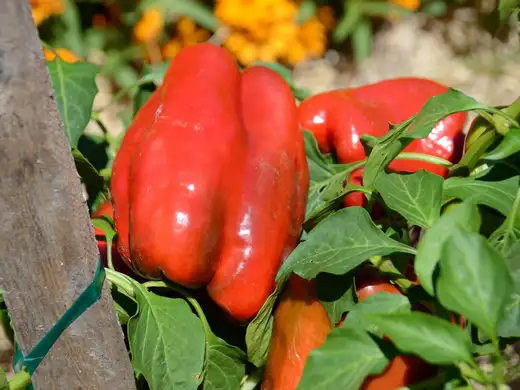
Sweet peppers can be picked once full size with firm walls, while still green. Left on the plant, most turn red, yellow, orange or brown, and Clemson notes that fully colored peppers are sweeter than green ones. Jalapeños are ready at full size with a deep, dark green sheen. Pepper branches are brittle, so cut the stems instead of pulling. Picking regularly increases yields, according to Texas A&M. Before the first fall frost, you can pull whole hot pepper plants and hang them to finish.
Storage advice varies: Clemson recommends 45 to 50°F with high humidity for 2 to 3 weeks, Utah State 50 to 55°F for 1 to 2 weeks with a warning about chilling injury, and Texas A&M says to use refrigerated peppers within 3 to 5 days.
Questions
Why are my pepper flowers falling off?
Peppers drop their flowers when nights fall below about 55°F or days rise above about 90°F, according to Utah State. Uneven watering also causes flower drop. Fruit set usually resumes when the weather moderates.
How long does it take a green pepper to turn red?
Utah State says peppers need about 35 to 45 days from flowering to reach full color, depending on temperature and variety. Fully colored peppers are sweeter than green ones.
Why do my pepper plants have lots of leaves but no peppers?
Usually too much nitrogen. Clemson notes that heavy, leafy plants with few blooms point to over-fertilizing; follow a soil test and side-dress lightly.
How many pepper plants should I grow?
Utah State suggests 3 to 4 plants per person for fresh use, plus 5 to 10 more for canning, pickling, drying or freezing. Texas A&M figures 3 to 4 hot pepper and 8 to 10 sweet pepper plants for a family of four.
Should I pick peppers green or wait for color?
Either. Sweet peppers can be picked once they reach full size with firm walls. Leaving them to color makes them sweeter, but Texas A&M notes that picking peppers as they mature raises total yield.
Sources
- Pepper (HGIC 1316) · Clemson Cooperative Extension, Home & Garden Information Center
- How to Grow Peppers in Your Garden · Utah State University Extension
- Easy Gardening: Peppers (EHT-038) · Texas A&M AgriLife Extension Service
- Florida Vegetable Gardening Guide (SP 103/VH021) · UF/IFAS Extension
- Vegetable Planting Calendar for Maricopa County (AZ1005) · University of Arizona Cooperative Extension
- Soil Temperature Conditions for Vegetable Seed Germination (Garden Notes GN 154) · UC Cooperative Extension Sacramento County (UC ANR)
- Capsicum annuum · NC State Extension Gardener Plant Toolbox
- Vegetable Gardening in Containers (E-545) · Texas A&M AgriLife Extension Service
- Types of Containers for Growing Vegetables · University of Maryland Extension