How to Grow Peanuts
Peanuts need loose, sandy soil, full sun, soil at least 65°F at planting and about 120 or more frost-free days. Sow raw seed directly after the last frost, keep the soil loose so the flower pegs can push in, and dig the plants when the leaves yellow in late summer or fall. Then cure them for several weeks before roasting.

Your dates for peanuts
Set your ZIP code at the top of the page and we will work out when to plant peanuts where you live, from the frost records of the nearest NOAA weather station. Your ZIP code is remembered on this device only.
Peanuts at a glance
- Botanical name
- Arachis hypogaea
- Light
- full sun (6+ hours)
- Frost tolerance
- Tender: killed by frost
- Soil temperature to plant
- At least 65°F
- Days to harvest
- 120–150 days from seed
- Planting depth
- 1.5 inches
- Spacing
- 6–9 inches apart, rows 24–36 inches apart
When to plant peanuts
| Zone | Sow outdoors |
|---|---|
| Zone 2a | May 26 to Jun 9 |
| Zone 3a | Jul 9 to 23 |
| Zone 3b | Jun 29 to Jul 13 |
| Zone 4a | Jun 19 to Jul 3 |
| Zone 4b | Jun 12 to 26 |
| Zone 5a | Jun 7 to 21 |
| Zone 5b | Jun 6 to 20 |
| Zone 6a | Jun 4 to 18 |
| Zone 6b | May 30 to Jun 13 |
| Zone 7a | May 24 to Jun 7 |
| Zone 7b | May 14 to 28 |
| Zone 8a | May 1 to 15 |
| Zone 8b | Apr 21 to May 5 |
| Zone 9a | Apr 6 to 20 |
| Zone 9b | Mar 30 to Apr 13 |
How peanuts grow
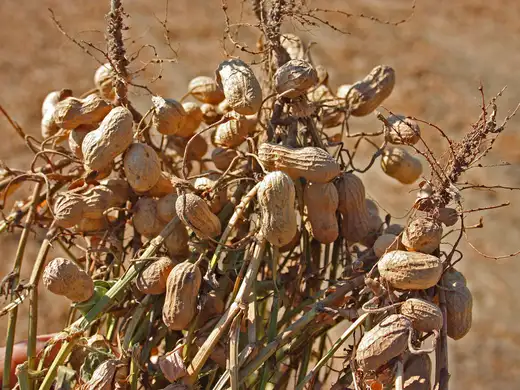
A peanut is a legume, not a nut. The plant flowers above ground, starting about 30 to 40 days after emergence (Iowa State). After a flower is pollinated, a stalk called a peg grows down and pushes into the soil, which takes about 10 days. The pod forms at the tip and matures in about 9 to 10 weeks. If a peg can’t get into the soil, no pod develops, and that one fact drives most of the care below: loose soil, hilling and shallow cultivation.
Choosing a type
Peanuts come in four main types:
- Valencia (120-130 days, Utah State): three or more small, sweet kernels per pod. Utah State calls it the best choice where frost-free days are limited, and it is the type for boiling green. UF/IFAS says Valencias dug green can be ready in as little as 75 days.
- Spanish (90-130 days): small kernels with a reddish skin and high oil content. Iowa State suggests Spanish and Early Spanish for home gardens. For Florida, UF/IFAS lists Star (about 120 days), Tifspan, Sancross and Tamnut 74.
- Virginia (120-130 days): the largest kernels, one or two per pod, good for roasting in the shell. Iowa State suggests Virginia Improved and Jumbo Virginia, and UF/IFAS recommends Florigiant (about 135 days) for Florida.
- Runner (125-165 days): the main commercial type in the Southeast. UF/IFAS recommends Florunner and Sunrunner (about 135 days) for Florida gardens.
Peanuts need at least about 120 frost-free days (Iowa State). In northern and mountain gardens, Valencia and early Spanish types are the realistic choices. For Florida, UF/IFAS recommends runner, Spanish and Virginia varieties.
Soil and site
Choose full sun and loose, sandy, well-drained soil. Heavy clay is the main obstacle, because pegs struggle to enter it. Iowa State says to avoid wet, poorly drained sites and clay. Utah State says most soils can work if enough organic matter is added to let pegs penetrate, but limits compost to 1 inch per 100 square feet. Peanuts also need calcium to fill their pods. Get a soil test, and follow the UF/IFAS suggestion to apply agricultural gypsum beside the row just after the plants bloom.
Planting
Sow seed directly in the garden. Peanuts aren’t transplanted. Plant after frost danger is over and once the soil is at least 65°F, which Utah State says usually arrives around the last frost date. UF/IFAS’s stricter rule for Florida growers is to wait until the soil at planting depth has topped 65°F for three or more consecutive days. Cool, wet soil slows germination, so don’t water heavily right after planting in cool weather. Use the dates for your zone above. In North and Central Florida, UF/IFAS plants from March through May, and the University of Arizona calendar for the Phoenix area seeds from mid-March through April.
Use raw peanuts. UF/IFAS leaves them in the shell for the fastest germination; Utah State finds shelled seed germinates faster but warns that any seed with a cracked red seed coat is probably dead. Before planting, coat the seed with a peanut rhizobium inoculant from a seed supplier so the roots can form nitrogen-fixing nodules. Utah State says inoculated plants usually need no nitrogen fertilizer, and uninoculated plants should get fertilizer at planting and a month later, based on a soil test.
Depth and spacing vary more than for most crops:
- Iowa State: 1 to 1½ inches deep, 6 to 8 inches apart, in rows 24 inches apart for bunch types and 36 inches for runners.
- NC State: about 2 inches deep, 6 to 9 inches apart, in rows about 3 feet apart.
- UF/IFAS (Florida’s sandy soils): 2 to 4 inches deep, 4 to 6 inches apart, in rows 24 to 36 inches apart.
- Utah State: 1½ inches deep, 4 seeds per mound with mounds 18 inches apart, in rows 24 inches apart.
Season extenders such as row covers, cold frames or hoop houses can raise yields in short-season areas. Utah State adds that any plastic mulch must come off when plants begin to flower, so the pegs can reach the soil.
Care
Hoe shallowly to control weeds and keep the soil surface loose, but stop working the soil near the plants once the pegs start going in (Iowa State). When plants are about a foot tall, Utah State hills them like potatoes, mounding about 6 inches of soil around each one. Hilling gives the pods room and improves drainage. Then spread 3 to 4 inches of compost or grass clippings to hold moisture and suppress weeds.
Give 1 to 2 inches of water a week, and keep it steady. Utah State warns that irregular watering, too much or too little, causes root rot and lowers yields.
Problems
- Rodents: mice and other animals eat pods underground and while plants cure. Iowa State advises watching for mice in the curing shed.
- Leaf spot and rust: the main foliar diseases. UF/IFAS notes that some garden vegetable fungicides are labeled for them, and that commercial growers spray about every two weeks.
- Tomato spotted wilt virus: UF/IFAS says it can be devastating. In UF/IFAS work on dry-market peanuts, early and late plantings lost more to the virus than mid-season plantings.
- Soil diseases: NC State lists southern stem rot, Sclerotinia blight and Cylindrocladium black rot. Avoid poorly drained ground, and UF/IFAS advises growing peanuts on the same soil no more than once every 3 to 4 years.
- Insects: usually minor. Utah State lists wireworms, armyworms, cutworms, aphids, thrips and corn earworm as possible pests.
NC State notes that peanut is allelopathic, meaning it releases compounds that can suppress other plants. Peanut proteins can also cause severe allergic reactions in some people.
Harvest and curing
Dig when the foliage begins to yellow in late summer or early fall, or, in Utah State’s short season, after the first frost. Pods form over several weeks. Iowa State notes they don’t all mature at once, while UF/IFAS says the early pegs mature more slowly, so most pods end up ready together. Either way, open a few pods first and look for darkening seeds inside (UF/IFAS). Lift the whole plant with a spading fork, shake off loose soil and sift the bed for pods left behind.
Cure the plants in a warm, dry, well-ventilated spot, hung up or piled loosely off the ground, for 1 to 2 weeks. Then pull the pods and dry them another 1 to 2 weeks (Iowa State) or 2 to 3 weeks (Utah State), ideally below 60 to 70% humidity. Store dry pods in mesh bags somewhere cool and well ventilated; Utah State suggests 35 to 40°F. Throw out any moldy or damaged nuts. After harvest, NC State suggests removing only the tops and leaving the roots in the ground to release their nitrogen.
Questions
Can you grow peanuts in the North?
Yes, with the right type. Iowa State says peanuts can be grown in Iowa, and Utah State says certain types produce where the frost-free season exceeds 110 days. Choose Valencia or early Spanish types and plant as soon as the soil reaches 65°F.
Can I plant peanuts from the grocery store?
UF/IFAS says to plant raw peanuts, not roasted ones, and Utah State notes seed peanuts are sold online and by mail order. Utah State also notes that a shelled seed with a cracked or damaged red seed coat is most likely dead.
Should peanuts be planted in the shell?
Either works. UF/IFAS recommends leaving them in the shell, while Utah State says shelled seeds germinate faster. Handle shelled seed gently so you don't damage the thin seed coat.
Do peanuts need fertilizer?
Usually not nitrogen, if you coat the seed with peanut rhizobium inoculant so the plants can fix their own. Base other fertilizer on a soil test. Peanuts do need calcium for pod fill, and UF/IFAS suggests gypsum beside the row just after bloom.
How do you know when peanuts are ready to dig?
The leaves begin to yellow in late summer or early fall. Before digging everything, open a few pods. UF/IFAS says seeds that are turning darker inside signal maturity.
Sources
- Peanuts in the Garden · Utah State University Extension
- Is it possible to grow peanuts in Iowa? · Iowa State University Extension and Outreach
- Growing Peanuts in the Home Garden (1997 article) · Iowa State University Extension and Outreach
- Arachis hypogaea (Peanut) · NC State Extension Gardener Plant Toolbox
- Peanuts (Gardening Solutions) · University of Florida IFAS Extension
- Producing Peanuts for the Fresh Market (SS-AGR-190, archival) · University of Florida IFAS Extension (EDIS)
- Vegetable Planting Calendar for Maricopa County (AZ1005) · University of Arizona Cooperative Extension