How to Grow Leeks
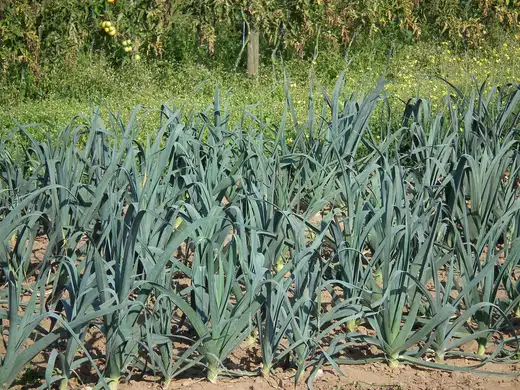
Leeks are a long, slow crop: most need 100 to 120 days from seed, so northern gardeners start them indoors 8 to 12 weeks before setting them out a few weeks ahead of the last frost. Drop each seedling into a 5- to 6-inch-deep hole and hill soil around the stems as they grow to get long white shanks. Harvest once the stems are about an inch thick; under heavy mulch, many gardens can keep digging them into winter.

Your dates for leeks
Set your ZIP code at the top of the page and we will work out when to plant leeks where you live, from the frost records of the nearest NOAA weather station. Your ZIP code is remembered on this device only.
Leeks at a glance
- Botanical name
- Allium porrum (syn. Allium ampeloprasum Porrum group)
- Light
- full sun (at least 6 hours; 8-10 hours preferred)
- Frost tolerance
- Hardy: takes a hard frost
- Days to harvest
- 100–120 days from seed; 75–100 days from transplanting
- Planting depth
- 0.5 inches
- Spacing
- 4–6 inches apart, rows 8–16 inches apart
When to plant leeks
| Zone | Start indoors | Plant out |
|---|---|---|
| Zone 2a | Feb 24 to Mar 24 | Apr 21 to May 19 |
| Zone 3a | Mar 3 to 31 | Apr 28 to May 26 |
| Zone 3b | Feb 22 to Mar 22 | Apr 19 to May 17 |
| Zone 4a | Feb 18 to Mar 18 | Apr 15 to May 13 |
| Zone 4b | Feb 13 to Mar 13 | Apr 10 to May 8 |
| Zone 5a | Feb 8 to Mar 8 | Apr 5 to May 3 |
| Zone 5b | Feb 6 to Mar 6 | Apr 3 to May 1 |
| Zone 6a | Feb 4 to Mar 4 | Apr 1 to 29 |
| Zone 6b | Jan 29 to Feb 26 | Mar 26 to Apr 23 |
| Zone 7a | Jan 22 to Feb 19 | Mar 19 to Apr 16 |
| Zone 7b | Jan 11 to Feb 8 | Mar 8 to Apr 5 |
| Zone 8a | Jan 4 to Feb 1 | Mar 1 to 29 |
| Zone 8b | Dec 23 to Jan 20 | Feb 17 to Mar 17 |
| Zone 9a | Dec 8 to Jan 5 | Feb 2 to Mar 2 |
| Zone 9b | Nov 8 to Dec 6 | Jan 3 to 31 |
Spring dates before the last frost assume the soil has thawed and is dry enough to work. After a late or wet spring, wait for that even if the date has passed.
Summer leeks and overwintering leeks
Leeks never make a bulb. The stem just keeps thickening into a tight sheath of rolled leaves, and each plant gives one shank about 6 to 8 inches long and 1 to 2 inches across (Maryland, Utah State). Maryland Extension separates two groups. Summer leeks are smaller and harvested the same season they’re planted. Overwintering leeks are bigger and stronger-flavored, and they’re harvested the following spring.
Extension-recommended varieties by region:
- Utah: Large American Flag, Comanche and King Richard (Utah State).
- South Carolina: Arkansas (Clemson).
- Florida: American Flag (UF/IFAS).
- Tennessee: Lancelot, an early hybrid reported to be slow to bolt (Tennessee Extension).
Starting leeks
Transplants give the earliest crop (Utah State). Sources disagree on how long to grow them indoors. The Maryland Grows video allows 8 to 12 weeks indoors. Utah State says 6 to 8 weeks of growth before planting out. In the University of Rhode Island calendar, which assumes a mid-May last frost, seed is sown indoors in early to mid-March and transplanted on the frost date.
Leeks handle cold well. Maryland Extension sets hardened-off transplants out several weeks before the last frost. Use the dates for your zone above. Direct seeding also works. Utah State sows outdoors in late March, 1/4 to 1/2 inch deep, and Clemson sows 10 to 15 seeds per foot of row. Thin to 4 to 6 inches apart in rows 8 to 16 inches apart (Utah State). Maryland spaces leeks at 5 inches and Clemson at 4.
Planting deep for white stems
Blanching keeps the lower stem out of the light so it stays white, tender and mild. The easiest way is to plant deep. Maryland Extension makes holes 5 to 6 inches deep with a dowel about 1 to 1-1/4 inches thick. Drop one seedling into each hole and water it in without backfilling. Water gradually washes soil in around the stem. Utah State uses the same method with 10- to 12-inch transplants in 6-inch holes.
As the plants grow, pull soil up around the stems. Utah State hills 2 to 3 inches of soil two or three times a season, and notes that dibble-planted leeks need less of this. Clemson and UF/IFAS both say to wait until the stems are about as thick as a pencil before hilling. Clemson warns against starting too early. Maryland adds that blanching improves texture and flavor but is optional.
Water, feeding and weeds
Leek roots are shallow, and Maryland and Utah State both say drought cuts yield. Utah State wets the soil to 18 inches every 7 days. Mulch with compost, grass clippings or shredded leaves to hold moisture. Mulch also matters for weed control, because leeks grow slowly for their first two months and compete poorly with weeds. Cultivate shallowly so you don’t damage the roots.
Leeks need a steady supply of nitrogen. Utah State side-dresses with 1/4 pound of 21-0-0 per 100 square feet in mid-May and again in late June, and Maryland side-dresses in June. In South Carolina’s fall-to-spring season, Clemson splits nitrogen into four light feedings: mid-November, early January, mid-February and early March.
Southern and desert gardens
Where summers are hot, leeks are a fall and winter crop. Clemson plants seed or transplants in late summer or early fall for an early-winter harvest in South Carolina, and notes that leeks mature best when average temperatures stay below 75°F. UF/IFAS sows in fall in Florida and expects a harvest in 3 to 4 months. Around Phoenix, the University of Arizona calendar sows leeks from mid-August to early October and again in January. It allows 180 to 200 days to maturity there.
Tennessee Extension notes that leeks prefer cooler conditions than onions, which can make them tricky in mid-latitude gardens. It suggests trying them as an overwintered crop, grown much like garlic.
Harvest and winter storage
Leeks are ready once the shanks are about 1 inch thick (Maryland, Utah State, Clemson). Maturity times vary widely. Utah State and Maryland give 100 to 120 days for most leeks and Clemson about 120. Maryland’s range across cultivars runs from 70 to 120 days, and the Rhode Island calendar gives 75 to 100 days from transplanting. Small leeks can be pulled from about 60 days, when they are around green-onion size. The roots are large, so Maryland recommends digging rather than pulling.
The garden is the best storage place. Maryland and Utah State both suggest hilling soil around the plants in fall and covering them with a thick layer of straw or leaves, then digging leeks as needed through winter. Sources differ on how far that works. Utah State says leeks can be overwintered this way in most areas. Iowa State calls them nonhardy biennials in Iowa and uses straw to stretch the harvest into late fall or early winter. Where the ground freezes hard, Utah State lifts the leeks and stores them at 32 to 40°F in damp sand to keep them from drying out.
Harvested leeks keep about 7 to 10 days in the refrigerator (Maryland). Clemson says several weeks. For longer storage, Utah State trims leeks, blanches them for 2 to 3 minutes, cools them quickly and freezes them.
Leeks left in the ground into spring will flower and set seed. Maryland notes that they may also form small bulblets at the base, which can be replanted to start a new crop.
Pests
Leeks share onion pests. Maryland Extension lists allium leafminer as a leek problem. Thrips leave leaves silvery, twisted and dying, and Utah State notes they hide low on the plant at the base of the leaves. Onion maggots and wireworms feed on roots and underground stems. For onion maggots and wireworms, Utah State relies on crop rotation and avoiding excessive organic matter.
Questions
Do I have to blanch leeks?
No. Maryland Extension says blanching makes leeks milder and more tender but is not essential. Deep planting alone blanches the lower stem.
How cold-hardy are leeks?
Sources disagree. Maryland and Utah State say leeks can be overwintered in the garden under heavy mulch in most areas, while Iowa State treats them as not fully hardy and uses straw mainly to stretch harvest into late fall or early winter. In very cold areas, Utah State lifts them and stores them cold and humid.
Can I grow leeks in the South?
Yes, as a cool-season crop. Clemson plants them in late summer or early fall in South Carolina, UF/IFAS sows in fall in Florida, and Clemson notes they mature best when average temperatures stay below 75°F.
How long do harvested leeks keep?
About 7 to 10 days in the refrigerator according to Maryland Extension (Clemson says several weeks). In cold climates, they keep longer packed in damp sand at 32 to 40°F.
Sources
- Onions, Leeks and Shallots for the Tennessee Vegetable Garden (D 127) · University of Tennessee Extension
- The Other Onions · Iowa State University Extension and Outreach
- How to Grow Leeks in Your Garden · Utah State University Extension
- Growing Leeks in a Home Garden · University of Maryland Extension
- How to Start Onions and Leeks from Seeds · University of Maryland Extension (Maryland Grows)
- Rhode Island Planting Calendar for Fruits and Vegetables · University of Rhode Island Cooperative Extension
- Onion, Leek, Shallot, & Garlic (HGIC) · Clemson Cooperative Extension Home & Garden Information Center
- Leeks · University of Florida IFAS Gardening Solutions
- Vegetable Planting Calendar for Maricopa County (AZ1005) · University of Arizona Cooperative Extension