How to Plant Grass Seed
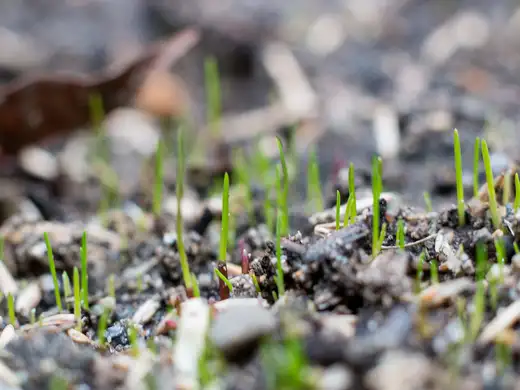
Sow cool-season grass seed (tall fescue, Kentucky bluegrass, ryegrass, fine fescue) in late summer to early fall, at least four to six weeks before your first fall frost, and warm-season seed (bermudagrass, zoysia, centipede) in late spring to early summer once the soil holds about 65°F. Rake the seed into the top 1/4 inch of prepared soil, then keep the surface moist with light watering two or three times a day for two to three weeks.

Your dates for grass seed
Set your ZIP code at the top of the page and we will work out when to plant grass seed where you live, from the frost records of the nearest NOAA weather station. Your ZIP code is remembered on this device only.
Grass Seed at a glance
- Botanical name
- Poaceae (lawn grasses: e.g. Poa pratensis, Festuca arundinacea, Lolium perenne, Cynodon dactylon)
- Light
- most lawn grasses need full sun; turfgrasses need at least 4 hours of direct sun, and fine fescues are the most shade tolerant
- Frost tolerance
- Hardy: takes a hard frost
- Germination
- 5–30 days
- Planting depth
- 0.25 inches
When to plant grass seed
| Zone | Sow outdoors | Fall planting |
|---|---|---|
| Zone 2a | Apr 7 to 21 | Jul 25 to Aug 8 |
| Zone 3a | Apr 14 to 28 | Aug 3 to 17 |
| Zone 3b | Apr 5 to 19 | Aug 13 to 27 |
| Zone 4a | Apr 1 to 15 | Aug 17 to 31 |
| Zone 4b | Mar 27 to Apr 10 | Aug 20 to Sep 3 |
| Zone 5a | Mar 22 to Apr 5 | Aug 23 to Sep 6 |
| Zone 5b | Mar 20 to Apr 3 | Aug 29 to Sep 12 |
| Zone 6a | Mar 18 to Apr 1 | Sep 5 to 19 |
| Zone 6b | Mar 12 to 26 | Sep 10 to 24 |
| Zone 7a | Mar 5 to 19 | Sep 13 to 27 |
| Zone 7b | Feb 22 to Mar 8 | Sep 20 to Oct 4 |
| Zone 8a | Feb 15 to Mar 1 | Sep 26 to Oct 10 |
| Zone 8b | Feb 3 to 17 | Oct 2 to 16 |
| Zone 9a | Jan 19 to Feb 2 | Oct 15 to 29 |
| Zone 9b | Dec 20 to Jan 3 | Oct 28 to Nov 11 |
Spring dates before the last frost assume the soil has thawed and is dry enough to work. After a late or wet spring, wait for that even if the date has passed.
Pick the right grass before you buy seed
Lawn grasses fall into two groups, and choosing the wrong one is the most common reason a new lawn fails.
Cool-season grasses (Kentucky bluegrass, tall fescue, perennial ryegrass and the fine fescues) grow most in spring and fall and suit the northern US and the transition zone, the band where cool- and warm-season grasses overlap. Tall fescue handles summer heat better than bluegrass and is the main lawn grass in Maryland and the most common one in California, according to Maryland Extension and UC IPM.
Warm-season grasses (bermudagrass, zoysiagrass, centipedegrass and St. Augustinegrass) grow in summer and turn brown after the first hard frost. They suit the South, the Southwest and other areas with long, hot summers.
Not every grass can be seeded. Clemson notes that several warm-season grasses produce no viable seed, and Virginia Tech that many of the best cultivars of bermudagrass, zoysiagrass and St. Augustinegrass must be planted as sod, plugs or sprigs. Clemson names centipedegrass, carpetgrass, common bermudagrass and Japanese lawngrass (Zoysia japonica) as the warm-season exceptions that can be grown from seed. Maryland Extension calls zoysia from seed challenging because the seed is costly, scarce and germinates unreliably.
Match the grass to your light. Maryland says lawns do best with six or more hours of direct sun after nearby trees leaf out, and no lawn grass thrives in deep shade. For partly shaded sites, Penn State suggests a mix of fine fescues, Kentucky bluegrass and a little perennial ryegrass, or tall fescue alone; for full shade, fine fescues or rough bluegrass.
Mixes and blends
Cool-season seed is usually sold as a mix of species or a blend of cultivars, and that is a good thing. Different species cover different conditions in the same yard, and Penn State recommends blending three or four Kentucky bluegrass cultivars because the species has so little genetic variation. Nebraska Extension suggests a blend of three or four bluegrass and/or turf-type tall fescue cultivars for fall seedings. UC IPM recommends that bluegrass mixes include at least 15 percent perennial ryegrass, which sprouts fast and holds the soil while the bluegrass fills in.
Warm-season grasses are the opposite: NC State and Virginia Tech advise planting a single variety rather than a blend.
Read the seed tag
By federal law every bag of lawn seed carries a label listing each species and cultivar, its purity, its germination percentage, the weed seed content and the date the seed was tested. It is the best guide to what you are paying for.
- Purity and germination. Clemson suggests buying seed with at least 90 percent purity and at least 85 percent germination.
- Named cultivars. “Variety not stated” (VNS) or “common” on the label usually means lower-quality seed (Penn State).
- Weed and crop seed. As low as possible. Nebraska looks for no noxious weeds and 0.5 percent weed seed or less.
- Test date. Germination drops as seed ages, so fresher is better.
- Certified (blue-tag) seed is the only real guarantee of cultivar purity, according to Penn State.
To compare bags fairly, work out the pure live seed (PLS): multiply percent purity by percent germination and divide by 100. Penn State’s example: 92 percent purity times 80 percent germination is 74 percent PLS. A cheaper bag with a low PLS often costs more per pound of seed that will actually grow.
When to sow
Cool-season seed: late summer to early fall. Warm soil makes the seed sprout fast, and the new grass gets two cool growing seasons, fall and the following spring, before summer stress (Penn State). Weeds are also less of a problem than in spring. Typical windows are mid-August to mid-September in Indiana and Nebraska, the last week of August to mid-September in northern Virginia, mid-August to mid-October in Maryland, and mid- to late September in South Carolina. Utah State says to allow four to six weeks before the expected first frost; Illinois says at least 45 days. Earlier is safer: Nebraska Extension notes that each week of delay adds two to four weeks to the time the grass needs to mature in fall. The dates for your zone above follow that rule.
Cool-season seed in spring: second best. Spring seedings face crabgrass and then summer heat before roots are deep. If you must seed in spring, do it as early as possible: mid-February to mid-March and no later than mid-April in Kentucky, March into early April in Maryland. Purdue also describes dormant seeding: sowing before the frost comes out of the ground, from about Thanksgiving through March in Indiana, so the seed waits in the soil and sprouts as soon as it warms.
Warm-season seed: late spring to early summer. Wait until the soil holds about 65 to 70°F, which NC State’s Pender County office ties to daytime highs around 80°F. Clemson’s target is May 1-14 for all of South Carolina, Tennessee plants from May 1 to June 30, K-State from mid-May through July, and Kentucky late May through June. Planting earlier invites seed rot in cold soil (Clemson); planting much later leaves too little summer for the grass to toughen up before winter (Virginia Tech).
Preparing the seedbed
- Test the soil two to three months ahead (Clemson) so there is time to add lime or nutrients. Maryland puts the best pH for turf at 6.0 to 6.8.
- Kill out weeds and old grass if you are starting over. Nebraska waits 10 to 14 days after a glyphosate application before seeding.
- Loosen and improve the soil. Work any recommended lime and fertilizer into the top 4 to 6 inches. Maryland suggests tilling in 1 to 2 inches of compost where soil organic matter tests below 3 percent. Don’t till wet soil.
- Add starter fertilizer. Penn State applies 0.5 to 1 pound of nitrogen per 1,000 square feet in a starter fertilizer and warns that more than 1.5 pounds can burn young grass.
- Grade and firm. Rake out rocks and roots, smooth the surface, slope it gently away from buildings (Maryland), and firm it with a water-ballast roller (Clemson).
For overseeding a thin lawn rather than starting over, Nebraska mows the existing grass to about 2.5 to 3 inches and core-aerates in at least three passes to expose plenty of bare soil for the seed.
How to sow
Use a drop or rotary spreader rather than throwing by hand. Split the seed into two equal halves and sow one half walking north-south and the other walking east-west, with the spreader set to half the rate each time, to avoid stripes and skips.
How much to use per 1,000 square feet (Penn State and Maryland):
| Grass | Seed per 1,000 sq ft |
|---|---|
| Tall fescue | 6-8 lb |
| Kentucky bluegrass | 2-3 lb |
| Fine fescues | 4-6 lb |
| Perennial ryegrass | 4-5 lb |
| Bermudagrass or zoysia | about 1 lb |
More is not better. Penn State notes that very heavy seeding produces crowded seedlings that are more prone to disease, though slightly higher rates help when you sow past the ideal window.
Rake the seed lightly into the top 1/4 inch of soil (Clemson), then roll it with a light or empty roller for firm seed-to-soil contact. Grass seed needs light to sprout, so Maryland warns against burying it under more than about 1/2 inch of soil.
Finish with a thin mulch, especially on slopes. Penn State uses 80 to 100 pounds of weed-free straw per 1,000 square feet, about two to three bales. Maryland recommends a layer thin enough that you can still see some soil through it, and warns against hay, which carries weed seed, and mesh netting that can entangle wildlife.
Watering new grass seed
Water is the step that makes or breaks a seeding. Clemson calls it the most critical part of establishing a lawn from seed: if the soil surface dries out after the seed has swollen but before roots form, many seedlings die.
- First two to three weeks: water lightly two or three times a day, about 1/4 inch at a time, so the top inch of soil stays moist like a wrung-out sponge. On hot, windy days you may need more passes.
- After the grass is up: shift gradually to less frequent, longer waterings that wet the top 4 to 6 inches, working up to about 1 inch at a time (Maryland).
- Water in the morning or midday, not in the evening, so the leaves dry before night and disease has less chance (Maryland).
Watch for washouts. Heavy watering or a thunderstorm on bare soil moves seed into puddles and leaves bare streaks. Mulch helps, and Pender County’s office advises avoiding cold, waterlogged soil after sowing warm-season seed.
The first mowing and feeding
Start mowing when the seedlings are about one-third taller than the height you plan to keep. For tall fescue kept at 3 inches, that means mowing when it reaches 4 inches. Under good conditions that is typically four to six weeks after seeding (Maryland). Use a sharp blade; a dull one pulls seedlings out of the ground.
Clemson gives new seedlings a light feeding of about 1/2 pound of nitrogen per 1,000 square feet once they are 1½ to 2 inches tall. Hold off on most weed killers: Maryland and Purdue wait until a new lawn has been mowed at least three times before using broadleaf herbicides, and Maryland waits until four mowings before a crabgrass preventer. Many crabgrass preventers also stop grass seed from sprouting. Siduron and mesotrione are the exceptions Kentucky lists for use at seeding time.
Warm-winter areas and overseeding
Where winters are mild, permanent lawns are usually warm-season grasses planted in spring and summer. UC IPM sows common bermudagrass in spring or summer at about 1 pound per 1,000 square feet. To keep a dormant bermudagrass lawn green in winter, overseed it in fall with ryegrass: October to early November in north Florida, October to early December in central Florida, and October in Arizona’s low desert. In frost-free south Florida, lawns usually stay green without it.
Why grass seed fails
- Seed sown into cold soil or allowed to dry out after it swelled. Most germination failures come down to timing and water.
- Seed buried too deep. Keep cool-season seed in the top 1/4 inch and leave warm-season seed near the surface.
- Weeds. Spring seedings fight crabgrass. Maryland calls weed competition the most common cause of failed spring seedings; Purdue recommends seeding as early as possible to give grass a head start.
- Patchy stand. Usually too little seed, uneven spreading or low-quality seed. Overseed the gaps.
- Seedling disease. From overwatering, evening watering or sowing in hot weather.
- Fall seed that never came up. Maryland notes that seed that has not sprouted by winter dies, with the exception of Kentucky bluegrass, which can lie in the soil and come up in spring.
Seed or sod?
Seed costs less, offers more cultivar choice and is easy to blend for sun and shade, but it is slower and has a narrow planting window. Sod gives instant cover and roots in about two to three weeks. Maryland notes it can go down any time the ground is not frozen and daytime highs stay below about 90°F. For many warm-season grasses, sod, plugs or sprigs are the only way to get the best cultivars.
Questions
When is the best time to plant grass seed?
For cool-season grasses, late summer to early fall: mid-August to mid-September across much of the North, and at least 45 days before the first fall frost (Illinois). For warm-season grasses, late spring to early summer, once the soil holds about 65°F, such as May 1-14 in South Carolina (Clemson).
How often should I water new grass seed?
Lightly, two or three times a day for about two to three weeks, so the top inch stays moist but not soggy (Clemson). Once seedlings are tall enough to mow, water less often but more deeply.
How much grass seed do I need?
Per 1,000 square feet: tall fescue 6 to 8 pounds, Kentucky bluegrass 2 to 3, fine fescue 4 to 6, perennial ryegrass 4 to 5, and bermudagrass or zoysia about 1 pound (Penn State, Maryland).
Can I just throw grass seed on the lawn?
Not with good results. Seed needs firm contact with loose soil to sprout and root, so rake or core-aerate first, then rake the seed into the top 1/4 inch and roll it (Clemson, Nebraska).
How long does grass seed take to grow?
Perennial ryegrass sprouts in 5 to 10 days, tall fescue in 7 to 12, Kentucky bluegrass in 14 to 30 and seeded bermudagrass in 10 to 30 (UC IPM). Most new lawns are ready for a first mowing 4 to 6 weeks after seeding.
When can I walk on new grass?
Keep people and pets off for at least a month after the seed sprouts, or until the lawn has been mowed at least twice (Maryland).
Sources
- Extension Gardener Handbook, Chapter 9: Lawns · NC State Extension
- Tall fescue (UC Guide to Healthy Lawns) · UC Statewide IPM Program, University of California ANR
- Lawn Establishment (HGIC 1203) · Clemson Cooperative Extension Home & Garden Information Center
- Starting a New Lawn · University of Maryland Extension
- AGR-50 Lawn Establishment in Kentucky · University of Kentucky Cooperative Extension Service
- Lawn Establishment · Penn State Extension
- AY-20 Seeding a Turf Area in the Spring · Purdue University Cooperative Extension Service
- Choose the right grass seed for a thriving lawn · University of Illinois Extension
- Northern Utah Turfgrass Management Calendar · Utah State University Extension
- Time for Fall Lawn Seeding · University of Nebraska-Lincoln Extension (Lancaster County)
- Spring/Summer Lawn Care (Crop and Soil Environmental News, March 2005) · Virginia Cooperative Extension / Virginia Tech
- Planting Summer Grass · NC State Extension, Pender County
- Grass seed germination rates · UC Statewide IPM Program, University of California ANR
- Turfgrass Species (Pest Management Guidelines) · UC Statewide IPM Program, University of California ANR
- ENH14 Overseeding Florida Lawns for Winter Color (2007 revision, archival) · University of Florida IFAS Extension (EDIS)
- AZ1683 Overseeding Winter Grasses into Bermudagrass Turf · University of Arizona Cooperative Extension
- Bermudagrass · K-State Research and Extension, Ford County
- Chapter 10: Turfgrass Management in Tennessee (Master Gardener Handbook) · University of Tennessee Extension
- Chapter 11: Lawns (Virginia Cooperative Extension Master Gardener Handbook) · Virginia Cooperative Extension / Virginia Tech