How to Grow Daylilies
Daylilies are among the easiest perennials: plant them in full sun or light shade, with the crown no more than 1 inch below the soil, 18 to 24 inches apart. Late summer to early fall is the best planting time in most of the country, with early spring as a second choice. Feed lightly, water deeply before and during bloom, and divide when flowering drops off.

Your dates for daylilies
Set your ZIP code at the top of the page and we will work out when to plant daylilies where you live, from the frost records of the nearest NOAA weather station. Your ZIP code is remembered on this device only.
Daylilies at a glance
- Botanical name
- Hemerocallis spp. and hybrids
- Light
- full sun to partial shade; dark-flowered cultivars benefit from some afternoon shade, pale colors need full sun
- Frost tolerance
- Hardy: takes a hard frost
- Hardiness zones
- 3-9
- Planting depth
- 1 inch
- Spacing
- 18–24 inches apart
- Containers
- Yes
When to plant daylilies
| Zone | Fall planting |
|---|---|
| Zone 2a * | Jul 4 to Aug 15 |
| Zone 3a | Jul 13 to Aug 24 |
| Zone 3b | Jul 23 to Sep 3 |
| Zone 4a | Jul 27 to Sep 7 |
| Zone 4b | Jul 30 to Sep 10 |
| Zone 5a | Aug 2 to Sep 13 |
| Zone 5b | Aug 8 to Sep 19 |
| Zone 6a | Aug 15 to Sep 26 |
| Zone 6b | Aug 20 to Oct 1 |
| Zone 7a | Aug 23 to Oct 4 |
| Zone 7b | Aug 30 to Oct 11 |
| Zone 8a | Sep 5 to Oct 17 |
| Zone 8b | Sep 11 to Oct 23 |
| Zone 9a | Sep 24 to Nov 5 |
| Zone 9b | Oct 7 to Nov 18 |
* Outside zones 3 to 9, the hardiness range our sources give for daylilies. Plants there may not survive the winter or get enough winter chill, and are usually grown as annuals or in pots.
What daylilies need
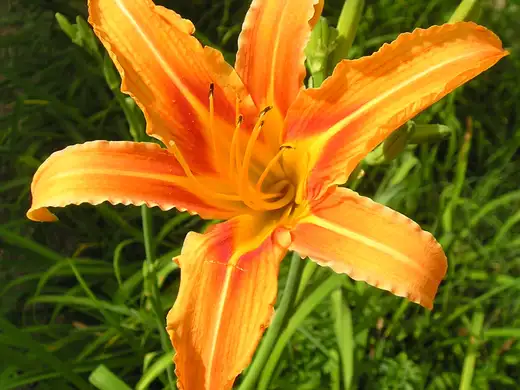
Daylilies, Hemerocallis, are not true lilies. They are tough, clump-forming perennials from Asia and central Europe, and the name means roughly “beautiful for a day.” Each flower lasts a single day, but each stalk carries many buds, so a clump blooms for weeks. Clemson puts the total bloom time of an established clump at 30 to 40 days, and reblooming types flower again later in the season.
They grow in full sun or partial shade. Pale yellows, pinks and pastels need full sun to color well, while dark reds and purples hold their color better with some afternoon shade, which keeps the petals from fading. Heavy shade gives thin, spindly growth and few flowers.
Daylilies grow in almost any soil except a waterlogged one. They do best in a loamy, slightly acid soil with organic matter; Clemson suggests pH 6 to 6.5 and UF/IFAS 6.2 to 6.8. If drainage is poor, plant in a raised bed. Avoid very rich soil, which, Purdue warns, pushes leaves at the expense of flowers.
When and how to plant daylilies
Late summer to early fall is the preferred time in most of the country. Purdue’s window for Indiana is August 15 through September 30. Top growth slows then while the roots grow quickly and next year’s flowers are forming, so the plant goes into winter well anchored. Early spring, while soil temperatures are still moderate, is the second choice. It works, but expect fewer flowers that first summer. In Florida, UF/IFAS says daylilies can be planted in any month, with spring and fall best.
- Loosen the bed about 1 foot deep and mix in organic matter if the soil is sandy.
- Dig a hole about 6 inches wider than the roots, leaving a mound or ridge of soil in the center.
- Spread the roots over the mound so the crown, where roots and leaves meet, sits no more than 1 inch below the surface. Set potted plants at the depth they grew in the pot.
- Firm the soil and water thoroughly.
Space plants 18 to 24 inches apart; dwarf types can go closer. Planting deeper than an inch, Purdue warns, causes browning leaves and weak growth. Planting in groups of three or more of one variety gives a fuller show.
Watering and fertilizing
Established daylilies handle dry spells well, but bloom suffers in a long drought and some cultivars drop their buds. Water new plants deeply at least once a week until they are established. For established clumps, water most during the run-up to bloom and while flowering. In a prolonged dry spell, Purdue soaks the soil 10 inches deep and then waits until it dries before watering again.
Feed lightly. Too much nitrogen gives yellowish, coarse leaves and fewer flowers. Purdue suggests a fertilizer higher in phosphorus and potassium, such as 5-20-20, at 1 to 2 tablespoons per plant in early spring. Clemson feeds in early spring and again in midsummer with a slow-release product.
Grooming and dividing
Snap off spent flowers and any seed pods to keep plants tidy and encourage rebloom. When every bud on a stalk has opened, cut the stalk back close to the ground. Remove damaged or diseased leaves as you see them, and clear dead foliage in fall. A 2- to 3-inch mulch of pine needles, leaves or shredded bark helps hold moisture and suppress weeds.
Divide when a clump gets crowded and flowering declines. Clemson usually divides right after flowering, though daylilies tolerate division through the growing season. Lift the clump with a fork, shake or wash off the soil, and cut or pull it into sections with several fans each. Purdue trims the leaves back to 8 to 10 inches; replant at the original depth.
Common problems
- Daylily rust: yellow streaks and bright yellow spots on leaves, with orange powdery spores underneath. UF/IFAS says it has affected daylilies nationwide since 2000. Grow resistant cultivars and cut off and remove infected leaves.
- Daylily leaf streak: Clemson calls it the most common daylily disease. Remove damaged leaves.
- Thrips: distorted, discolored flowers and fewer buds. UF/IFAS counts them among the most serious daylily pests.
- Aphids and spider mites: sap feeders that curl or yellow the leaves.
- Slugs and snails: chew the foliage.
- Deer: NC State notes daylilies are often browsed.
Evergreen or dormant: choosing for your climate
Daylilies come in three foliage types. Dormant (deciduous) types die back in winter, evergreen types keep their leaves, and semi-evergreen types fall in between. Clemson says evergreens do better in hot climates with very mild winters and dormant types prefer cold areas.
In central and south Florida, UF/IFAS warns that dormant types may not get enough winter chill to grow and bloom well, so choose evergreens. In Indiana, Purdue says dormant types grow well statewide, and many gardeners also succeed with evergreen and semi-evergreen types if they mulch them late in the season for their first few years.
For the South, Clemson lists cultivars that do well there, including ‘Stella de Oro’, ‘Happy Returns’, ‘Hyperion’, ‘Joan Senior’ and ‘Mary Todd’. For the Midwest, Purdue recommends cultivars bred and selected in the region and those that have won American Hemerocallis Society awards.
Daylilies also pair well with spring bulbs, as Purdue suggests: their arching foliage grows up just as the bulb leaves die down and hides them. That is a design idea, not a proven benefit to either plant.
Questions
When is the best time to plant daylilies?
Late summer to early fall in most regions, when roots grow fast and next year's flowers are forming. Purdue gives August 15 through September 30 for Indiana. Early spring also works but may mean fewer flowers the first summer.
Why is my daylily not blooming?
Common causes are deep planting, too much shade, too much nitrogen fertilizer, or an old, crowded clump. A new plant may also need a season or two; Purdue says most reach peak bloom in their third season.
How often should daylilies be divided?
Only when flowering declines. Purdue suggests usually no more often than every 5 to 7 years, and UF/IFAS says plants spaced 18 to 24 inches apart typically go 3 to 5 years.
Are daylilies poisonous to cats?
Yes. NC State warns that daylilies are toxic to cats and can cause kidney failure and death. Keep cats away from the plants and cut flowers.
Are daylily flowers edible?
The buds and flowers are eaten raw or cooked, and dried petals are used in Chinese cooking. NC State notes they can act as a diuretic or laxative, so eat them in moderation.
Sources
- HO-16: Daylilies · Purdue University Cooperative Extension Service
- Daylily (HGIC factsheet) · Clemson Cooperative Extension Home & Garden Information Center
- Hemerocallis (Daylily) - Plant Toolbox · North Carolina State Extension
- EP006 Daylilies for Florida · University of Florida IFAS Extension
- Establishing perennials in the early fall · University of Illinois Extension