How to Grow Centipedegrass
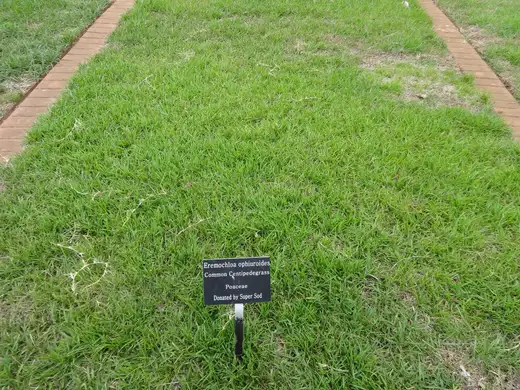
Centipedegrass is the low-maintenance lawn grass of the southern coastal plain: slow-growing, naturally apple-green, and happiest in acidic, infertile soil with very little fertilizer. Sod it, or sow its tiny seed at about ¼-½ lb per 1,000 sq ft, in late spring to early summer, never in fall. Mow at about 1.5-2 inches, and resist feeding it dark green, which leads to thatch and centipedegrass decline.

Your dates for centipedegrass
Set your ZIP code at the top of the page and we will work out when to plant centipedegrass where you live, from the frost records of the nearest NOAA weather station. Your ZIP code is remembered on this device only.
Centipedegrass at a glance
- Botanical name
- Eremochloa ophiuroides
- Light
- full sun to light or moderate shade; fair shade tolerance (needs more sun than St. Augustinegrass, less than bermudagrass), not for heavy shade
- Frost tolerance
- Tender: killed by frost
- Soil temperature to plant
- At least 65°F (best 65–70°F)
- Germination
- 14–28 days
- Planting depth
- 0.25 inches
When to plant centipedegrass
| Zone | Sow outdoors |
|---|---|
| Zone 2a | Jun 23 to Jul 28 |
| Zone 3a | Jul 9 to Aug 13 |
| Zone 3b | Jun 29 to Aug 3 |
| Zone 4a | Jun 19 to Jul 24 |
| Zone 4b | Jun 12 to Jul 17 |
| Zone 5a | Jun 7 to Jul 12 |
| Zone 5b | Jun 6 to Jul 11 |
| Zone 6a | Jun 4 to Jul 9 |
| Zone 6b | May 30 to Jul 4 |
| Zone 7a | May 24 to Jun 28 |
| Zone 7b | May 14 to Jun 18 |
| Zone 8a | May 3 to Jun 7 |
| Zone 8b | Apr 21 to May 26 |
| Zone 9a | Apr 6 to May 11 |
| Zone 9b | Mar 30 to May 4 |
Centipedegrass is a warm-season grass for the South and the transition zone. In colder zones most varieties do not survive the winter, so the dates there apply only to the most cold-tolerant varieties.
Where centipedegrass grows
Centipedegrass reached the United States in 1916 from seed in the luggage of Frank Meyer, a USDA plant explorer who disappeared on his fourth trip to China (Clemson). It was first used on low-maintenance cemeteries, earning the nicknames “lazy man’s grass” and “poor man’s grass.” Clemson says it is well adapted to the coastal plain and lower piedmont of the southern United States.
UF/IFAS calls it the most common home lawn grass in the Florida Panhandle and well suited to central and north Florida. Nematodes have historically limited it on south Florida’s sandy soils. Texas A&M considers it best adapted to East Texas, and NC State says it is grown mostly east of Interstate 95 in North Carolina. Freeze tolerance is poor, so it thins out to the north. In Tennessee, the limited hardiness of common centipedegrass has restricted its use, though the cold-tolerant TifBlair has been planted in various parts of the state (Tennessee Extension).
The soil it wants
Centipedegrass prefers what most lawns dislike: acidic, infertile soil. UF/IFAS gives a pH range of 4.5-6.5 and warns of severe yellowing above 6.5-7.0. If your soil is alkaline, centipedegrass may simply be the wrong grass. Lime is rarely needed. Clemson adds that it needs moderately to well-drained soil; heavy clay or muck will not suit it without serious drainage work. It is also sensitive to high phosphorus. Where a soil test shows medium or higher phosphorus, Clemson uses a slow-release 15-0-15 at planting instead of a high-phosphorus starter fertilizer.
Seed, sod, plugs or sprigs
Centipedegrass can be grown from seed, sod, plugs or sprigs. UF/IFAS says good, weed-free sod gives the best-quality lawn fastest and is less vulnerable to stress. Texas A&M also prefers sod because seeding is so much slower. Plugs and sprigs leave bare soil that weeds quickly claim, since centipede spreads only by slow aboveground runners. Scout the gaps and pull weeds until the grass fills in.
Seed is cheap to use because so little is needed. UF/IFAS sows 4 ounces per 1,000 sq ft and NC State ¼-½ lb, mixed with sand so the tiny seed spreads evenly. UF/IFAS asks for seed with at least 90% purity and 85% germination. Rake the seed in lightly and keep the seedbed moist but not soggy. NC State waters lightly several times a day for 28 days. UF/IFAS suggests a light, weed-free straw mulch covering 50-75% of the soil to limit erosion. Expect patience. UF/IFAS gives up to two to three weeks to germinate plus six to eight weeks to establish, and NC State says a seeded lawn can take up to three years to look uniform.
Among improved varieties, Clemson says only TifBlair is currently sold as seed. For South Carolina it recommends Santee for the lower third of the state and Covington everywhere except the Upstate.
When to plant centipedegrass
Plant in late spring to early summer, once the soil holds about 65-70°F. The dates for your zone above start roughly five to ten weeks after your average last spring frost. NC State replants in May, or once daytime temperatures stay above 60°F. UF/IFAS seeds from April through July, Tennessee from May 1 to June 30, and Clemson targets May 1-14 for warm-season seeding in South Carolina. Do not seed in fall: UF/IFAS warns the seedlings may not establish well enough to survive winter cold.
Watering new sod and plugs
UF/IFAS gives a step-down schedule:
- For the first 7-10 days, water two or three times a day in brief runs of 5-10 minutes.
- For the next 7-10 days, water once a day with ¼ inch.
- For the following week, water every other day with ¼-½ inch.
- After about 30 days, switch to normal watering.
Start mowing once a gentle tug no longer lifts the sod or plugs, usually after two to three weeks.
Mowing
Clemson recommends 1.5-2 inches, UF/IFAS 1.5-2.5 inches, and NC State 1-2 inches, never letting it grow past 2.5 inches. Mow every 7-14 days with a sharp rotary mower and remove no more than one-third of the blade. Leave the clippings; UF/IFAS says they break down and do not cause thatch. UF/IFAS says mowing at the right height deepens roots, which helps the grass resist drought and nematodes. NC State warns never to burn off centipedegrass to clear debris.
Fertilizing: less is more
NC State says centipedegrass has the lowest nitrogen needs of the common lawn grasses. UF/IFAS puts it at about half what other Florida lawn grasses need, in one to three applications from green-up through fall. Don’t feed before April 15 in north Florida or mid-May in North Carolina, and make the last feeding by mid-September in north Florida or early October in central Florida. Clemson’s total for the year is 0-2 lb of nitrogen per 1,000 sq ft. NC State adds a potassium application four to six weeks before the first frost.
Its natural color is a pale, Granny Smith apple green. Pushing it darker with nitrogen reduces cold tolerance, builds thatch from its slow-to-decay stolons, and feeds centipedegrass decline. For yellowing, use iron, not more nitrogen.
Watering an established lawn
Centipedegrass is shallow-rooted. Clemson warns that light, frequent watering keeps roots shallow and weak. Water only when the grass shows stress: folded, blue-gray leaves or lingering footprints. Then soak the soil to about 6 inches, applying ½-¾ inch per UF/IFAS or about 1 inch per Clemson, and let it dry before watering again. Sources differ on drought: UF/IFAS and Clemson rate its drought tolerance good, and it survives dry spells by going dormant and brown. NC State and Texas A&M, on the other hand, say it does not tolerate prolonged drought.
Shade, traffic and winter overseeding
Centipedegrass grows in full sun to moderate shade but not heavy shade (NC State). It forms a loose turf with poor wear tolerance and does not handle heavy traffic or compacted soil. It is sensitive to some herbicides, including 2,4-D, so read labels. Clemson advises against overseeding it with ryegrass for winter color, because the extra water, fertilizer and shading damage it the following spring.
Common problems
- Centipedegrass decline. Patches fail to green up in spring, usually in lawns given heavy nitrogen for several years. Stolons ride up on thatch, never root, and are killed by cold. Feed lightly, mow at the right height, and remove thatch over ½ inch.
- Iron chlorosis. Yellowing is worst in early spring and on soils above about pH 6.5.
- Ring nematodes. They cause serious root damage on sandy soils. The turf wilts even when watered.
- Ground pearls. These root-feeding scale insects have no effective control products (UF/IFAS).
- Other insects. Spittlebugs, mole crickets, sod webworms, white grubs and lawn caterpillars all damage it.
- Diseases. Large patch shows up sporadically (UF/IFAS), and NC State lists fairy ring.
- Thatch. Power-rake in late May if thatch tops ½ inch. NC State uses a 2- or 3-inch blade spacing and warns that 1-inch spacing can badly damage the lawn.
Questions
How much centipedegrass seed per 1,000 square feet?
Very little. UF/IFAS suggests 4 ounces (¼ lb) and NC State ¼-½ lb per 1,000 sq ft. Mix the seed with dry sand so it spreads evenly. UF/IFAS uses 10-20 lb of sand, and NC State about 2 gallons of fine sand.
How long does centipedegrass seed take to grow?
It is slow. UF/IFAS says up to 2-3 weeks to germinate and another 6-8 weeks to establish; NC State expects germination in about 28 days. NC State says a seeded lawn can take up to three years to fill in fully.
Why is my centipedegrass turning yellow?
Usually iron chlorosis, which is worst on soils above about pH 6.5 and in early spring, when warm days push leaf growth faster than cool-night roots can keep up. UF/IFAS suggests 2 ounces of ferrous sulfate in 3-5 gallons of water per 1,000 sq ft or a chelated iron product. Iron is not a substitute for nitrogen.
How short should centipedegrass be mowed?
Clemson recommends 1.5-2 inches, UF/IFAS 1.5-2.5 inches, and NC State 1-2 inches, never letting it pass 2.5 inches. Mow every 7-14 days with a sharp rotary mower and leave the clippings.
When should I fertilize centipedegrass?
Lightly, after it greens up. UF/IFAS makes one to three applications from green-up to fall and none before April 15 in north Florida. NC State waits until mid-May. Clemson suggests 0-2 lb of nitrogen per 1,000 sq ft a year in total.
Can centipedegrass handle shade and foot traffic?
Some shade, but little traffic. UF/IFAS rates its shade tolerance fair, needing more sun than St. Augustinegrass but less than bermudagrass. Clemson and NC State say it does not stand up to heavy foot traffic or compaction.
Sources
- Overseeding With Ryegrass (HGIC 1206) · Clemson Cooperative Extension Home & Garden Information Center
- Centipedegrass for Florida Lawns (ENH8/LH009) · University of Florida IFAS Extension (EDIS)
- Establishing Your Florida Lawn (ENH-03/LH013) · University of Florida IFAS Extension (EDIS)
- Centipedegrass (HGIC 1209) · Clemson Cooperative Extension Home & Garden Information Center
- Lawn Establishment (HGIC 1203) · Clemson Cooperative Extension Home & Garden Information Center
- Centipedegrass Lawn Maintenance Calendar · NC State Extension
- Planting Summer Grass · NC State Extension, Pender County Center
- Turfgrass Selection for Texas (L-5519) · Texas A&M AgriLife Extension
- Bermudagrass · K-State Research and Extension, Ford County
- Chapter 10: Turfgrass Management in Tennessee (Master Gardener Handbook) · University of Tennessee Extension
- Chapter 11: Lawns (Virginia Cooperative Extension Master Gardener Handbook) · Virginia Cooperative Extension / Virginia Tech