How to Grow Broccoli
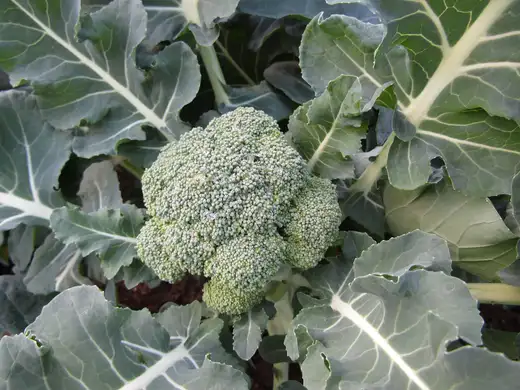
Broccoli needs cool weather while its head forms, so set out young transplants a few weeks before your last spring frost or grow it for fall harvest, which many extension services say gives the better crop. Give it full sun, rich soil, about 1 to 2 inches of water a week and a nitrogen side-dressing a few weeks after planting. Cut the main head while the buds are still tight and green, then keep picking side shoots for weeks.

Your dates for broccoli
Set your ZIP code at the top of the page and we will work out when to plant broccoli where you live, from the frost records of the nearest NOAA weather station. Your ZIP code is remembered on this device only.
Broccoli at a glance
- Botanical name
- Brassica oleracea (Italica Group)
- Light
- full sun (at least 6 hours; 8-10 preferred)
- Frost tolerance
- Hardy: takes a hard frost
- Soil temperature to plant
- At least 40°F (best 60–85°F)
- Days to harvest
- 75–90 days from seed; 50–75 days from transplanting
- Planting depth
- 0.25 inches
- Spacing
- 12–24 inches apart, rows 24–36 inches apart
- Containers
- Yes, at least 5 gallons
When to plant broccoli
| Zone | Start indoors | Plant out | Sow outdoors | Fall planting |
|---|---|---|---|---|
| Zone 2a | Mar 3 to 24 | Apr 21 to May 5 | Apr 28 to May 5 | Jun 20 to Jul 18 |
| Zone 3a | Mar 10 to 31 | Apr 28 to May 12 | May 5 to 12 | Jun 29 to Jul 27 |
| Zone 3b | Mar 1 to 22 | Apr 19 to May 3 | Apr 26 to May 3 | Jul 9 to Aug 6 |
| Zone 4a | Feb 25 to Mar 18 | Apr 15 to 29 | Apr 22 to 29 | Jul 13 to Aug 10 |
| Zone 4b | Feb 20 to Mar 13 | Apr 10 to 24 | Apr 17 to 24 | Jul 16 to Aug 13 |
| Zone 5a | Feb 15 to Mar 8 | Apr 5 to 19 | Apr 12 to 19 | Jul 19 to Aug 16 |
| Zone 5b | Feb 13 to Mar 6 | Apr 3 to 17 | Apr 10 to 17 | Jul 25 to Aug 22 |
| Zone 6a | Feb 11 to Mar 4 | Apr 1 to 15 | Apr 8 to 15 | Aug 1 to 29 |
| Zone 6b | Feb 5 to 26 | Mar 26 to Apr 9 | Apr 2 to 9 | Aug 6 to Sep 3 |
| Zone 7a | Jan 29 to Feb 19 | Mar 19 to Apr 2 | Mar 26 to Apr 2 | Aug 9 to Sep 6 |
| Zone 7b | Jan 18 to Feb 8 | Mar 8 to 22 | Mar 15 to 22 | Aug 16 to Sep 13 |
| Zone 8a | Jan 11 to Feb 1 | Mar 1 to 15 | Mar 8 to 15 | Aug 22 to Sep 19 |
| Zone 8b | Dec 30 to Jan 20 | Feb 17 to Mar 3 | Feb 24 to Mar 3 | Aug 28 to Sep 25 |
| Zone 9a | Dec 15 to Jan 5 | Feb 2 to 16 | Feb 9 to 16 | Sep 10 to Oct 8 |
| Zone 9b | Nov 15 to Dec 6 | Jan 3 to 17 | Jan 10 to 17 | Sep 23 to Oct 21 |
Spring dates before the last frost assume the soil has thawed and is dry enough to work. After a late or wet spring, wait for that even if the date has passed.
When to plant broccoliWhen to harvest broccoli
What broccoli needs to head well
A broccoli head is a tight cluster of flower buds, cut before any of them open. The plant first has to grow a large frame of leaves, then switch to making buds, and the buds have to form in mild weather. Heat makes the head loose and bitter, a long cold snap can push a small plant into heading too early, and any shortage of water or nitrogen means smaller heads.
Utah State University Extension says broccoli grows best and yields most when temperatures stay below 75°F. Clemson Extension puts its preferred average at 65 to 75°F, and Iowa State gives 60 to 70°F for cole crops in general. At the warm end, Iowa State reports that days of 86°F or more combined with nights of 77°F or more can stop plants from forming a head at all. At the cold end, the plant itself is tough: Utah State says it is not seriously damaged down to 28°F.
Spring or fall?
Both work, but fall is usually easier. In spring, plants start in cold soil and race toward summer heat, so a hot spell at heading time can ruin the crop. In fall, plants grow through late summer and form heads as the weather cools. University of Maryland Extension says fall broccoli often outyields spring plantings in the mid-Atlantic, and Clemson calls fall the best season for broccoli in South Carolina, where spring temperature swings often produce uneven, loose heads.
In the upper Midwest, Iowa State and Wisconsin schedule both a spring and a fall crop. In zones 9 to 11 broccoli is a fall-through-winter crop, covered below.
Planting in spring
Most gardeners set out transplants, which buy several weeks in a short season. The planting window is in the dates for your zone above. Extension services differ on exactly how early to go: Utah State sets transplants out 2 to 3 weeks before the average last frost, while Maryland recommends about 4 weeks before. Seed can go straight into the garden at about the same time; Utah State and Wisconsin both suggest roughly 2 to 3 weeks before the last frost.
If you grow your own transplants, the starting date depends on how long they take to reach planting size. Utah State sows 6 to 7 weeks ahead, Clemson allows 6 to 8 weeks in spring, Maryland uses 5- to 7-week-old plants and Iowa State sows only 4 to 5 weeks before setting out. Whichever schedule you use, the target is the same: a stocky plant with 4 to 6 true leaves and a healthy root ball, hardened off outdoors for several days before planting.
Do not hold transplants back. Utah State and Iowa State warn that older, larger or rootbound transplants are the ones most likely to form small early heads, and Penn State notes that older transplants yield less than young ones.
Watch the cold as well as the frost. Clemson notes that 10 or more days in a row between 35 and 50°F, after plants have been growing well, can make cole crops bolt, and larger plants are more susceptible. Maryland warns that temperatures below 45°F may inhibit heading. Young, hardened transplants and a row cover on cold nights are better insurance than planting very early with big plants.
Planting for fall
For a fall crop, count backward. Utah State recommends early-maturing varieties planted 50 to 75 days before the date you want to harvest, and points out that the harvest can run several weeks past the first fall frost because broccoli tolerates light freezes. Wisconsin suggests direct-seeding fall crops 10 to 12 weeks before the first killing frost. In Maryland, the guidance is to direct-seed in mid-July or set transplants out by the first week of August. In central Iowa, transplants go out between late June and early August.
Fall transplants take less time to raise: Clemson allows 5 to 6 weeks, and Maryland 4 to 6. The hard part is getting young plants through late-summer heat: keep them moist and add organic mulch, which Utah State recommends once temperatures pass 80°F because it cools the soil. Maryland also notes that fall broccoli takes longer to mature than spring broccoli, so do not cut the schedule too fine.
Site, soil and spacing
Choose full sun. Iowa State asks for at least 6 hours of direct sun, and Maryland says 8 to 10 hours is better. Broccoli wants fertile, well-drained soil with plenty of organic matter.
Soil pH matters more than many gardeners expect. Clemson recommends 5.8 to 6.5, Iowa State 6 to 7, and Penn State and Wisconsin 6.0 to 6.8. Wisconsin explains the reasons: acid soils encourage clubroot, a serious root disease of cole crops, and they lock up molybdenum, which broccoli needs in larger amounts than most vegetables. Clemson suggests testing several months before planting so there is time to adjust the pH as the report recommends.
Utah State notes that a tight 1-foot grid works but gives smaller heads and fewer side shoots, so use the wider spacings if you want a long side-shoot harvest.
Rotate. Iowa State suggests growing cole crops (broccoli, cabbage, cauliflower, Brussels sprouts, kale, collards and kohlrabi) in the same spot only once every 3 or 4 years, and Penn State says never to follow another brassica in the next year. Wisconsin explains that moving cole crops each year keeps soil-borne diseases from building up.
Feeding: the step that decides head size
Broccoli is a heavy feeder, and nitrogen is what builds the leaf frame that supports a large head. Have the soil tested if you can. Without a test, Clemson suggests working 2.5 pounds of 10-10-10 into each 100 square feet before planting, and Iowa State 1 to 2 pounds of an all-purpose fertilizer per 100 square feet.
Then side-dress. Clemson applies calcium nitrate at 2 pounds per 100 feet of row 3 to 4 weeks after transplanting, or when direct-seeded plants are 6 inches tall, and adds more often on sandy soil or after heavy rain. Utah State uses ½ cup of 21-0-0 per 10 feet of row about 4 weeks after planting, another ¼ cup when the head is the size of a quarter, and a little more after the main head is cut to push the side shoots. Place it about 6 inches from the stems and water it in.
More is not better. Clemson lists excess nitrogen, along with warm temperatures, too much water and low pH, as a cause of hollow stems. Wisconsin notes that broccoli also needs a good supply of boron; a shortage shows up as brown hearts or hollow stems. If a soil test reports low boron, use a complete fertilizer that includes it.
In cool, wet weather, Clemson says yellowing between the veins of older leaves points to magnesium deficiency, corrected with a spray of 2 tablespoons of Epsom salts per gallon of water.
Water and mulch
Broccoli has a shallow, fibrous root system, so it dries out quickly and does not forgive skipped watering. Utah State recommends 1 to 2 inches a week, applied deeply and infrequently; Iowa State says to water when rain does not supply at least 1 inch a week. Clemson advises wetting the soil at least 6 inches deep and watering in the morning so the leaves dry before night, which matters for disease in the humid Southeast.
Two stages are critical: the first weeks after planting and the period when heads are forming. Maryland recommends watering more often once heads appear. Drip lines keep foliage dry, and Iowa State’s 2- to 3-inch layer of straw or shredded leaves holds moisture and smothers weeds. Because the roots are shallow, pull weeds by hand or hoe very lightly.
Regional differences
Cold North (Upper Midwest, northern New England, high mountain valleys). Both spring and fall crops are standard here. Wisconsin starts transplants in mid-March and sets them out about May 1 in the south of the state and two weeks later in the north. Once hardened off, Wisconsin says, the transplants will take 28°F. Floating row covers are worth using: Wisconsin notes they give roughly 4 to 8 degrees of frost protection depending on fabric weight and also keep egg-laying moths and flea beetles off young plants.
Humid South and Southeast. Fall is the main season. Clemson’s South Carolina transplanting windows run from mid-August through September for fall, and spring plantings must go in early enough to finish before heat arrives. Black rot is the most severe broccoli disease in South Carolina, and Alternaria leaf and head blight becomes serious in warm weather. Water in the morning, avoid wetting leaves, rotate faithfully, and choose varieties with domed heads: Wisconsin notes that rounded heads shed water and are less prone to bacterial soft rot.
Florida, the Gulf Coast and south Texas (zones 9 to 11). Broccoli is a fall and winter crop. UF/IFAS lists it as very cold hardy and gives planting windows that run from fall into late winter in north and central Florida and a shorter window in south Florida. UF also warns that late-summer plantings face heat-loving insects and diseases. In the Lower Rio Grande Valley, Texas A&M AgriLife sows seed in flats from early September to early December, transplants after 3 to 4 weeks when seedlings are 3 to 4 inches tall, and finds plants perform best when set out from mid-October onward.
Arid West and low desert. In the Phoenix area, the University of Arizona treats broccoli as a cool-season crop planted from late summer through winter, and its calendar allows 90 to 100 days from transplants and 120 to 130 days from seed. In Utah and similar high-desert areas, Utah State’s advice applies: mulch once days pass 80°F, water deeply rather than often, and use drip irrigation to save water. Utah State also notes that boron deficiency is more likely on high-pH soils and in water-stressed plants, both common in the West.
Pacific Northwest west of the Cascades. Mild maritime winters allow a different crop: overwintering sprouting broccoli. Oregon State’s PNW 548 lists transplanting from mid-July to early August for harvest from February to April, with hardiness to about 15 to 20°F. These plants need a large leafy frame before winter, then form shoots after a period of cold. Sudden cold snaps without snow cover do more damage than steady cold with snow.
Varieties recommended by region
Extension services name different varieties for their own conditions:
- Utah: Utah State recommends Packman, Green Comet and Premium Crop.
- South Carolina: Clemson lists Packman (early), Emerald Crown (mid-season), and Lieutenant, Belstar and Green Magic (full-season); it singles out Green Magic as slow to bolt.
- Iowa: Iowa State suggests Arcadia for fall, Green Magic, Gypsy and Imperial for heat tolerance, plus Goliath, Marathon and Packman.
- Wisconsin: Arcadia, Emperor, Green Belt, Green Comet, Green Valiant, Packman and Saga; Green Comet is noted for a good second cutting.
- Florida: UF/IFAS lists Early Green, Early Dividend, Green Sprouting (Calabrese), Waltham, Packman and De Cicco.
- Lower Rio Grande Valley, Texas: Packman, Belstar, Green Magic, Waltham, Premium Crop, Express, Blue Wind, Arcadia and Marathon.
- Western Oregon and Washington (overwintering sprouting types): Bonarda, Burgundy, Mendocino, Red Fire and Rudolph.
Broccoli raab, often sold beside broccoli, is a different plant: Maryland and UF both note that it is a turnip relative, not a true broccoli.
Pests
Caterpillars are the main threat. Imported cabbageworms (the larvae of the small white butterflies seen over gardens), cabbage loopers and diamondback moth larvae chew leaves and hide inside heads. Clemson stresses controlling them before heads start to form. Iowa State recommends Bacillus thuringiensis (Bt) as soon as caterpillars appear; Wisconsin notes it spares the caterpillars’ natural enemies, though some diamondback moth populations now resist it. Penn State suggests floating row covers and hand-picking. Wisconsin adds that a cover only works as an insect barrier if all its edges are sealed to the ground.
Flea beetles chew small round holes in leaves. Iowa State says light damage barely affects yield, but Utah State warns they can kill seedlings, so cover seedbeds and new transplants. Aphids cluster on the undersides of leaves; Utah State recommends insecticidal soap or a strong spray of water. In the North, Wisconsin flags cabbage maggots, which feed on roots and stunt plants; row covers keep the flies from laying eggs at the base of the stems.
Common problems and how to fix them
- Tiny heads soon after planting (buttoning). Caused by overgrown or rootbound transplants, long spells below 50°F, drought or poor soil. Fix: plant younger transplants, keep them watered and fed, and protect early plantings from cold.
- Plants bolt into flower stalks in spring. Usually a cold spell of 10 days or more after good growth, worse with larger plants (Clemson). Fix: plant on time, not early, with young transplants, and choose slow-bolting varieties such as Green Magic in the South.
- No head, or a loose, bitter head. Heat during heading. Fix: plant earlier in spring or shift to fall; keep the soil moist through heading.
- Hollow stem. If the hollow is clean, Clemson ties it to excess nitrogen, warm weather, overwatering and low pH; if it is brown and decayed, boron is the likely shortage. Fix: balanced feeding, correct pH and a complete fertilizer with boron.
- Tip burn and internal browning. Clemson ties these to pH, uneven watering and the balance of nitrogen and calcium.
- Rotting heads and leaf diseases. Clemson lists black rot, Alternaria, downy mildew, bacterial head rot and soft rot, and notes that black rot shows up after long moist spells where rotation is skipped. Fix: water at the base in the morning, rotate, and grow domed-head varieties that shed water.
Harvesting
Cut the main head when it is full and firm and the buds are still tightly closed, before any yellow shows. Mature size varies a great deal by variety and season: Clemson and Penn State give 3 to 6 inches, Maryland 3 to 8, and Iowa State about 6 to 7. Cut the stem a few inches below the head; Clemson and Utah State take about 6 inches of stalk.
Leave the plant in place: most varieties then form side shoots, about 1 to 3 inches across according to Iowa State, for several weeks.
Refrigerate it in a perforated bag; Iowa State and Maryland give 10 to 14 days, Clemson up to a week. Blanch and freeze any surplus.
Growing broccoli in containers
N.C. Cooperative Extension suggests one plant per 5-gallon pot, while Texas A&M AgriLife’s container guide gives 2 gallons per plant as a minimum and names Packman and Bonanza for pots. The larger pot dries out more slowly, which matters because drought stress can cause buttoning and loose, open heads.
Questions
Why is my broccoli making tiny heads?
That is buttoning: the plant switches to heading before it has enough leaves to feed a full-size head. Iowa State and Utah State link it to transplants that were too large or rootbound, long spells below 50°F, drought and poor fertility. Set out young transplants with 4 to 6 leaves and keep them watered and fed.
How long does broccoli take to grow?
Most varieties are ready 50 to 75 days after transplanting, depending on the variety, and 75 to 90 days from seed according to UF/IFAS. Fall and winter crops take longer; the University of Arizona allows 90 to 100 days from transplants in the Phoenix area's winter season.
Does broccoli grow back after you cut it?
The main head does not regrow, but most varieties push out smaller side shoots from the leaf joints after it is cut. Iowa State puts them at about 1 to 3 inches across. Utah State recommends a little extra nitrogen and water after the first cut to keep them coming.
Can broccoli survive frost?
Yes. Utah State says broccoli is not seriously hurt by temperatures down to 28°F, and University of Wisconsin Extension gives the same figure for hardened-off cole crop transplants. Fall plantings often keep producing after the first light frosts.
Why did my broccoli flower before I could pick it?
Heat and stress are the usual causes. Iowa State reports that days of 86°F or more with nights of 77°F or more can stop heads from forming, and Utah State notes that heads open and flower quickly when plants run short of water in hot weather. Plant earlier in spring, switch to a fall crop, and cut heads as soon as they are full and firm.
How many broccoli plants should I grow?
Utah State suggests 3 to 5 plants per person for fresh eating, plus 5 to 10 more if you want to freeze broccoli. Iowa State estimates 8 to 12 pounds from a well-managed 10-foot row.
Sources
- Growing Broccoli, Cauliflower, Cabbage, and Other Cole Crops in Wisconsin (A3684) · University of Wisconsin-Extension
- Winter Vegetable Production on Small Farms and Gardens West of the Cascades (PNW 548) · Oregon State University Extension Service
- Cole Crops for the Home Vegetable Garden · Penn State Extension
- Broccoli in the Garden (How to Grow Broccoli in Your Garden) · Utah State University Extension
- Broccoli (HGIC 1301) · Clemson Cooperative Extension Home & Garden Information Center
- Growing Broccoli in a Home Garden · University of Maryland Extension
- Growing Broccoli in the Home Garden · Iowa State University Extension and Outreach
- Florida Vegetable Gardening Guide (SP 103/VH021) · University of Florida IFAS Extension
- Vegetable Planting Calendar for Maricopa County (AZ1005) · University of Arizona Cooperative Extension
- RGV Homeowner Vegetable Guide (rev. 2022) · Texas A&M AgriLife Extension Service
- Soil Temperature Conditions for Vegetable Seed Germination (Garden Notes GN 154) · University of California Cooperative Extension, Sacramento County
- Easy Container Vegetables and How to Grow Them · N.C. Cooperative Extension, Onslow County Center
- Vegetable Gardening in Containers (E-545) · Texas A&M AgriLife Extension Service