How to Care for a ZZ Plant
Water a ZZ plant only after its potting mix has dried out completely, which is about once or twice a month in summer and roughly once a month in winter. It tolerates very low light but grows faster in bright, indirect light, and it wants a coarse, fast-draining mix and warmth above 60°F. Overwatering, not neglect, is what kills it.
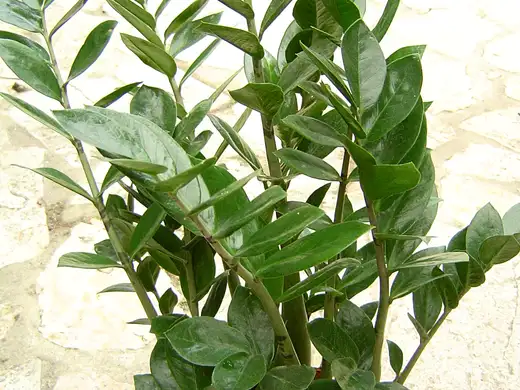

ZZ Plants at a glance
- Botanical name
- Zamioculcas zamiifolia
- Light
- bright indirect light for faster growth; tolerates very low light; no direct sun
- Hardiness zones
- 10b-12
- Containers
- Yes
Light
ZZ plant earned its reputation in offices: it copes with very low light, including spaces lit only by fluorescent fixtures, NC State says. But tolerating dim light is not the same as thriving in it. Every source agrees it grows best in bright, indirect light, and Clemson notes growth speeds up there. UF/IFAS adds that it will not bloom in low light.
Keep it out of direct sun. Sunlight falling on the leaves scalds and browns the leaflets. A spot near an east window or a few feet back from a brighter window is ideal.
Watering
Treat a ZZ plant like a succulent. Its thick, potato-like rhizomes and swollen leaf stalks store water, which is how it survives dry seasons in its native eastern Africa. Water sitting around those rhizomes is what rots them.
The rule is simple: water only after the potting mix has dried out completely.
- Clemson and NC State put that at about once or twice a month in the growing season and roughly once a month in winter, when the plant stops actively growing.
- UF/IFAS suggests moderate watering every week or two. That works in a warm, bright spot with a fast-draining mix, but in a dim room the soil may still be damp after two weeks.
Because the frequency depends so heavily on light, temperature and pot size, check the mix rather than the calendar. Push a finger or a wooden skewer deep into the pot; if any moisture remains, wait. When you water, soak the mix until water runs from the drainage holes, let it drain completely, and only then return the pot to its cachepot or saucer. Never leave it standing in water.
If you forget it for a long time, it will tell you. In severe drought a ZZ drops its leaflets and the upper part of each leaf stalk, surviving on the swollen base until water returns, according to UF/IFAS.
Potting mix and pot
Use a coarse, well-draining mix. Clemson suggests about 50 percent peat- or coir-based potting soil, 25 percent perlite and 25 percent sand. UF/IFAS says any well-drained peat- or bark-based potting soil works. Either way, the pot needs drainage holes.
No source gives a repotting schedule, and ZZ is very slow-growing, so repotting is occasional. When the thick rhizomes crowd the pot, move it to a slightly larger container with the same gritty mix, or divide it.
Temperature and humidity
UF/IFAS gives a preferred range of 65 to 90°F, and Clemson says to keep it above 60°F because it is sensitive to cold. Below 50°F, growth slows and leaves can be injured or discolored. Keep it away from cold windows and doors in winter.
Humidity is not a concern. ZZ is adapted to dry conditions, and Clemson says ordinary indoor humidity suits it.
Feeding
ZZ grows slowly even under ideal conditions, so it needs little fertilizer. NC State recommends a balanced liquid houseplant fertilizer once or twice a year, and UF/IFAS a low-dose liquid fertilizer twice a year, both during the warm growing season. Skip winter feeding.
Propagation
ZZ plants are propagated by division or by leaf cuttings, according to NC State, and UF/IFAS calls them easy to propagate from leaf cuttings, which makes them a popular pass-along plant.
- Division. When repotting, separate the clump into sections, each with its own rhizome and leaves, and pot each in fresh gritty mix.
- Leaf cuttings. Root leaves or leaflets in the same coarse, well-drained mix, kept warm and out of direct sun. Be patient: this is a very slow-growing plant.
Pests and problems
ZZ has few problems. UF/IFAS and Clemson report no serious pests or diseases, and NC State suggests only watching for scale.
- Root rot. Caused by overwatering or a poorly drained mix. Let the mix dry out fully between waterings and repot into a gritty mix if the soil stays wet.
- Scorched or brown leaflets. Direct sun. Move it to indirect light.
- Leaflets falling off with dry soil. Severe drought. Water thoroughly; the swollen stalk bases keep the plant alive.
- Black spots on the stems. Normal for the plant, Clemson says, not a disease.
- Small bumps on stems and leaves. Scale insects. Treat early, before they spread.
- No flowers. Expected indoors. UF/IFAS says it does not bloom in low light; mature plants with enough light may flower in spring and early summer, with a green spathe just above the soil.
Toxicity
ZZ plant contains calcium oxalate. NC State rates it medium toxicity for cats and dogs, causing vomiting and diarrhea if leaves are eaten in quantity. Clemson labels it not pet safe, and UF/IFAS says all parts are toxic if ingested. Keep it out of reach of pets and young children.
Summering outdoors and warm-winter gardens
NC State says a potted ZZ can spend the warm months outdoors in some areas, as long as it comes back inside once temperatures fall below 60°F. Give it filtered light or shade outdoors, never direct sun, and keep checking that the mix dries between waterings.
In frost-free areas it can grow in the ground. UF/IFAS rates it suitable for year-round outdoor planting in zones 10b-12, such as South Florida, in strong filtered light and well-drained soil, where it acts as a perennial. NC State’s map lists zones 9a-10b. It has no freeze tolerance, so even in zone 9 or 10 a cold snap can damage it.
Questions
How often should I water a ZZ plant?
Only after the mix is completely dry. Clemson and NC State put that at once or twice a month in the growing season and about once a month in winter. UF/IFAS suggests moderate watering every week or two, so check the soil rather than following any fixed schedule.
Can a ZZ plant live in a room with no windows?
It tolerates very low light, and NC State says it will grow even where the only light is fluorescent. It grows slowly there and will not flower; bright, indirect light speeds growth.
What usually kills a ZZ plant?
Too much water. Overwatering and poorly drained soil cause root rot, the one serious problem every source warns about. Let the mix dry out fully between waterings and make sure the pot drains.
Is ZZ plant toxic to cats and dogs?
Yes. NC State rates it medium toxicity for cats and dogs, with vomiting and diarrhea if leaves are eaten in quantity, Clemson labels it not pet safe, and UF/IFAS says all parts are toxic if ingested.
Are the black spots on my ZZ plant's stems a disease?
No. Clemson notes that black spots on the stems are normal for this plant.
Sources
- Zamioculcas zamiifolia (ZZ Plant) · North Carolina State University Extension (Extension Gardener Plant Toolbox)
- ZZ Plant (Zamioculcas zamiifolia): Indoor Care, Growing Tips & Plant Guide, HGIC 1570 · Clemson Cooperative Extension Home & Garden Information Center
- ZZ Plant · University of Florida IFAS Extension (Gardening Solutions)
- ENH1219/EP480: Florida Foliage House Plant Care: ZZ Plant · University of Florida IFAS Extension (EDIS)