How to Grow Zucchini
Sow zucchini seeds 1 inch deep in warm soil (60°F or more) a week or two after your last frost, two plants to a hill, with 3 to 4 feet between hills. Plants flower in 35 to 45 days and the first fruit is ready in about 40 to 60 days. Pick zucchini at 6 to 8 inches long, every day or two, and the plants keep producing until pests or frost stop them.

Your dates for zucchini
Set your ZIP code at the top of the page and we will work out when to plant zucchini where you live, from the frost records of the nearest NOAA weather station. Your ZIP code is remembered on this device only.
Zucchini at a glance
- Botanical name
- Cucurbita pepo
- Light
- full sun
- Frost tolerance
- Tender: killed by frost
- Soil temperature to plant
- At least 60°F (best 65–90°F)
- Germination
- 5–7 days
- Days to harvest
- 40–65 days from seed
- Planting depth
- 1 inch
- Spacing
- 24–36 inches apart, rows 36–72 inches apart
- Containers
- Yes, at least 5 gallons
When to plant zucchini
| Zone | Start indoors | Plant out | Sow outdoors | Fall planting |
|---|---|---|---|---|
| Zone 2a | May 20 to Jun 3 | Jun 17 to Jul 1 | Jun 17 to Jul 1 | — |
| Zone 3a | May 14 to 28 | Jun 11 to 25 | Jun 11 to 25 | — |
| Zone 3b | May 11 to 25 | Jun 8 to 22 | Jun 8 to 22 | — |
| Zone 4a | May 5 to 19 | Jun 2 to 16 | Jun 2 to 16 | — |
| Zone 4b | Apr 30 to May 14 | May 28 to Jun 11 | May 28 to Jun 11 | — |
| Zone 5a | Apr 25 to May 9 | May 23 to Jun 6 | May 23 to Jun 6 | — |
| Zone 5b | Apr 25 to May 9 | May 23 to Jun 6 | May 23 to Jun 6 | — |
| Zone 6a | Apr 21 to May 5 | May 19 to Jun 2 | May 19 to Jun 2 | — |
| Zone 6b | Apr 14 to 28 | May 12 to 26 | May 12 to 26 | — |
| Zone 7a | Apr 7 to 21 | May 5 to 19 | May 5 to 19 | — |
| Zone 7b | Mar 29 to Apr 12 | Apr 26 to May 10 | Apr 26 to May 10 | Aug 9 to 23 |
| Zone 8a | Mar 15 to 29 | Apr 12 to 26 | Apr 12 to 26 | Aug 15 to 29 |
| Zone 8b | Mar 3 to 17 | Mar 31 to Apr 14 | Mar 31 to Apr 14 | Aug 21 to Sep 4 |
| Zone 9a | Feb 14 to 28 | Mar 14 to 28 | Mar 14 to 28 | Sep 3 to 17 |
| Zone 9b | Feb 8 to 22 | Mar 8 to 22 | Mar 8 to 22 | Sep 16 to 30 |
Planting
Zucchini is a summer squash, a bushy form of Cucurbita pepo that is eaten young. It needs full sun, fertile, well-drained soil and warmth. Clemson notes that squash seed germinates poorly in cold soil and waits for 60°F at 4 inches deep; Utah State plants at 65°F. That usually means 1 to 3 weeks after the last frost, as the dates for your zone above show.
Sow seeds 1 inch deep in hills. Iowa State plants 4 to 5 seeds per hill and thins to 2 or 3 strong plants once they have one or two true leaves; Utah State thins to two. Space hills and rows 3 to 4 feet apart (Iowa State). In rows, Clemson thins seedlings to 12 to 15 inches apart with rows 3 feet apart.
Transplants give an earlier harvest in short-season areas. Start them 3 to 4 weeks ahead in peat pots or other plantable containers, since squash roots do not tolerate disturbance, and harden them off before planting. With black plastic mulch and row covers, Utah State plants 2 to 3 weeks before the last frost date.
Fertilizer and water
Without a soil test, Iowa State works 1 to 2 pounds of 10-10-10 into each 100 square feet before planting; Clemson uses 3 pounds of 5-10-10 over the same area. When the plants start to run, side-dress with nitrogen: Utah State uses 3 to 4 tablespoons of 21-0-0 per plant, watered in, and Clemson 1 pound of 34-0-0 per 100 feet of row.
Water deeply, 1 to 2 inches a week, preferably by drip so the leaves stay dry. Clemson says moisture matters most during fruit set and development and should reach 6 inches deep. Uneven watering and too much nitrogen both interfere with calcium uptake and lead to blossom-end rot, where the flower end of the fruit rots. Iowa State says the cure is steady moisture, not added calcium. Hold off on organic mulch until the soil reaches about 75°F.
Flowers and pollination
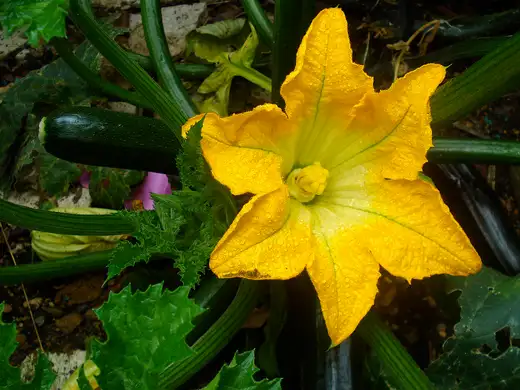
Squash plants carry separate male and female flowers. The first flowers are male and drop without fruit, which is normal. Female flowers have a small zucchini at the base and appear soon after. Bees must move pollen from male to female flowers; if they don’t, the young fruit starts to grow, then yellows and shrivels. Iowa State notes that bees and other pollinators are less active in cold, rainy or windy weather. Avoid daytime insecticide sprays that kill pollinators.
Varieties
Extension services recommend these zucchini varieties for their regions:
- Southeast (Clemson): ‘Black Beauty’, ‘Eight Ball’, ‘Elite’, ‘Embassy’, ‘Senator’ and ‘Spineless Beauty’. ‘Black Beauty’ dates from the 1920s.
- Midwest (Iowa State): ‘Elite’, ‘Jaguar’, ‘Spineless Beauty’ and the golden zucchini ‘Goldfinger’.
- Florida (UF/IFAS): ‘Cocozelle’, ‘Spineless Beauty’ and ‘Black Beauty’.
Utah State says most zucchini varieties perform well throughout Utah.
Regional notes
Cold North. Zucchini’s short season makes it one of the most dependable warm-season crops in the North. Colorado State notes that summer squash, like cucumbers, does well above 5,000 feet because it matures quickly.
Humid South. The season is long enough for two crops. Clemson plants from mid-March or mid-April into July and again in late summer: July 15 to August 15 in the Piedmont and through August on the coast. Powdery mildew and aphid-spread viruses are the main diseases Clemson lists.
Desert Southwest. In the Phoenix area, the University of Arizona sows summer squash from mid-February to early April and again from mid-August to early September, avoiding the hottest weeks.
Warm-winter zones 9 to 11. UF/IFAS grows summer squash through the cool season in South Florida, from August to March, and in spring and late summer farther north.
Pests and diseases
Squash vine borer causes the sudden midsummer collapse that ends many zucchini plantings. The larvae of a day-flying, wasp-like orange and black moth bore into the stem near the soil, and the plant collapses. UConn notes that C. pepo, including zucchini, is highly susceptible because of its thin, hollow stems. Defenses:
- Cover plants with row covers by early June and remove them when flowers open, but do not use covers where squash grew last year, since adults emerge from the soil beneath (Iowa State).
- Wrap foil or nylon around the base of young stems before moths appear (UConn).
- Plant a second crop in late June or early July, after egg-laying ends. Iowa State says this works for fast-maturing zucchini, and it also replaces tired spring plants.
- If borers get in, slit the stem, remove the larvae, and bury the cut section so it can root (UConn). Insecticides only work before larvae enter the stem.
Squash bugs suck sap until leaves wilt. Crush the bronze to brick-red egg clusters under the leaves, hand-pick adults, and trap them under boards laid near the plants, checking each morning.
Powdery mildew coats leaves with white powder from midsummer. Give plants full sun and good spacing, avoid overhead watering, and grow resistant varieties where available.
Cucumber beetles and aphids spread bacterial wilt and viruses. Row covers on young plants help with both.
Remove and destroy vines after harvest to cut down overwintering squash bugs and borers.
Harvest
Zucchini grows fast, and the fruit is usually ready 3 to 5 days after the flower opens. Pick at 6 to 8 inches long and about 2 inches thick (Clemson suggests 7 to 8 inches), while the skin is glossy and soft enough to dent with a fingernail and the seeds are small. Iowa State allows long types up to 12 inches, but quality drops as the skin toughens and seeds form. Check plants every day or two, and pick oversized fruit too so the plant keeps setting new ones.
Handle the fruit gently, as it bruises easily. Store zucchini in a plastic bag in the refrigerator crisper, where Iowa State says it keeps 5 to 7 days. Extra fruit can be frozen or pickled.
Questions
Why do my small zucchini turn yellow and rot?
Those fruits were not pollinated. Bees must carry pollen from male to female flowers, and they are less active in cold, rainy or windy weather. Output improves when the weather settles and pollinators return.
How many zucchini plants do I need?
Utah State suggests 1 to 3 hills of squash per person for fresh eating.
Why did my zucchini plant suddenly wilt?
Sudden wilting of a vigorous plant in early to midsummer is the classic sign of squash vine borer. Look at the base of the stem for an entry hole and yellow, sawdust-like frass.
Can you grow zucchini in a container?
Yes. Texas A&M recommends one squash plant per 5-gallon container, and compact bush varieties suit pots best. Keep the soil evenly moist, since containers dry out fast.
Are zucchini flowers edible?
Yes. Iowa State recommends picking male flowers, the ones on thin stems with no tiny fruit at the base, on the day they open, and leaving a few for pollination.
Sources
- Reasons for Poor Fruiting of Vine Crops · Iowa State University Extension and Outreach
- How do I prevent damage to my squash plants from the squash vine borer? · Iowa State University Extension and Outreach
- Squash Vine Borer (Melittia cucurbitae) in Home Gardens · University of Connecticut Extension
- Summer Squash (HGIC factsheet) · Clemson Cooperative Extension Home & Garden Information Center
- How to Grow Summer and Winter Squash in Your Garden · Utah State University Extension
- Growing Squash in Iowa · Iowa State University Extension and Outreach
- Summer Squash (Mid-Atlantic Commercial Vegetable Production Recommendations, section F) · University of Maryland Extension
- Vegetable Planting Guide (CMG GardenNotes #720) · Colorado State University Extension
- Cucumbers, Pumpkins, Squash, and Melons (Fact Sheet 7.609) · Colorado State University Extension
- Fall Vegetable Gardening (G1343) · University of Nebraska-Lincoln Extension
- Vegetable Gardening in Containers · Texas A&M AgriLife Extension
- Florida Vegetable Gardening Guide (VH021), Table 1 · University of Florida IFAS Extension (EDIS)
- Vegetable Planting Calendar for Maricopa County (AZ1005) · University of Arizona Cooperative Extension