How to Grow Winter Squash
Plant winter squash about two weeks after your last frost, once the soil is 60°F or warmer, in hills 4 to 5 feet apart with 5 to 7 feet between rows. It needs 85 to 120 days, so it is a single long-season crop: harvest when the rind is hard and dull and the vines start to die back, always before a hard freeze. Cure most types for about 10 days at 80 to 85°F, and they will keep for 2 to 6 months.

Your dates for winter squash
Set your ZIP code at the top of the page and we will work out when to plant winter squash where you live, from the frost records of the nearest NOAA weather station. Your ZIP code is remembered on this device only.
Winter Squash at a glance
- Botanical name
- Cucurbita maxima, C. moschata, C. pepo
- Light
- full sun
- Frost tolerance
- Tender: killed by frost
- Soil temperature to plant
- At least 60°F (best 65–90°F)
- Germination
- 6–10 days
- Days to harvest
- 85–120 days from seed
- Planting depth
- 1 inch
- Spacing
- 36–60 inches apart, rows 60–96 inches apart
When to plant winter squash
| Zone | Start indoors | Plant out | Sow outdoors |
|---|---|---|---|
| Zone 2a | May 20 to Jun 3 | Jun 17 to Jul 1 | Jun 17 to Jul 1 |
| Zone 3a | May 14 to 28 | Jun 11 to 25 | Jun 11 to 25 |
| Zone 3b | May 11 to 25 | Jun 8 to 22 | Jun 8 to 22 |
| Zone 4a | May 5 to 19 | Jun 2 to 16 | Jun 2 to 16 |
| Zone 4b | Apr 30 to May 14 | May 28 to Jun 11 | May 28 to Jun 11 |
| Zone 5a | Apr 25 to May 9 | May 23 to Jun 6 | May 23 to Jun 6 |
| Zone 5b | Apr 25 to May 9 | May 23 to Jun 6 | May 23 to Jun 6 |
| Zone 6a | Apr 21 to May 5 | May 19 to Jun 2 | May 19 to Jun 2 |
| Zone 6b | Apr 14 to 28 | May 12 to 26 | May 12 to 26 |
| Zone 7a | Apr 7 to 21 | May 5 to 19 | May 5 to 19 |
| Zone 7b | Mar 29 to Apr 12 | Apr 26 to May 10 | Apr 26 to May 10 |
| Zone 8a | Mar 15 to 29 | Apr 12 to 26 | Apr 12 to 26 |
| Zone 8b | Mar 3 to 17 | Mar 31 to Apr 14 | Mar 31 to Apr 14 |
| Zone 9a | Feb 16 to Mar 2 | Mar 16 to 30 | Mar 16 to 30 |
| Zone 9b | Feb 8 to 22 | Mar 8 to 22 | Mar 8 to 22 |
Types of winter squash
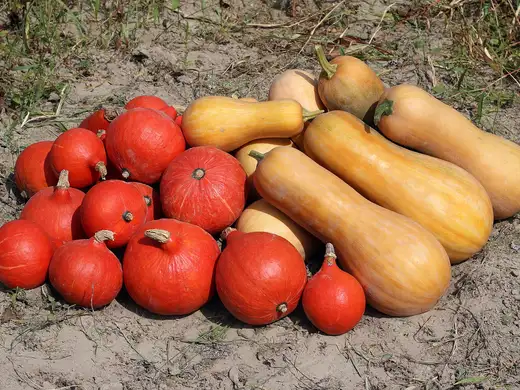
Winter squash are picked fully mature, with hard rinds and seeds, which is why they store. They come from three species. Acorn and spaghetti squash are Cucurbita pepo, the same species as zucchini and jack-o’-lantern pumpkins. Butternut is C. moschata. Buttercup, Hubbard and banana squash are C. maxima. The species affects storage life and how well the plants stand up to squash vine borers.
When and how to plant
Winter squash is very tender. Colorado State plants it about two weeks or more after the last frost, once days stay above 55°F and the soil at 2 inches is at least 60°F. Because it needs 85 to 120 days, the late limit matters as much as the early one: Iowa State plants from mid-May in central Iowa and says winter squash must be in by June 10. The dates for your zone above show your window.
Sow 4 to 6 seeds 1 to 2 inches deep per hill and thin to the two strongest seedlings (Utah State), or 4 to 5 seeds 1 inch deep thinned to 2 or 3 (Iowa State). Iowa State spaces hills 4 to 5 feet apart in rows 5 to 7 feet apart. Clemson gives large vining types 3 to 5 feet in rows 6 to 8 feet apart, and bush or short-vined types 2 to 3 feet in rows 3 to 5 feet apart. Iowa State notes that semi-bush varieties are available for small gardens.
In short-season areas, start seeds 3 to 4 weeks ahead in peat pots or other plantable containers (Iowa State); Colorado State prefers transplants no older than 2 to 3 weeks, since squash roots do not tolerate disturbance.
Regional timing
North and high elevations. Fit the variety to your season. Acorn types need about 55 to 60 days from flowering to maturity, butternut 60 to 70 and Hubbard 80 to 90, according to Iowa State, and cool weather slows all of them. Colorado State notes that winter squash is most productive below 5,000 feet.
South. Clemson plants winter squash from April 15 to June 15 in the South Carolina Piedmont and March 20 to May 1 on the coast, where a second planting in August is also possible.
Desert Southwest. The University of Arizona sows in March or from July to early August in the Phoenix area.
Warm-winter zones 9 to 11. UF/IFAS plants winter squash from February to April and again in August and September in North Florida, January to April and August to September in Central Florida, and August to March in South Florida.
Varieties
- Utah (Utah State): ‘Pink Banana’ (25 to 40 pounds), ‘Early Butternut’ and ‘Table Ace’.
- South Carolina (Clemson): ‘Early Butternut’, ‘Cornell’s Bush Delicata’ and ‘Table Ace’.
- Iowa (Iowa State): ‘Blue Hubbard’, ‘Burgess Buttercup’, ‘Butternut Supreme’, ‘Sweet Mama’ (buttercup), ‘Table Ace’ and ‘Table Queen’ (acorn), and spaghetti squash.
- Florida (UF/IFAS): spaghetti, ‘Table King’, ‘Table Queen’ and ‘Table Ace’ (acorn), ‘Waltham’ and ‘Early Butternut’.
Care
Squash grows best in full sun and fertile, well-drained soil. Utah State works in up to 2 inches of compost or 4 to 6 cups of all-purpose fertilizer such as 10-10-10 per 100 square feet before planting, then side-dresses with 3 to 4 tablespoons of 21-0-0 per plant when the vines start to run.
Water deeply, 1 to 2 inches a week, with drip if possible, and keep leaves and fruit dry. Utah State cuts back on water as the fruit ripens to reduce fruit rot. Hold organic mulch until the soil reaches about 75°F. Bees must pollinate the female flowers, so if you use row covers against early insects, remove them when flowering starts.
Pests and diseases
Squash vine borer larvae tunnel into stems near the soil, causing sudden wilting. UConn ranks butternut and other C. moschata squash least susceptible because of their thicker, more succulent stems, Hubbard and other C. maxima types more so, and C. pepo types such as acorn the most. If borers have been a problem, butternut is the safest choice. Iowa State notes that ‘Blue Hubbard’ is so attractive to the moths that commercial growers plant it as a trap crop, though most home gardens lack the space. Protect stems with foil wraps or row covers early in the season, and remove infested plants.
Squash bugs wilt leaves with their feeding. Hand-pick adults and egg clusters and trap them under boards. Cucumber beetles spread bacterial wilt; row covers protect young plants. Powdery mildew whitens leaves from midsummer; full sun, good spacing and resistant varieties help.
Clemson recommends waiting at least three years before planting squash where cucumbers, melons or other squash grew, and clearing vines after harvest.
Harvest, curing and storage
Winter squash is ripe when the rind is too hard to pierce with a thumbnail, the skin has gone from glossy to dull with solid color for its type, and the vines start to die back. Spaghetti squash turns from ivory to golden yellow. Harvest everything before a hard freeze. Cut fruit from the vine with about an inch of stem; Iowa State warns that squash with no stem left will not store well.
Cure all types except acorn at 80 to 85°F and 80 to 85 percent humidity for about 10 days to harden the rind and heal scratches. The University of Vermont adds that curing raises sugar content, improving flavor.
Store cured squash at 50 to 55°F in a dry, well-ventilated place away from apples and pears. Expected storage life:
- Acorn: 5 to 8 weeks (Iowa State)
- Butternut: 2 to 3 months (Iowa State) or up to 3 to 4 months (University of Vermont)
- Hubbard and buttercup: 4 to 6 months (University of Vermont); Iowa State gives Hubbard 5 to 6 months
Check stored squash monthly and use any that soften or show spots first.
Questions
How do I know when butternut squash is ripe?
The skin turns from glossy to dull with an even tan color, and the rind is too hard to dent with your thumbnail. Iowa State notes that butternut needs about 60 to 70 days from flowering to maturity in warm weather.
Should I cure acorn squash?
No. Iowa State says the warm, humid curing treatment that toughens other winter squash actually reduces the quality and storage life of acorn types. Store acorn squash cool right after harvest and use it within 5 to 8 weeks.
Which winter squash stores the longest?
Hubbard and buttercup types keep longest, about 4 to 6 months under good conditions. Butternut keeps about 2 to 4 months, and acorn squash only 5 to 8 weeks.
Which winter squash resists squash vine borers?
Butternut and other Cucurbita moschata squash have thicker, more succulent stems that larvae have trouble establishing in, so UConn ranks them least susceptible. Hubbard and other C. maxima types are more vulnerable, and acorn and spaghetti squash (C. pepo) the most.
Sources
- Harvesting and Storing Vine Crops · Iowa State University Extension and Outreach
- Squash Vine Borer (Melittia cucurbitae) in Home Gardens · University of Connecticut Extension
- How do I prevent damage to my squash plants from the squash vine borer? · Iowa State University Extension and Outreach
- Pumpkins & Winter Squash (HGIC 1318) · Clemson Cooperative Extension Home & Garden Information Center
- How to Grow Summer and Winter Squash in Your Garden · Utah State University Extension
- Growing Squash in Iowa · Iowa State University Extension and Outreach
- Pumpkin and Squash Harvest and Storage · University of Vermont Extension
- Vegetable Planting Guide (CMG GardenNotes #720) · Colorado State University Extension
- Cucumbers, Pumpkins, Squash, and Melons (Fact Sheet 7.609) · Colorado State University Extension
- Florida Vegetable Gardening Guide (VH021), Table 1 · University of Florida IFAS Extension (EDIS)
- Vegetable Planting Calendar for Maricopa County (AZ1005) · University of Arizona Cooperative Extension