How to Grow Turnips
Turnips are among the fastest root crops: sow seed directly once the soil reaches about 40°F, thin the seedlings to a few inches apart, and you can pick greens in about 40 days and roots in 50 to 60. Fall is usually the better season, because spring turnips turn pithy and bolt once days get long and hot. Pull roots at 2 to 3 inches across for the best texture.

Your dates for turnips
Set your ZIP code at the top of the page and we will work out when to plant turnips where you live, from the frost records of the nearest NOAA weather station. Your ZIP code is remembered on this device only.
Turnips at a glance
- Botanical name
- Brassica rapa (Rapifera Group)
- Light
- full sun (6+ hours)
- Frost tolerance
- Hardy: takes a hard frost
- Soil temperature to plant
- At least 40°F
- Germination
- 3–10 days
- Days to harvest
- 40–60 days from seed
- Planting depth
- 0.5 inches
- Spacing
- 2–6 inches apart, rows 12–18 inches apart
- Containers
- Yes
When to plant turnips
| Zone | Sow outdoors | Fall planting |
|---|---|---|
| Zone 2a | Apr 7 to May 5 | Jun 27 to Jul 18 |
| Zone 3a | Apr 14 to May 12 | Jul 6 to 27 |
| Zone 3b | Apr 5 to May 3 | Jul 16 to Aug 6 |
| Zone 4a | Apr 1 to 29 | Jul 20 to Aug 10 |
| Zone 4b | Mar 27 to Apr 24 | Jul 23 to Aug 13 |
| Zone 5a | Mar 22 to Apr 19 | Jul 26 to Aug 16 |
| Zone 5b | Mar 20 to Apr 17 | Aug 1 to 22 |
| Zone 6a | Mar 18 to Apr 15 | Aug 8 to 29 |
| Zone 6b | Mar 12 to Apr 9 | Aug 13 to Sep 3 |
| Zone 7a | Mar 5 to Apr 2 | Aug 16 to Sep 6 |
| Zone 7b | Feb 22 to Mar 22 | Aug 23 to Sep 13 |
| Zone 8a | Feb 15 to Mar 15 | Aug 29 to Sep 19 |
| Zone 8b | Feb 3 to Mar 3 | Sep 4 to 25 |
| Zone 9a | Jan 19 to Feb 16 | Sep 17 to Oct 8 |
| Zone 9b | Dec 20 to Jan 17 | Sep 30 to Oct 21 |
Spring dates before the last frost assume the soil has thawed and is dry enough to work. After a late or wet spring, wait for that even if the date has passed.
Roots, greens or both
Turnips are grown for two crops, the swollen root and the leafy tops, and varieties lean one way or the other. A variety bred for roots will also give you greens, but a greens variety may never make a good root. Clemson notes that some varieties are grown only for their leaves and never form a swollen root. Pick your variety by what you plan to eat:
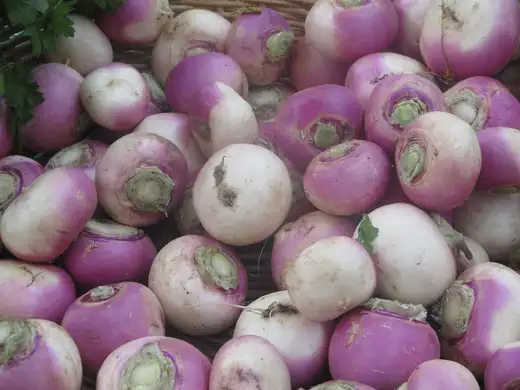
- Roots and greens: Purple Top White Globe and Shogoin (Clemson, South Carolina). Maryland Extension also names Purple Top White Globe and Hakurei as dual-purpose in the mid-Atlantic.
- Roots: Royal Crown, White Lady and Hakurei in South Carolina (Clemson). Just Right, Royal Crown, Tokyo Cross and White Lady in Texas (Texas A&M). Purple Top White Globe, the yellow-fleshed Golden Ball and Just Right in Wisconsin (UW Extension).
- Greens: Alamo and Topper (Clemson). Alamo, All Top, Seven Top, Shogoin and Topper (Texas A&M). Seven Top and Shogoin in Florida (UF/IFAS).
When to sow
Turnips are a cool-season crop that loses quality fast in heat, so most of the work is timing.
In spring, sow as soon as the soil can be worked. Texas A&M says turnip seed will sprout once the soil is 40°F, and Colorado State lists turnips among the hardy crops that can go in 2 to 4 weeks before the average last frost. Warmer soil speeds things up a lot: a University of California table shows emergence taking about 5 days at 50°F and about 2 days at 68°F. Spring turnips need to be pulled before summer, because they lose quality and go to seed quickly once days turn long and hot.
Fall is usually the better crop. Texas A&M starts fall sowings 8 to 10 weeks before the first expected frost, and Illinois Extension says very hardy crops like turnips need at least 8 weeks. Wisconsin Extension advises sowing as late as you can while still letting roots mature before a hard freeze, since cool weather produces the best roots. The dates for your zone above show both windows.
In mild-winter areas, sow from late summer through winter. North Florida also gets a late-winter sowing, and the Lower Rio Grande Valley and Phoenix-area calendars run turnips through fall and winter.
Soil and sowing
A smooth, round turnip needs loose soil. Heavy clay makes roots rough and misshapen, so Texas A&M recommends loosening the soil 10 to 12 inches deep and working in compost. Clemson targets a pH of 6.0 to 6.5 and advises adding any lime at least 3 months before planting. Do not plant where cabbage-family crops have grown in the past 3 years.
Sow seed about ½ inch deep, in rows 12 to 18 inches apart. Seed can also be broadcast across a wide row. Keep the surface moist until seedlings are up: seedlings are tender, and a crusted surface leads to a patchy stand. In late summer, a thin cover of compost or potting soil over the row helps.
Thin early, because crowded turnips cannot swell. Recommended final spacing ranges from 2 to 3 inches (Clemson) and 3 to 4 inches (Texas A&M) to 4 inches (Maryland). Texas A&M’s Rio Grande Valley guide thins to 5 to 7 inches, depending on variety. Eat the thinnings as greens.
Feeding and watering
Texas A&M scatters 2 to 3 pounds of 10-20-10 per 100 square feet before planting, noting that phosphorus is especially important for good roots. When plants are 4 to 5 inches tall, side-dress with about ½ cup of fertilizer per 10 feet of row. Clemson side-dresses 3 to 4 weeks after planting and splits the dose in two on sandy soil. Go easy on nitrogen, because too much produces leaves at the expense of roots.
Water regularly through the seedling stage and while roots swell, keeping the soil moist but not soggy. Do not let the leaves wilt.
Pests and problems
- Flea beetles. They chew small holes in young leaves. Cover the row at sowing.
- Root maggots. Cabbage maggot larvae tunnel into roots and leave brown trails. In Wisconsin the adult flies emerge in early to mid-May and lay eggs on the soil surface within 1 to 3 inches of the plants, so spring sowings are most exposed. Use row covers and rotate.
- Aphids and cabbage loopers. Check the undersides of leaves and treat or remove them.
- Pithy, strong-flavored roots. These were left in the ground into hot weather. Harvest on time.
- Rough, misshapen roots. Heavy clay soil is the cause. Loosen it deeply and add organic matter before the next sowing.
Harvest and storage
Most varieties give greens in about 40 days and roots in 50 to 60. Cut greens when the leaves are 4 to 6 inches long, taking the large outer leaves and leaving the center to regrow. Roots are ready at 2 to 3 inches across; Clemson aims for tennis-ball size, about 2½ to 2¾ inches. UF/IFAS notes that 2-inch roots are milder. Wisconsin Extension adds that small, smooth baby turnips can be pulled about 30 days after sowing, but roots are sweeter at 60 to 70 days. Leave them much longer and they turn tough and stringy.
Cut off the tops for storage. Roots keep several weeks in a cool, humid spot or a bag in the refrigerator, and Wisconsin Extension says mature, topped turnips can keep up to 6 months in cold storage. Greens last only a few days in a closed bag in the refrigerator.
Extension services disagree on leaving roots in the ground. Maryland Extension says turnips can be heavily mulched and dug through the winter as needed in the mid-Atlantic. Clemson advises against leaving roots in the ground through hot weather or hard freezes.
Questions
When are turnips ready to harvest?
Roots are usually ready 50 to 60 days after sowing, at 2 to 3 inches across. Clemson suggests about tennis-ball size (2½ to 2¾ inches), and smaller roots around 2 inches are milder. Greens are best at 4 to 6 inches long.
Can I eat both the greens and the roots from the same plant?
Yes, but take only some leaves. Clemson notes that continuous leaf picking reduces root growth. Varieties such as Purple Top White Globe and Shogoin are grown for both.
Why are my turnips woody or bitter?
Roots left in the ground too long, especially into hot weather, become tough, stringy and strong-flavored. Harvest on time and grow turnips in the cool seasons.
Should turnips be started indoors?
No. Sow them directly in the garden. UF/IFAS rates turnips as a crop that should be grown only from seed or from containerized transplants with well-developed roots.
Can turnips stay in the ground over winter?
It depends on the winter. Maryland Extension says roots can be heavily mulched and dug as needed through winter in the mid-Atlantic, while Clemson advises against leaving them in the ground through a hard freeze.
Sources
- Growing Leafy Greens in a Home Garden · University of Maryland Extension
- Soil Temperature Conditions for Vegetable Seed Germination (Garden Notes GN 154) · University of California Cooperative Extension, Sacramento County
- RGV Homeowner Vegetable Guide · Texas A&M AgriLife Extension Service
- Florida Vegetable Gardening Guide (SP 103/VH021) · University of Florida IFAS Extension
- Turnips & Rutabagas (HGIC 1324) · Clemson Cooperative Extension Home & Garden Information Center
- Vegetable Planting Guide · Colorado State University Extension
- Root crops (beets, carrots, radishes, turnips) presentation · Texas A&M AgriLife Extension, Leon County
- Vegetable Planting Calendar for Maricopa County (AZ1005) · University of Arizona Cooperative Extension
- Vegetable Crops of the Lower Rio Grande Valley (planting guide) · Texas A&M AgriLife Extension, Cameron County
- Growing carrots, beets, radishes, and other root crops in Wisconsin (A3686) · University of Wisconsin Extension
- Plan Now for a Fall Vegetable Garden · University of Illinois Extension
- The Fall Vegetable Garden (HO-66-W) · Purdue University Extension
- Fall Vegetable Gardening (G1343) · University of Nebraska-Lincoln Extension
- Growing Vegetables in Containers · University of Wisconsin-Madison Extension