How to Grow Tulips
Plant tulip bulbs in fall, once the soil has cooled below about 60°F, setting them 6 to 8 inches deep in well-drained soil with at least six hours of sun. They need a long cold winter to bloom, so in the North they simply stay in the ground, while in Florida, the Gulf Coast and other warm-winter areas you must chill the bulbs in a refrigerator first and treat them as annuals. Expect big hybrid tulips to fade after a year or two; species tulips are the ones that come back.
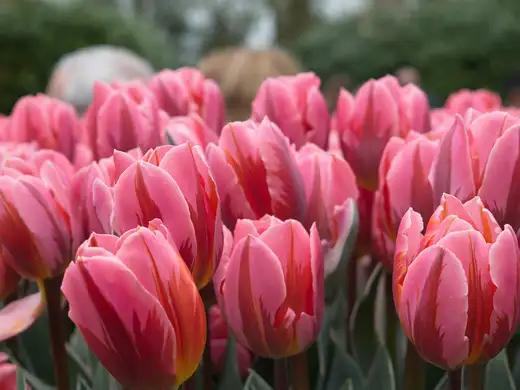

Your dates for tulips
Set your ZIP code at the top of the page and we will work out when to plant tulips where you live, from the frost records of the nearest NOAA weather station. Your ZIP code is remembered on this device only.
Tulips at a glance
- Botanical name
- Tulipa spp. (garden hybrids and species tulips)
- Light
- full sun; at least 5-6 hours of direct sun (Rutgers), and about 8 hours if you want reliable bloom year after year (Nebraska)
- Frost tolerance
- Hardy: takes a hard frost
- Hardiness zones
- 3-8 (NC State Extension; UF/IFAS Leon County also gives 3-8). In zones 9-10 grow as an annual from pre-chilled bulbs.
- Planting depth
- 8 inches
- Spacing
- 4–8 inches apart
- Containers
- Yes
When to plant tulips
| Zone | Fall planting |
|---|---|
| Zone 2a * | Jul 25 to Sep 19 |
| Zone 3a | Aug 3 to Sep 28 |
| Zone 3b | Aug 13 to Oct 8 |
| Zone 4a | Aug 17 to Oct 12 |
| Zone 4b | Aug 20 to Oct 15 |
| Zone 5a | Aug 23 to Oct 18 |
| Zone 5b | Aug 29 to Oct 24 |
| Zone 6a | Sep 5 to Oct 31 |
| Zone 6b | Sep 10 to Nov 5 |
| Zone 7a | Sep 13 to Nov 8 |
| Zone 7b | Sep 20 to Nov 15 |
| Zone 8a | Sep 26 to Nov 21 |
| Zone 8b | Oct 2 to Nov 27 |
| Zone 9a * | Oct 15 to Dec 10 |
| Zone 9b * | Oct 28 to Dec 23 |
* Outside zones 3 to 8, the hardiness range our sources give for tulips. Plants there may not survive the winter or get enough winter chill, and are usually grown as annuals or in pots.
What tulips need to bloom
A tulip bulb works on a warm-cool-warm cycle. After fall planting, South Dakota State University Extension explains, the bulb grows roots best while the soil is still about 63 to 68°F. It then needs a long cold spell, 35 to 48°F for roughly 13 to 20 weeks, before the flower inside the bulb can develop properly. When the soil warms again in spring, the stalk lengthens and the flower opens.
That cold requirement explains most of where tulips succeed and fail. They are hardy in USDA zones 3 to 8 (NC State Extension) and are happiest where winters are cool and moist and summers are warm and dry. NC State notes that flowering vigor drops once soil reaches about 70°F, which is why tulips fade quickly in the heat of a Southern spring and why they so rarely return in zones 8b and warmer.
Bulb size matters too. South Dakota State reports that bulbs under about 2.5 inches around will not form a flower, and recommends buying bulbs at least 4 inches in circumference. Pick bulbs that are plump and firm, with no soft spots, mold or nicks.
Choosing tulips that come back
Most of the tall, large-flowered hybrids sold in fall bags are short-lived. NC State says their performance usually drops noticeably from the second year, and Iowa State puts the useful life of most modern varieties at three or four years. Public gardens and cut-flower growers often pull them after bloom and replant fresh bulbs every fall. That is a perfectly reasonable way to grow them if you want the biggest display.
If you want tulips that persist, choose by class:
- Darwin hybrid tulips are the longest-blooming hybrids, according to Iowa State, with large flowers on stems up to 30 inches tall.
- Fosteriana (Emperor) tulips also perennialize well and flower early on 10- to 20-inch stems.
- Species tulips are the longest-lived of all. Wisconsin Extension suggests named forms of Tulipa clusiana, T. tarda, T. greigii and T. kaufmanniana for gardeners whose hybrids keep disappearing.
For South Carolina, Clemson recommends Single Late tulips (such as ‘Maureen’, ‘Menton’ and ‘Queen of Night’), Darwin hybrids (such as ‘Apeldoorn’ and ‘Pink Impression’) and Lily-flowered types (such as ‘West Point’ and ‘White Triumphator’), grown as annuals. Clemson adds that a few warm-climate species, T. bakeri ‘Lilac Wonder’ and the lady tulip, T. clusiana, can naturalize in the South without a cold period. Texas A&M AgriLife in Austin lists T. clusiana ‘Lady Jane’ and the golden tulip, T. clusiana var. chrysantha, for Central Texas.
Where to plant
Give tulips full sun. Rutgers asks for at least five to six hours of direct sun a day, and Nebraska Extension says about eight hours if you want reliable bloom year after year. Beds under deciduous trees can work for early types, because the sun reaches the ground before the trees leaf out.
Drainage is the other non-negotiable. Bulbs rot in soggy soil, especially while dormant in summer. Avoid spots that get lawn sprinklers or heavy summer irrigation, and don’t plant thirsty annuals right on top of a tulip bed; Wisconsin Extension notes that hybrid tulips, which evolved in dry-summer climates, decline faster in wet clay that is watered all summer. Rutgers puts the ideal soil pH at 6 to 7.
A bed against a south-facing wall warms early and flowers first, but Nebraska warns that the early leaves there are more exposed to late spring freezes.
When to plant
Plant in fall once the soil at planting depth has cooled below about 60°F. In the North that usually means mid-September through October (Rutgers, Nebraska, Penn State); in central Illinois, mid-October to early November. In general, the window runs from about six weeks before your average first fall frost to a couple of weeks after it; the dates for your zone above apply that rule to your local frost dates. If you run late, Iowa State notes that tulips can still go in through late November or early December wherever the ground is not yet frozen.
Warm-winter gardens work differently: see the section on growing tulips in the South below, and when to plant tulips for more detail.
How to plant tulip bulbs
- Prepare the bed, not just holes. Loosen the soil at least 4 inches below planting depth (Nebraska) and mix in compost, about 1 part organic matter to 4 parts soil. Rutgers prefers digging out a whole bed over using a bulb planter, because a fully loosened bed drains better and the bulbs last longer.
- Add phosphorus below the bulbs if a soil test calls for it. Rutgers suggests working bone meal or superphosphate into the bottom of the bed, where roots will reach it.
- Set the depth. Aim for 6 to 8 inches, measured to the bottom of the bulb. Sources differ slightly: Rutgers and Nebraska say about 8 inches, Clemson 6 to 8, South Dakota State 5 to 6, and NC State about three times the bulb’s height. Go 1 to 2 inches deeper in sandy soil.
- Space them 4 to 8 inches apart, pointed end up. Tulips look best in clumps or drifts rather than single rows; Wisconsin suggests 5 to 8 bulbs per hole with about an inch between them.
- Water well to settle the soil and start rooting. Nebraska advises a deep weekly watering in dry falls until the ground freezes. Don’t overwater, which invites rot.
- Mulch 2 to 3 inches of shredded bark, straw or pine needles. Nebraska applies it after the ground freezes, to keep the soil from thawing and refreezing.
Care in spring and after bloom
Tulips need little during bloom beyond water in a dry spring. Once the petals drop, snap off the seed head so the plant doesn’t spend energy on seed. Nebraska notes that deadheading some tulip types can stretch the flowering season considerably.
The important part comes next: leave the leaves alone until they turn yellow. They are rebuilding the bulb for next year. Clemson says to keep them at least six weeks after flowering, and Nebraska warns that braiding or tying the foliage reduces future bloom. To hide the fading leaves, Rutgers suggests interplanting with pansies, hostas, daylilies or ferns, or setting the bulbs behind perennials that grow up as the tulips go dormant.
Feeding advice varies. Nebraska recommends a balanced fertilizer such as 10-10-10 after the flowers fade to build a larger bulb, while Rutgers advises against fertilizing once flowering has started because it can encourage bulb rot. A soil test before fall planting is the safest guide.
Growing tulips in the South and other warm-winter areas
Florida, south Texas, the Gulf Coast, the mild-winter parts of California and similar areas don’t stay cold long enough to chill tulip bulbs. You can still grow them, but as one-season annuals:
- Chill the bulbs yourself or buy pre-chilled bulbs. Texas A&M AgriLife in San Antonio keeps them in the refrigerator crisper for 45 to 60 days; UC Master Gardeners in Solano County chill them in a paper bag for at least 6 to 8 weeks, noting that tulips need about 10 to 12 weeks below 55°F in all; UF/IFAS calls for two to four months. Never freeze them.
- Keep fruit out of the refrigerator drawer. Ripening fruit gives off ethylene, which can kill the flower inside the bulb (Clemson, Nebraska).
- Plant right after they come out of the cold, in late November or December in San Antonio and from November to late December in central and coastal South Carolina. UF/IFAS simply says winter for Florida.
- Expect one show. Bulbs that are not chilled enough bloom on very short stems close to the ground (Clemson). Pull them after flowering and buy fresh bulbs next year.
Tulips in pots and forced indoors
Tulips grow well in outdoor containers and are among the easiest bulbs to force for winter bloom. Rutgers and Nebraska fit about six tulip bulbs in a 6-inch pot, tips at the soil line. Set each bulb with its flat side facing the pot wall: the first leaf grows from that side, so the leaves frame the pot.
For forcing, pot bulbs in October or November in a well-drained mix without fertilizer. Hold the pots at 35 to 48°F for at least 12 to 13 weeks (Nebraska notes some cultivars need 15 to 18) in an unheated basement, garage or cold frame, keeping the soil evenly moist. Once roots fill the pot and short shoots show, move them into a bright, cool room at 55 to 60°F. Flowers follow in three to four weeks. Forced bulbs seldom bloom again in the garden, so compost them afterward.
Digging, dividing and storing bulbs
When a planting starts producing fewer and smaller flowers, dig and divide it. Wait until the foliage has yellowed and withered, around mid-July in New Jersey (Rutgers). Mature bulbs are tan to brown; white ones are immature. Keep only firm, healthy bulbs, dry them in a shady, airy place, then store them cool and dry at 60 to 65°F until fall planting, checking now and then for rot.
Common problems
- Bulbs dug up or eaten: Squirrels, chipmunks, voles, mice and rabbits all eat tulips. Lay wire mesh or chicken wire over the bed at planting, weighted down, and remove it in spring. Wisconsin also suggests a layer of chicken grit just under the soil surface, or planting daffodils and hyacinths, which rodents leave alone.
- Flowers eaten but leaves left: That is usually deer, which eat tulip blossoms but tend to skip the leaves (NC State). Rutgers suggests repellents.
- Gray mold (Botrytis): The most common leaf disease of spring bulbs. Remove badly infected plants and don’t replant diseased bulbs.
- Streaked or distorted flowers: Tulip breaking virus and mosaic virus cause flame-like streaks or deformities. Pull infected plants and control aphids, which spread viruses.
- Rotting bulbs: Almost always wet soil. Move tulips to a raised or better-drained bed.
- Cold damage in spring: Leaves and closed buds shrug off short light freezes. South Dakota State notes it takes 24 hours or more of freezing for serious damage, though long spells below 23°F can stop stems from lengthening and kill the flower.
- Leaves but no flowers: Usually bulbs that were too small, foliage removed early the year before, too little sun, or too little winter chill.
Handle bulbs with gloves if your skin is sensitive. NC State notes that tulip bulbs contain tulipalin, which causes an allergic rash in some people.
A flower with a long history
Tulips are native from southern Europe to central Asia. UF/IFAS Extension in Leon County notes they were being grown by the Turks by around 1000 AD and reached the West through the Ottoman Empire; the tulip is still Turkey’s national flower. In 17th-century Europe, prices for prized bulbs climbed so high that the episode is remembered as “tulipmania.” Today tulips come in every color but a true blue.
Questions
How deep should I plant tulip bulbs?
About 6 to 8 inches to the bottom of the bulb in most soils (Rutgers and Nebraska say about 8, Clemson 6 to 8, South Dakota 5 to 6). In loose, sandy soil, go an inch or two deeper.
Do tulips come back every year?
Species tulips and a few hybrid classes, such as Darwin hybrids and Fosterianas, often return for several years. Most large modern hybrids bloom well for only one to four years, so many gardeners replant them each fall.
Can I plant tulip bulbs in December?
Yes, if the ground is not frozen. Iowa State notes tulips can go in as late as late November or early December. Late bulbs root less before winter, so mulch them after planting.
Should I cut the leaves off after tulips bloom?
No. Snap off the faded flower, but leave the leaves until they yellow, at least six weeks after bloom by Clemson's count. The leaves rebuild the bulb for next year, and braiding or tying them reduces future flowering.
How long do tulip bulbs need to be chilled?
Recommendations range from about 6 to 16 weeks. Texas A&M AgriLife in San Antonio uses 45 to 60 days in the refrigerator, UC Master Gardeners in Solano County at least 6 to 8 weeks (tulips need about 10 to 12 weeks below 55°F in all), and UF/IFAS two to four months. Keep chilling bulbs away from fruit.
Why are squirrels digging up my tulips?
Tulip bulbs are food for squirrels, chipmunks, voles and mice. Lay wire mesh or chicken wire over the bed at planting, or plant daffodils and hyacinths instead, which rodents avoid.
Sources
- Tulips Bring Early-Season Color to the Garden Each Year · South Dakota State University Extension
- Planting Tulips (Iowa State University, distributed by Cornell Cooperative Extension Monroe County) · Cornell Cooperative Extension of Monroe County
- Tulipa (Tulip) - North Carolina Extension Gardener Plant Toolbox · NC State Extension
- Spring Flowering Bulbs (FS1220) · Rutgers Cooperative Extension
- Spring Flowering Bulbs (G1742) · University of Nebraska-Lincoln Extension
- Plant Bulbs Now for Spring Color · University of Wisconsin-Madison Division of Extension
- Bulbs to Plant in the Fall · South Dakota State University Extension
- Spring-Flowering Bulbs (HGIC) · Clemson Cooperative Extension Home & Garden Information Center
- Tulips · UF/IFAS Gardening Solutions
- Horticultural Activities for Fall · Texas A&M AgriLife Extension, Bexar County
- Bulbs for Central Texas · Texas A&M AgriLife Extension, Travis County
- Chill Out, Tulips! (Under the Solano Sun) · UC ANR, UC Master Gardeners of Solano County
- Bulbs · UF/IFAS Extension Leon County
- Plant Bulbs in the Fall for a Spring Celebration · Penn State Extension
- Bulbs (Backyard Farmer) · University of Nebraska-Lincoln Extension, Backyard Farmer
- How to plant flower bulbs for a colorful spring display · University of Illinois Extension