How to Grow Tomatoes in Pots
Grow one tomato plant per pot. Use at least 5 gallons and 12 inches of depth for compact determinate or patio varieties, and 8 to 10 gallons for full-size plants. Fill the pot with a soilless or potting mix, place it where it gets full sun, cage the plant at planting, and expect to water about once a day in summer.
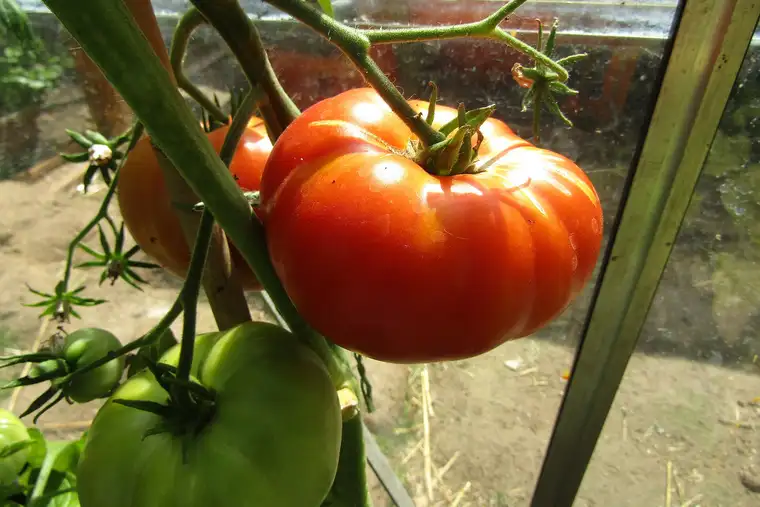
Why grow tomatoes in containers
A pot lets you grow tomatoes on a patio, balcony or driveway, and it solves two common garden problems. Texas A&M and Oregon State both point out that fresh potting mix avoids the soil-borne diseases and nematodes that build up in garden beds where tomatoes have grown before. You can also move the pot to the sunniest spot, or under shelter on a cold spring night.
The tradeoff is water. A pot holds far less moisture than open ground, and Texas A&M expects container vegetables to need watering about once a day.
Choosing the pot
Size is the most important choice. The sources give different minimums:
- Texas A&M and NC State: 5 gallons for one plant. NC State adds a depth of 1 to 2 feet. Texas A&M considers 1 to 2 gallons enough for dwarf tomatoes.
- University of Maryland: 8 to 10 gallons of mix, 12 to 16 inches deep, for full-size tomatoes; 4 to 6 gallons, 8 to 12 inches deep, for dwarf varieties.
- Oregon State: at least 12 inches deep, such as a 5-gallon nursery pot, for determinate types. Plant growth is limited by the size of the container, so a bigger pot gives a bigger plant and a bigger crop.
A 5-gallon bucket works for a patio or dwarf variety. Give a full-size or indeterminate tomato 8 to 10 gallons or more. Put one plant in each pot.
Every pot needs drainage holes. Texas A&M suggests holes along the side, about ¼ to ½ inch above the bottom. The sources disagree about gravel: Texas A&M says an inch of coarse gravel in the bottom improves drainage, while University of Maryland says gravel or pot shards do not help and can leave the bottom of the mix wetter. Both agree that drainage is critical. Raising pots on feet or a brick helps them drain freely.
Material changes how often you water. Maryland notes that clay, ceramic, concrete and wood dry out faster than plastic or metal, and that dark containers can get hot enough to injure young roots. In the hot South and the desert Southwest, a light-colored plastic pot is the easier choice.
Varieties for pots
Determinate and dwarf types take longer to outgrow a pot and are easier to support. Texas A&M recommends Patio, Pixie, Tiny Tim, Saladette, Toy Boy, Spring Giant, Tumbling Tom and Small Fry for Texas container gardens, and notes that small-fruited types make good hanging baskets. NC State lists Tiny Tim as a dwarf patio cherry. Indeterminate varieties can grow in pots too, but they need the largest container you can manage and a tall, sturdy stake or cage.
Potting mix
Do not fill the pot with garden soil. Texas A&M recommends a soilless mix of peat moss, perlite or vermiculite, which drains well, is light, and is free of weed seed and disease. Texas A&M adds that mixes containing compost or pasteurized soil hold water better than purely soilless ones. Wet the mix thoroughly before planting.
Set the transplant deep, as you would in the ground, so the buried stem can root. Put the cage or stake in at planting time. Texas A&M notes that cages work well for container tomatoes.
Watering
Texas A&M finds that watering once a day is usually enough, and that large, leafy plants may need water twice a day in hot weather. Water until some drains from the bottom, so the whole root ball is wet. If the mix becomes waterlogged, roots run out of oxygen and plants yellow from the bottom up, so empty saucers after watering. Keep the leaves dry to limit leaf diseases.
Uneven watering causes blossom-end rot and cracked fruit, so check pots daily rather than waiting for plants to wilt. A layer of straw, compost or shredded bark on top of the mix slows drying. Texas A&M also mentions water-holding gels mixed into the potting mix before planting.
Feeding
Frequent watering washes nutrients out of a pot, so container tomatoes need regular feeding. Texas A&M describes two approaches: mix a time-release fertilizer into the potting mix at planting, or water with a dilute soluble fertilizer as the plants grow, following the label. If you feed with every watering, Texas A&M advises watering with plain water about once a week until it drains freely, to flush out salts. Leaf edges that brown and burn are a sign that salts have built up.
Don’t overdo nitrogen. Tall, leafy plants with few flowers mean either too much nitrogen or too little light.
Sun, heat and cold
Fruiting crops such as tomatoes need the most sun of any vegetable, so give pots the brightest spot you have, with at least 6 hours of direct sun. Texas A&M notes that stunted plants with a purplish color can mean the pot is too cold, so move it somewhere warmer. In cold areas, Oregon State suggests growing tomatoes beside a house wall, where radiant heat warms the plants on cool evenings, and a pot is easy to move there.
At the end of the season
Pick all mature fruit before frost and ripen green fruit indoors. Texas A&M advises discarding the plant and mix rather than reusing the mix next year unless it has been properly composted, because diseases carry over in the mix.
How to grow tomatoesWhen to plant tomatoes
Questions
What size pot does a tomato need?
Texas A&M and NC State set the minimum at 5 gallons for one plant, and NC State calls for 1 to 2 feet of depth. University of Maryland recommends 8 to 10 gallons, 12 to 16 inches deep, for full-size tomatoes and 4 to 6 gallons for dwarf varieties. Larger pots hold more water and give bigger plants.
How often should I water tomatoes in pots?
Usually once a day in summer, according to Texas A&M, and sometimes twice for large, leafy plants. Water until some drains from the bottom, and never let the pot stand in a full saucer.
Can I reuse potting soil for tomatoes next year?
Texas A&M advises against reusing the mix as-is, because diseases carry over into the next season. Compost it properly first, or start with fresh mix.
Which tomatoes grow best in containers?
Determinate, dwarf and small-fruited types. Texas A&M lists Patio, Pixie, Tiny Tim, Small Fry and Tumbling Tom for Texas containers, and NC State describes Tiny Tim as a patio plant.
Sources
- Grow Your Own Tomatoes and Tomatillos (EC 1333) · Oregon State University Extension Service
- Tomato (HGIC 1323) · Clemson Cooperative Extension, Home & Garden Information Center
- How to Grow Tomatoes in Your Garden · Utah State University Extension
- Easy Gardening: Tomatoes (EHT-043) · Texas A&M AgriLife Extension Service
- Florida Vegetable Gardening Guide (SP 103/VH021) · UF/IFAS Extension
- Vegetable Planting Calendar for Maricopa County (AZ1005) · University of Arizona Cooperative Extension
- Soil Temperature Conditions for Vegetable Seed Germination (Garden Notes GN 154) · UC Cooperative Extension Sacramento County (UC ANR)
- Solanum lycopersicum (Tomato) · NC State Extension Gardener Plant Toolbox
- Vegetable Gardening in Containers (E-545) · Texas A&M AgriLife Extension Service
- Types of Containers for Growing Vegetables · University of Maryland Extension