How to Grow Thyme
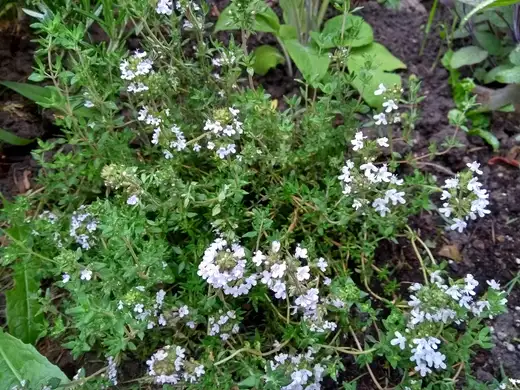
Thyme grows best from a starter plant, division or cutting set out after your last spring frost, in full sun and light, sandy or rocky soil that drains fast. It needs little water and no fertilizer once established, and a trim in early spring and summer keeps it from turning woody. Common thyme is rated hardy in zones 5-9, but wet winter soil kills it faster than cold.

Your dates for thyme
Set your ZIP code at the top of the page and we will work out when to plant thyme where you live, from the frost records of the nearest NOAA weather station. Your ZIP code is remembered on this device only.
Thyme at a glance
- Botanical name
- Thymus vulgaris
- Light
- full sun (6+ hours); some afternoon shade in very hot climates
- Frost tolerance
- Hardy: takes a hard frost
- Hardiness zones
- 5-9
- Days to harvest
- 90–180 days from seed
- Spacing
- 10–12 inches apart, rows 12–18 inches apart
- Containers
- Yes
When to plant thyme
| Zone | Plant out |
|---|---|
| Zone 2a * | May 19 to Jun 2 |
| Zone 3a * | May 26 to Jun 9 |
| Zone 3b * | May 17 to 31 |
| Zone 4a * | May 13 to 27 |
| Zone 4b * | May 8 to 22 |
| Zone 5a | May 3 to 17 |
| Zone 5b | May 1 to 15 |
| Zone 6a | Apr 29 to May 13 |
| Zone 6b | Apr 23 to May 7 |
| Zone 7a | Apr 16 to 30 |
| Zone 7b | Apr 5 to 19 |
| Zone 8a | Mar 29 to Apr 12 |
| Zone 8b | Mar 17 to 31 |
| Zone 9a | Mar 2 to 16 |
| Zone 9b | Jan 31 to Feb 14 |
* Outside zones 5 to 9, the hardiness range our sources give for thyme. Plants there may not survive the winter or get enough winter chill, and are usually grown as annuals or in pots.
Start with plants, divisions or cuttings
Thyme seed is tiny and germinates unevenly, and NC State calls common thyme difficult to propagate from seed. Penn State adds that seed-grown plants may take several years to grow large enough for a real harvest. Most gardeners buy a starter plant or take a piece of an established one.
Division is easiest in early spring: dig the whole root ball of a well-established plant and pull it into smaller pieces, each with roots attached. For cuttings, Penn State recommends 4-inch tips of new growth taken in late spring, stuck in pots of sand and kept well watered. Layering a low stem into the soil also works.
If you do try seed, Penn State says to sow in spring in a seed tray or scatter it on the ground, keep seedlings moist and thin to about 12 inches apart.
Choosing a thyme
Common or garden thyme (Thymus vulgaris) is the main cooking thyme. Penn State describes several cultivars: ‘Narrow Leaf French’, which chefs prefer for its lighter, sweeter taste; ‘Broadleaf English’, the most robust; and ‘German Winter’, very winter hardy with good flavor. University of Delaware Master Gardeners list English thyme at about 90 days, lemon thyme at 90 to 100 days and common thyme at about 180 days to harvest.
Lemon thyme (T. x citriodorus) has a light lemon taste and scent. Low species such as creeping thyme (T. praecox), only 2 to 3 inches tall, and woolly thyme suit rock gardens and the spaces between pavers. Colorado State notes creeping thyme can replace turf where foot traffic is light.
Hardiness varies by cultivar, so in cold regions look for a thyme sold specifically as winter hardy, as Oregon State advises.
Site and soil
Plant in full sun, at least 6 hours a day; Penn State and Colorado State say thyme tolerates partial shade. In the low desert, University of Arizona notes most herbs appreciate some afternoon shade during the hottest part of summer.
Drainage decides whether thyme lives through its first winter. NC State says it performs best in dry, sandy or rocky soil with a neutral to alkaline pH; Penn State gives a pH of about 6.3, so slightly acidic soil is fine too. In heavy clay, plant in a raised bed, a rock garden or a gravelly berm. Oregon State calls thyme well suited to a rock garden.
Space plants about 12 inches apart (Penn State and UC Master Gardeners of Orange County) or 10 to 12 inches (Texas A&M), in rows 12 to 18 inches apart. Common thyme forms a mound 6 to 12 inches high and up to about 16 inches wide.
Planting and care
Set plants out once the danger of frost has passed; the dates for your zone above show that window. Plant at the same depth as in the pot and water well.
Water: keep new plants moist while they establish, then water sparingly. Established thyme is drought tolerant, and wet soil does far more harm than dry. In the desert, University of Arizona recommends deep, infrequent watering of in-ground herbs and placing drip emitters carefully for creeping types such as thyme, which spread along the surface.
Fertilizer: none is needed once plants are established, according to Penn State.
Trimming: NC State recommends cutting back in early spring and again in summer to reduce woody growth, and trimming whenever plants get leggy. Even so, Penn State notes that plants eventually become overly woody and need to be replaced; division in spring renews them.
Winter: Colorado State suggests mulching thyme after the first of the year to prevent frost heaving and winter damage, and watering about once a month during dry winter periods.
Regional notes
- Cold north: choose a hardy cultivar such as ‘German Winter’, plant in spring in the best-drained spot you have, and mulch in midwinter. Where cooking thyme does not reliably survive, as Colorado State notes for Colorado, grow it as an annual or in a pot.
- Humid South and Gulf Coast: summer heat, humidity and wet soil are the threats. Plant in raised beds, give plants room for air flow and avoid wetting the foliage. In Florida, UF/IFAS treats thyme as a cool-season herb planted in late fall or early spring.
- Arid West and desert Southwest: thyme handles dry air well. University of Arizona lists October-November and February-April for planting in Tucson.
- Warm-winter zones 9-10: grow through the cool months and expect plants to struggle in a hot, rainy summer.
Harvesting and drying
Take only a few sprigs the first year so the plant can fill in. After that, the sources differ slightly on timing. Penn State and NC State harvest just before the plant flowers, when essential oil in the leaves peaks. UF/IFAS cuts the top third of the plant at full bloom. Either way, NC State advises cutting 5 to 6 inches of top growth and always leaving about 5 inches, including the woody base. Colorado State’s lighter approach is to cut 2 to 3 inches of stem tips as needed.
Pick on a dry morning, after dew dries and before midday. To dry, Penn State strips the bottom 2 inches of leaves, bundles the stems with a rubber band and hangs them upside down in a shady, dry, airy place. When the leaves are crisp, strip them off and store them in airtight containers.
Common problems
- Plants yellow, wilt and die, especially in winter: root rot, including Rhizoctonia, from wet, poorly drained soil. Move to a raised or gravelly bed.
- Gray mold or leaf spots: botrytis and Alternaria leaf spot, favored by humidity and crowding. Space plants and water the soil, not the leaves.
- Stippled leaves, fine webbing or clusters of small insects: spider mites or aphids. Rinse plants with water or use insecticidal soap.
- Sparse, woody plants: age. Trim yearly and divide or replace old plants.
- Plants pushed out of the ground in spring: frost heaving. Mulch after the ground freezes in midwinter.
Thyme is often grown beside rosemary, oregano, sage and lavender. That is a practical grouping because they share the same sun and dry-soil needs; Penn State says no companion-planting information is available for thyme.
Questions
How often should I water thyme?
Keep young plants moist until they are established, then water sparingly. Penn State notes established thyme needs little watering, and Colorado State suggests watering about once a month during dry winter spells.
Should I let thyme flower?
For the best flavor, harvest just before or as it starts to flower, when oil content peaks. Flowers that do open draw many small native bees and parasitoid wasps, so letting part of the plant bloom is worthwhile.
Why is my thyme turning woody?
Thyme naturally gets woodier with age. Trimming in early spring and summer slows it, but old plants eventually become sparse and need dividing or replacing.
Can thyme survive winter?
Penn State and NC State rate common thyme for zones 5-9, and Penn State names 'German Winter' as very winter hardy. Colorado State says cooking thyme is not reliably hardy there and may be grown as an annual; mulching after the first of the year helps prevent frost heaving.
Can I grow thyme in a pot?
Yes. NC State says common thyme does well in containers indoors or out. Use a fast-draining mix and let it dry slightly between waterings.
Sources
- Five Cold-Hardy Herbs to Grow · Oregon State University Extension
- Herb Garden Plants: Thyme · Penn State Extension
- Thymus vulgaris (Common Thyme) · NC State Extension Gardener Plant Toolbox
- Thyme · UF/IFAS Extension Gardening Solutions
- ENH1190/EP451: North Florida Gardening Calendar · UF/IFAS Extension (EDIS)
- ENH1189/EP450: Central Florida Gardening Calendar · UF/IFAS Extension (EDIS)
- ENH1191/EP452: South Florida Gardening Calendar · UF/IFAS Extension (EDIS)
- Growing Herbs in Tucson (AZ2061) · University of Arizona Cooperative Extension
- Growing Herbs (Bulletin #54) · University of Arizona Cooperative Extension, Yavapai County
- Growing Herbs in Texas · Texas A&M AgriLife Extension
- Culinary Use and Culture of Herbs · UC Master Gardeners of Orange County (UC ANR)
- Thyme (fact sheet) · University of Delaware Cooperative Extension
- 1063 - Thyme (PlantTalk Colorado) · Colorado State University Extension