How to Grow Swiss Chard
Sow Swiss chard outdoors 2 to 4 weeks before the last spring frost, 1/2 inch deep, and thin the seedlings to 6 to 12 inches apart. Keep the soil evenly moist and pick outer leaves as you need them. One planting keeps producing from early summer until temperatures fall to the mid-20s °F.

Your dates for swiss chard
Set your ZIP code at the top of the page and we will work out when to plant swiss chard where you live, from the frost records of the nearest NOAA weather station. Your ZIP code is remembered on this device only.
Swiss Chard at a glance
- Botanical name
- Beta vulgaris var. cicla
- Light
- full sun (6-8 hours best); tolerates partial shade (4-6 hours)
- Frost tolerance
- Half-hardy: takes a light frost
- Soil temperature to plant
- At least 40°F (best 55–75°F)
- Germination
- 7–14 days
- Days to harvest
- 45–70 days from seed
- Planting depth
- 0.5 inches
- Spacing
- 6–12 inches apart, rows 12–18 inches apart
- Containers
- Yes
When to plant swiss chard
| Zone | Start indoors | Plant out | Sow outdoors | Fall planting |
|---|---|---|---|---|
| Zone 2a | Apr 7 to 14 | May 12 to 26 | Apr 21 to May 5 | Jun 6 to Jul 4 |
| Zone 3a | Apr 14 to 21 | May 19 to Jun 2 | Apr 28 to May 12 | Jun 15 to Jul 13 |
| Zone 3b | Apr 5 to 12 | May 10 to 24 | Apr 19 to May 3 | Jun 25 to Jul 23 |
| Zone 4a | Apr 1 to 8 | May 6 to 20 | Apr 15 to 29 | Jun 29 to Jul 27 |
| Zone 4b | Mar 27 to Apr 3 | May 1 to 15 | Apr 10 to 24 | Jul 2 to 30 |
| Zone 5a | Mar 22 to 29 | Apr 26 to May 10 | Apr 5 to 19 | Jul 5 to Aug 2 |
| Zone 5b | Mar 20 to 27 | Apr 24 to May 8 | Apr 3 to 17 | Jul 11 to Aug 8 |
| Zone 6a | Mar 18 to 25 | Apr 22 to May 6 | Apr 1 to 15 | Jul 18 to Aug 15 |
| Zone 6b | Mar 12 to 19 | Apr 16 to 30 | Mar 26 to Apr 9 | Jul 23 to Aug 20 |
| Zone 7a | Mar 5 to 12 | Apr 9 to 23 | Mar 19 to Apr 2 | Jul 26 to Aug 23 |
| Zone 7b | Feb 22 to Mar 1 | Mar 29 to Apr 12 | Mar 8 to 22 | Aug 2 to 30 |
| Zone 8a | Feb 15 to 22 | Mar 22 to Apr 5 | Mar 1 to 15 | Aug 8 to Sep 5 |
| Zone 8b | Feb 3 to 10 | Mar 10 to 24 | Feb 17 to Mar 3 | Aug 14 to Sep 11 |
| Zone 9a | Jan 19 to 26 | Feb 23 to Mar 9 | Feb 2 to 16 | Aug 27 to Sep 24 |
| Zone 9b | Dec 20 to 27 | Jan 24 to Feb 7 | Jan 3 to 17 | Sep 9 to Oct 7 |
Spring dates before the last frost assume the soil has thawed and is dry enough to work. After a late or wet spring, wait for that even if the date has passed.
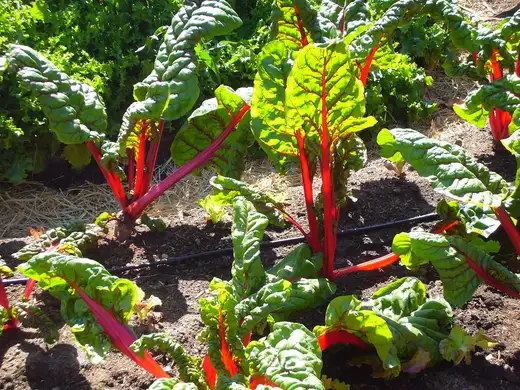
Swiss chard is a beet that was selected for its leaves and stalks instead of a swollen root (Maryland Extension). It’s one of the most forgiving greens. UW-Madison says it grows well regardless of soil type, day length or temperature, tolerates heat better than spinach and rarely bolts. One spring sowing can keep you in greens until hard frost, which makes chard the summer stand-in for spinach in hot regions.
When to plant
Sow chard outdoors 2 to 4 weeks before the last spring frost. Utah State says 2 to 3 weeks, and UW-Madison says about a month. UW-Madison adds that you can keep sowing through midsummer. For an earlier start, grow transplants indoors for 5 to 6 weeks (Utah State, Maryland) and set them out near the last frost. Maryland advises disturbing the roots as little as possible. Use the dates for your zone above.
Sources disagree on soil temperature. Utah State says chard can be sown at 40°F and germinates best at 55 to 75°F, emerging in 7 to 14 days. UW-Madison’s chart lists a 55°F minimum and an 85°F optimum. In practice, early sowings in cold soil come up slowly. Utah State notes germination drops when the soil is above 80°F.
Fall timing is less clear. Utah State’s main fact sheet times fall chard to mature 2 to 3 weeks before the first frost, sown 50 to 75 days before that, which works out to about 9 to 13 weeks before frost. Its own FAQ gives a much later 3 to 4 weeks before frost. The earlier timing lets plants reach full size first, and since chard keeps growing through light frosts, you can go on picking into early winter. In the Pacific Northwest, WSU Extension in Skagit County reseeds chard in July or August for a long winter harvest.
In warm-winter areas (Florida, the Gulf Coast, south Texas and the Arizona low desert), chard has a long season from late summer or fall through winter and spring. The months are in the dates for your zone above.
Sowing and thinning
Plant seed 1/2 inch deep (Utah State, Maryland). UW-Madison says 1 inch, Illinois says 1/2 to 3/4 inch, and Maryland suggests going to 1 inch in sandy soil. Each “seed” is a seed ball with several embryos (Maryland), so seedlings come up in small clumps. Thin them when they’re about 2 inches tall, unless the packet says monogerm.
Final spacing varies by source and by how big you want the plants. Utah State uses 6 inches in rows 12 inches apart. Maryland and Illinois go to 8 to 12 inches for larger plants, and UW-Madison to about a foot. Illinois suggests thinning first to 2 to 3 inches. Then, when plants are 6 to 8 inches tall, pull every other one for greens, leaving 9 to 12 inches between the rest. UW-Madison notes crowded chard doesn’t fail: it just makes more, smaller leaves.
Water, feeding and weeds
Give chard about 1 to 2 inches of water a week (Utah State). It tolerates some dryness but produces best when the soil stays evenly moist (UW-Madison), and moisture swings make leaves tough and off-flavored. Utah State sidedresses with 1/4 cup of 21-0-0 per 10 feet of row about 4 weeks after transplanting or thinning. Maryland calls chard a crop with high nutrient needs and recommends working in compost or fertilizer before planting.
Young chard competes poorly with weeds (Utah State). Pull weed seedlings by hand and mulch along the rows with straw or grass clippings. Mulch also cools the soil and saves water.
Regional notes
In the North, chard carries the harvest from early summer into fall. UW-Madison says a cold frame usually keeps it going well into December in southern Wisconsin. In the Pacific Northwest, WSU Extension says chard has few pests or diseases. In the humid South and Florida, heat is less of a problem than root-knot nematodes. UF/IFAS calls chard very susceptible to them. In the arid West, Utah State recommends mulch to save water and cool the soil, and notes that high summer temperatures slow growth and can make leaves bitter.
Extension services recommend these varieties for their states:
- Utah (Utah State): ‘Rhubarb’, ‘Bright Lights’, ‘Lucullus’, ‘Fordhook Giant’.
- Florida (UF/IFAS): ‘Bright Lights’, ‘Bright Yellow’, ‘Fordhook Giant’, ‘Lucullus’, ‘Red Ruby’.
- Texas (Texas A&M): ‘Bright Lights’, ‘Lucullus’, ‘Ruby’. For the Lower Rio Grande Valley, Texas A&M also lists ‘Rhubarb’, ‘Fordhook’, ‘Red Magic’ and ‘Red Winter’.
UW-Madison describes ‘Bright Lights’, a 1998 All-America Selections winner with stalks from white to red, as good enough for flower beds. It suggests pairing chard with low annuals such as petunias or dianthus. That is a design idea, not a companion-planting benefit.
Problems
- Leafminers. Larvae tunnel inside the leaves. Pick off and discard mined leaves. UW-Madison notes the weed lamb’s-quarters hosts the same pest, so pull it from around the garden.
- Aphids. Hose them off, use insecticidal soap, or let lady beetles, lacewing larvae and syrphid fly larvae handle them (UW-Madison).
- Root-knot nematodes. They cause galls on the roots, stunting and wilting. Maryland has documented them on chard in Baltimore. Rotate crops and add organic matter where they’re a problem.
- Cercospora leaf spot. A fungal spotting of the leaves (Maryland). Remove affected leaves and rotate the bed each year.
- Slugs and flea beetles. Slugs chew holes in damp conditions, and flea beetles riddle seedlings. Utah State recommends traps for slugs and floating row cover for flea beetles.
- Bolting. It’s uncommon. Pull any plant that sends up a seed stalk (UW-Madison).
Harvest and storage
Young leaves about 3 inches long are ready roughly 4 weeks after planting and are tender enough for salads (UW-Madison). For cooking greens, cut outer leaves near the base once they reach about 8 to 12 inches (Illinois) or 8 to 10 inches (UF/IFAS). Never damage the growing point at the center. Alternatively, cut the whole plant about 2 inches above the crown (Maryland, Utah State), or 3 inches according to UW-Madison, and it will regrow. UW-Madison puts the first whole-bunch harvest at about 2 months after planting. It advises picking early or late in the day, because leaves wilt fast in hot sun.
If leaves turn bitter in midsummer, keep removing the older ones. New growth gets milder as the weather cools. Utah State and Maryland both estimate 8 to 12 pounds from a 10-foot row, so a few plants feed a household. Storage advice differs: Utah State and UW-Madison say 1 to 2 weeks in the refrigerator, while Illinois says to use the leaves within 2 to 3 days. Store leaves unwashed in a bag. Maryland notes all parts of the plant contain oxalic acid.
Questions
Why do my chard seedlings come up in clumps?
Each chard "seed" is really a seed ball holding several embryos, so several seedlings sprout from one spot. Thin them when they're about 2 inches tall, unless you bought monogerm seed.
Does Swiss chard come back after cutting?
Yes. Cut outer leaves near the base and the center keeps producing. You can also cut the whole plant about 2 to 3 inches above the crown and it will regrow, as long as the growing point isn't damaged.
Can Swiss chard handle heat?
Better than spinach. It rarely bolts and is a standard summer green in Florida. Leaves may taste more bitter in midsummer, but new growth turns milder as the weather cools.
How cold can Swiss chard tolerate?
UW-Madison says chard keeps growing through frosts until temperatures drop to the mid-20s °F. Maryland notes the roots tolerate more cold than the tops.
How long does Swiss chard keep in the refrigerator?
Utah State and UW-Madison say 1 to 2 weeks unwashed in the refrigerator, but Illinois calls chard extremely perishable and advises using the leaves within 2 to 3 days. The stalks last longer if you separate them from the leaves.
Sources
- Cool Season Vegetables · Washington State University Extension, Skagit County
- How to Grow Swiss Chard in Your Garden · Utah State University Extension
- Swiss Chard · University of Wisconsin-Madison Extension (Wisconsin Horticulture)
- Chard | Home Vegetable Gardening · University of Illinois Extension
- Growing Swiss Chard in a Home Garden · University of Maryland Extension
- Florida Vegetable Gardening Guide (SP 103/VH021) · UF/IFAS Extension
- Vegetable Planting Calendar for Maricopa County (AZ1005) · University of Arizona Cooperative Extension
- RGV Homeowner Vegetable Guide · Texas A&M AgriLife Extension Service
- Fall Vegetable Gardening Guide for Texas · Texas A&M AgriLife Extension Service
- When Is the Right Time to Plant Vegetable Seeds? Check Soil Temperature · University of Wisconsin-Madison Extension (Wisconsin Horticulture)