How to Care for String of Pearls
String of pearls needs bright, indirect light, a shallow clay pot of gritty, fast-draining mix, and water only when the mix has dried and the pearls begin to look slightly shriveled. Overwatering is the most common way it dies. Give it a cool, drier rest in winter and hang it out of reach of pets.
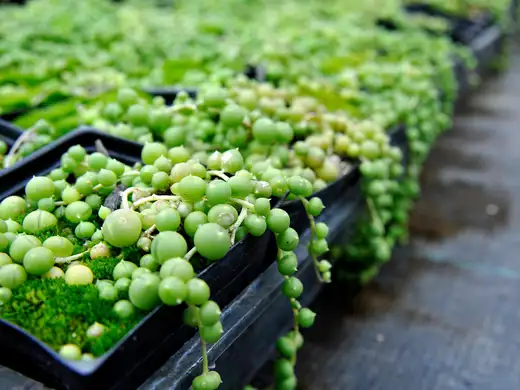

String of Pearls Plants at a glance
- Botanical name
- Curio rowleyanus (syn. Senecio rowleyanus)
- Light
- bright, indirect light indoors; partial shade outdoors; direct sun can scorch
- Hardiness zones
- 9b-12
- Containers
- Yes
When to repot and propagate string of pearls plants
String of pearls (Curio rowleyanus, formerly Senecio rowleyanus) is a trailing succulent from dry parts of South Africa, where its stems creep along the ground under shrubs and between rocks, rooting wherever they touch soil. Each pea-sized leaf is a water store. The round shape exposes as little surface as possible to dry air, and a translucent stripe on the side, called an epidermal window, lets light into the leaf to make up for it.
That background explains the care. It wants bright light but not baking sun, it holds water in its leaves rather than its roots, and it rots quickly in soil that stays wet. NC State calls it very particular: it does not tolerate overwatering, underwatering or poor light.
Light
Indoors, give it bright, indirect light. NC State and UW-Madison both stress bright light, and NC State says it does poorly in inadequate light. Keep it out of direct sun, though, which NC State says can scorch the leaves. A hanging basket near a bright window, with the stems trailing down into the light, suits it well.
Watering
Root rot from overwatering is the most common cause of death, according to UW-Madison. The plant is built to go without water for a while, so water infrequently.
Use the pearls as your gauge. UW-Madison says to water when the leaves start to look a little shriveled. When you water, soak the mix until water drains out the bottom, then let it drain completely; never leave the pot sitting in water.
The two extension sources differ on how dry is too dry. UW-Madison says to let the mix dry out completely between waterings. NC State says never to let the plant dry out completely. In practice, check often and water soon after the mix reaches dry, rather than leaving it bone-dry for weeks. Give more water in summer, when it is growing, and much less in winter.
NC State adds a warning: wilting or shriveling can come from either too little or too much water. Always check the soil before reaching for the watering can. Dry, shriveled pearls need water; soft stems in wet soil need less.
Soil, pot and drainage
Drainage is everything. Use cactus mix, or regular potting mix amended with sand or perlite. UW-Madison suggests adding pea gravel, sharp sand, poultry grit or pumice, up to a 1:1 mix with the potting medium.
Choose a shallow pot. UW-Madison explains that the roots are not extensive, and a deep pot holds a volume of wet soil they cannot dry out, which invites rot. Unglazed clay is better than plastic or glazed ceramic because water evaporates through the sides, so the mix dries faster.
Temperature and winter rest
NC State recommends 70 to 80°F in summer and a cooler 50 to 60°F in winter; UW-Madison gives 55 to 60°F for the winter rest. Keep the soil drier during this cool period. UW-Madison says the cool, dry rest may encourage summer flowers, which are small, white and spicy-scented, with red stamens.
Feeding and repotting
It needs very little fertilizer. UW-Madison’s advice is to repot every year or two, or fertilize lightly in spring. Do either in spring as growth resumes, and move only into another shallow pot with fresh gritty mix.
Propagation
Stem cuttings root easily. NC State recommends 3- to 5-inch cuttings; UW-Madison suggests 3 to 4 inches from the stem tips.
- Cut a healthy stem tip and strip 3 or 4 pearls from the bottom end.
- Lay or insert the cut end on moist potting mix, lightly covering the bare nodes.
- Mist the surface rather than watering heavily until roots form. UW-Madison says roots should develop quickly at each node.
Single pearls dropped on soil can root, but NC State calls this slower and less reliable. Since NC State notes that plants tend to die back after several years, keeping a pot of rooted cuttings going is the simplest way to keep a full plant.
Pests and problems
- Mushy stems, collapse, pearls falling off: root rot from soggy soil. Let the mix dry out, and if the base keeps collapsing, root healthy stem tips in fresh gritty mix and start over.
- Shriveled or wilting pearls: too little water, or too much. Check the mix.
- Brown, scorched pearls: direct sun, or a plant moved outdoors without acclimating.
- Yellow or grayish leaves: NC State says these may point to insects.
- Mealybugs, aphids, whiteflies, gnats, ants: the pests NC State and UW-Madison list.
- Thin, sparse plant after several years: normal decline. Start over from cuttings.
Pets and toxicity
String of pearls is mildly toxic. The ASPCA says eating it can upset a pet’s stomach, mostly causing vomiting, and cause lethargy. NC State and UW-Madison note vomiting or diarrhea if eaten and say the sap can irritate skin, so wear gloves if you are sensitive. NC State lists pyrrolizidine alkaloids as the toxic compound and says it is toxic to people as well as pets. A hanging basket keeps it out of reach of children and animals.
Outdoors
NC State lists outdoor use only in USDA zones 9b and warmer, in partial shade, with very well-drained soil. In the rest of the country it can spend summer outside in its pot, but UW-Madison says to acclimate it gradually to avoid sunburn, protect it from heavy rain, and bring it indoors before frost. Iowa State warns that sun damage on succulents’ fleshy leaves is permanent, and Illinois Extension notes that too much rain leads to root rot in succulents. A spot under a covered porch or eave, out of midday sun, meets all of those needs.
Questions
How often should I water string of pearls?
Water when the mix has dried and the pearls look a little wrinkled, more often in summer and much less in winter. UW-Madison lets the mix dry completely between waterings, while NC State warns against letting it dry out completely, so water soon after it reaches dry.
Why is my string of pearls shriveling?
NC State says wilting can come from either too little or too much water. If the mix is dry, water thoroughly; if it is wet and the stems are soft near the soil, the roots are rotting.
Is string of pearls toxic to cats and dogs?
Yes, mildly. The ASPCA says eating it can cause stomach upset, mainly vomiting, and lethargy. NC State and UW-Madison add that the sap can irritate skin.
How do I propagate string of pearls?
Take stem tip cuttings 3 to 5 inches long, strip a few pearls from the bottom, and lay or set them on moist mix with the bare nodes lightly covered. Roots form at the nodes quickly.
Why is my old string of pearls thinning out?
NC State notes the plants tend to decline after several years. Instead of trying to revive a sparse plant, root cuttings from its healthiest stems and start again.
Sources
- Moving Indoor Plants Outside for the Summer · Iowa State University Extension and Outreach
- Take your houseplants on a summer vacation...to the patio! · University of Illinois Extension
- Curio rowleyanus (String of Pearls) · North Carolina Extension Gardener Plant Toolbox, NC State University
- String of Pearls, Curio rowleyanus · University of Wisconsin-Madison Division of Extension, Wisconsin Horticulture
- Are Succulents Safe to Have Around Pets? · ASPCA