How to Care for a Rubber Plant
A rubber plant grows best in bright, indirect light, ideally morning sun from an east window, kept between about 60°F at night and 80°F by day. Water it thoroughly, then let the soil surface dry a little before watering again, and water less from fall to late winter. Keep it in one spot, away from cold drafts, or it will drop leaves.
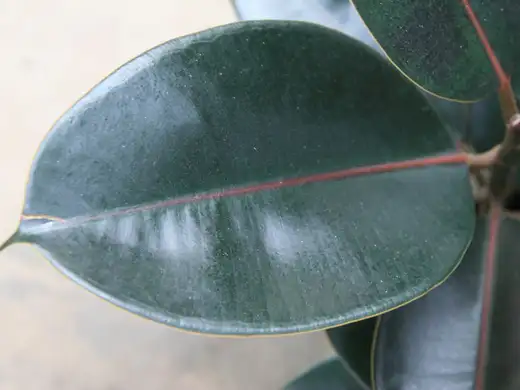

Rubber Plants at a glance
- Botanical name
- Ficus elastica
- Light
- bright indirect light (east window ideal); adapts to lower light; shield from hot afternoon sun
- Hardiness zones
- 10b-11
- Containers
- Yes
Rubber plant (Ficus elastica) is a fig from India and Malaysia that becomes a 100-foot tree in the wild. The species name refers to its milky latex sap, once tapped for rubber. Indoors it is usually kept between 2 and 10 feet, though Clemson notes it can easily reach 6 to 10 feet or more if it has room. It is tough and long-lived, but it reacts quickly to cold, drafts and being moved.
Light
Clemson recommends bright light, with morning sun from an east-facing window as the ideal. Keep it out of harsh afternoon sun. It adapts to lower light, and Clemson singles out ‘Robusta’, with leaves up to 18 inches long, as doing well in low light. Still, Clemson lists too little light as one cause of leaf drop, so a dim corner is a compromise, not a goal.
Once you find a good spot, leave it there. NC State notes that rubber plants prefer to stay in one location.
Watering
Water thoroughly until water runs from the drainage holes, then let the soil dry slightly to the touch before watering again. Empty the saucer after every watering. Clemson warns that poor drainage and overwatering lead to root rot, and that leaves may yellow if the soil stays too wet.
From fall to late winter, while growth is slow, NC State advises cutting watering back sharply. A plant in a cool room or dim spot dries out more slowly still, so check the soil each time instead of watering on a schedule. UF/IFAS adds that container rubber trees should be allowed to get fairly dry between waterings, and that the plant makes a good houseplant as long as it is not overwatered.
Pot and Mix
Use a well-drained houseplant mix (NC State suggests a soil-based potting mix) in a pot with drainage holes. Clemson recommends staking tall specimens.
Temperature and Humidity
Clemson gives the ideal range as 60 to 65°F at night and 75 to 80°F during the day, and advises against temperatures below 55°F. NC State agrees that it needs more than 55°F. Sudden drops in temperature and cold drafts make it shed leaves, so keep it away from exterior doors, drafty windows and air-conditioning vents.
It prefers humid air but copes with the dry air in most homes. If leaves drop in winter while the heat is running, a humidifier can help.
Feeding
Clemson recommends a water-soluble houseplant fertilizer every two weeks during active growth in spring and summer, and less often for plants growing in lower light. Stop feeding from fall through winter.
Repotting
Repot in late winter or early spring, and only when the plant has outgrown its container: roots circling the pot or pushing out the drainage holes, or a root ball so full of roots that little soil is left (signs University of Illinois Extension lists for houseplants). Colorado State Extension recommends a pot only 1 to 2 inches wider than the old one. Use fresh, well-drained mix and set the plant at the same depth.
Pruning and Cleaning
Prune in spring to control height or to rejuvenate a lanky plant. NC State notes that pruning the main branches makes the plant bushier, while leaving them alone gives a tall, narrow, tree-like form. Cut stems drip milky sap that can irritate skin, so wear gloves and protect floors. Support tall specimens with a stake.
Dust dulls the big leaves. Wipe them with a damp, soft cloth or sponge, as NC State suggests, or wash them gently.
Propagation
Rubber plant can be propagated from stem or tip cuttings, but air layering is the classic method for a tall plant. Iowa State’s steps:
- Pick a point on a stem 12 to 18 inches below the tip and strip the leaves there.
- Make two cuts around the stem, 1 inch apart, down to the woody center, join them with a lengthwise cut, and peel off the ring of bark. Scrape the exposed wood clean.
- Dust it with rooting hormone (optional, but rooting is faster).
- Pack one or two handfuls of moist sphagnum moss around the wound, wrap it in clear plastic and tie it off above and below.
- When roots fill the moss, usually after several weeks, cut the stem below the wrap and pot the new plant.
Iowa State calls early spring the ideal time for layering. The parent plant usually sprouts new branches just below the cut, so air layering also fixes a leggy plant.
Pests and Problems
- Leaves dropping – cold drafts, sudden temperature drops, too little light, dry air or overwatering. Keep the plant warm, in steady bright light, and away from drafts.
- Yellowing leaves – too much moisture. Let the soil dry slightly between waterings. NC State notes that a few lower leaves yellowing and falling is normal.
- Root rot – soggy, slow-draining mix or a pot without holes. Repot into a fast-draining mix in a pot with drainage holes, and empty the saucer after watering.
- White, cottony clusters – mealybugs, which Clemson calls a common pest. NC State also lists scale and spider mites. Inspect leaf undersides and stems, and treat early.
Toxicity
NC State flags Ficus elastica as a problem for cats, dogs and horses. Clemson warns that the sticky white sap can irritate skin or the stomach if eaten. The ASPCA’s entry for figs (Ficus species), which lists “Indian rubber plant” among its common names, rates them toxic to dogs, cats and horses.
Summer Outdoors and Warm-Winter Areas
Rubber plants can spend summer outdoors, but they dislike being moved and chilled, so do it only once. Iowa State’s general guidance is to wait until nights stay above 50°F, start in shade and add light over 10 to 14 days. Because Clemson says to keep this plant above 55°F, bring it in before nights fall to that level, and check it for mealybugs and scale before it comes inside.
In frost-free areas such as south Florida, rubber tree is planted as a fast-growing landscape tree, most often 35 to 45 feet tall, in sun or part shade on almost any well-drained soil. UF/IFAS lists zones 10b to 11; NC State lists 9a to 12b. Its limbs break in strong wind, so UF/IFAS recommends early pruning to a single trunk with well-spaced branches. UF/IFAS does not consider it an invasive problem in Florida.
Questions
How often should I water a rubber plant?
Water thoroughly, then wait until the soil surface feels slightly dry before watering again. From fall to late winter, when growth slows, water noticeably less.
Why is my rubber plant dropping leaves?
Clemson lists too little light, dry air and cold drafts; NC State adds overwatering and sudden temperature drops. Keep it warm, in steady bright light, and away from doors and vents.
How do I make my rubber plant bushier?
Prune the main stems in spring. NC State notes that cutting back main branches encourages a bushier habit, while leaving them uncut gives a tall, narrow tree form.
Is a rubber plant toxic to cats and dogs?
NC State lists Ficus elastica as a problem for cats, dogs and horses, and Clemson warns that the milky sap can irritate skin or the stomach if eaten. Keep it away from pets and young children.
When should I repot a rubber plant?
In late winter or early spring, and only once it has outgrown its pot, according to Clemson Extension.
Sources
- How can I propagate a rubber tree? · Iowa State University Extension and Outreach
- How to Propagate by Air Layering and Simple Layering · Iowa State University Extension and Outreach
- Moving Indoor Plants Outside for the Summer · Iowa State University Extension and Outreach
- Toxic and Non-toxic Plants: Weeping Fig (Ficus sp.) · ASPCA Animal Poison Control
- Repotting houseplants · University of Illinois Extension
- Houseplants - Repotting · Colorado State University Extension (PlantTalk Colorado)
- Ficus elastica (Rubber Plant) · North Carolina State University Extension (Extension Gardener Plant Toolbox)
- Rubber Plant (HGIC factsheet) · Clemson Cooperative Extension Home & Garden Information Center
- ENH411/ST252: Ficus elastica: Rubber Tree · University of Florida IFAS Extension (EDIS)