How to Grow Rhubarb
Plant dormant rhubarb crowns in early spring, 3 to 4 feet apart with the buds 1 to 2 inches below the soil, in a sunny, well-drained spot you won't need for anything else. Skip harvesting the first year, feed and water well, and a planting can keep producing for 10 to 15 years. Rhubarb needs cold winters and summers averaging below 75°F, so it thrives in the northern states and struggles in the South.

Your dates for rhubarb
Set your ZIP code at the top of the page and we will work out when to plant rhubarb where you live, from the frost records of the nearest NOAA weather station. Your ZIP code is remembered on this device only.
Rhubarb at a glance
- Botanical name
- Rheum rhabarbarum
- Light
- full sun; tolerates part shade
- Frost tolerance
- Hardy: takes a hard frost
- Hardiness zones
- 3-8
- Planting depth
- 2 inches
- Spacing
- 36–48 inches apart, rows 36–48 inches apart
When to plant rhubarb
| Zone | Plant out |
|---|---|
| Zone 2a | Apr 7 to 21 |
| Zone 3a | Apr 14 to 28 |
| Zone 3b | Apr 5 to 19 |
| Zone 4a | Apr 1 to 15 |
| Zone 4b | Mar 27 to Apr 10 |
| Zone 5a | Mar 22 to Apr 5 |
| Zone 5b | Mar 20 to Apr 3 |
| Zone 6a | Mar 18 to Apr 1 |
| Zone 6b | Mar 12 to 26 |
| Zone 7a | Mar 5 to 19 |
| Zone 7b | Feb 22 to Mar 8 |
| Zone 8a | Feb 15 to Mar 1 |
| Zone 8b | Feb 3 to 17 |
| Zone 9a | Jan 19 to Feb 2 |
| Zone 9b | Dec 20 to Jan 3 |
Spring dates before the last frost assume the soil has thawed and is dry enough to work. After a late or wet spring, wait for that even if the date has passed.
When to plant rhubarbWhen to harvest rhubarb
Climate comes first
Rhubarb is a hardy perennial in the buckwheat family, and its needs are set by temperature. Oregon State University Extension says the crown needs at least 500 hours between 28°F and 40°F each winter to form new leaf buds, spring temperatures above 40°F to start growing, and summers averaging under 75°F for strong leaf growth. That profile fits the northern states, the Pacific Northwest and the mountain West. Red Butte Garden lists rhubarb as hardy in zones 3 to 8, while Ohio State says common varieties do well in zones 4 to 7.
South of that band, results drop off. University of Arkansas Extension says rhubarb does not grow well in all parts of the state and recommends cool, north-facing slopes and partial shade there. Texas A&M’s Aggie Horticulture says it does not grow well as a perennial anywhere in Texas, except for an unnamed green variety that does well in the Panhandle north of Amarillo. In hot, dry parts of the West such as Oregon’s high desert, Oregon State recommends late-afternoon shade.
Choosing a site
Because one planting can produce for 10 to 15 years (Utah State), put it at the edge of the vegetable garden or in a sunny flower border where it won’t be tilled. Plants reach about 3 feet tall and wide. Ohio State notes that a south-facing site gives the earliest stalks in Ohio.
Drainage matters more than anything else about the soil, because wet ground invites crown and root rot. Arkansas and Wisconsin both recommend raised beds to keep crowns out of standing water. Oregon State gives an ideal pH of 6.0 to 6.8. Before planting, clear out perennial weeds completely, because you cannot dig around the crowns later. Utah State suggests working 2 to 4 inches of compost into the top 6 inches; Ohio State recommends loosening the soil 10 inches deep and adding 3 to 4 inches of compost or composted manure.
Planting crowns
Buy crowns or divisions rather than seed. Arkansas notes that seedlings are slow to establish and don’t come true to color and size, and Oregon State adds that rhubarb is cross-pollinated, so seedlings seldom resemble the parent. To keep crown rot out of a new bed, Ohio State advises planting purchased crowns rather than seed from a neighbor’s plants.
Plant in early spring while the crowns are dormant or just starting to push buds; Wisconsin times divisions about 4 to 6 weeks before the average last frost. Ohio State also allows fall planting after the plants go dormant, but Oregon State recommends spring wherever winters are severe so roots can build reserves first.
Depth advice varies by an inch or so. Utah State says to keep the bud no more than 1 inch below the surface, Ohio State and Oregon State say 1 to 2 inches, and Arkansas and Wisconsin say 2 inches. All agree that planting too deep delays production, and Utah State warns it can kill the plant. Space crowns 3 to 4 feet apart, with rows 3 to 4 feet apart, firm the soil, and water well.
Feeding, watering and mulch
Don’t fertilize in the first year. After that, feed in early spring as growth begins: Utah State suggests ½ cup of 16-16-16 around each plant, and Oregon State suggests ¾ to 1 cup of 10-10-10 or ½ to ¾ cup of 16-16-16 plus a layer of compost. Ohio State and Wisconsin both recommend a second nitrogen feeding after harvest, since picking draws down soil nutrients.
For the first two to three years, Utah State recommends watering once or twice a week so moisture reaches 6 to 12 inches down. Established plants can go every one to two weeks if the water soaks 12 to 18 inches deep. Oregon State advises letting the top 2 inches dry between waterings and notes that limp leaves mean the plant needs water.
Mulch with straw or compost to hold moisture and smother weeds, keeping it under the leaves and off the crown itself (Oregon State). In cold-winter areas, Ohio State and Wisconsin suggest a few inches of straw once the ground has frozen to reduce heaving and crown rot; pull it back off the crowns before spring growth begins.
Flower stalks and dividing
Cut off seed stalks as soon as they appear. Oregon State lists age, heat, drought, low fertility, swings between hot and cold, and long nights as triggers. Some varieties bolt more than others, and sources disagree on one of them: Oregon State and Wisconsin describe ‘Valentine’ as producing few seed stalks, while Ohio State lists it as more likely to bolt. Both Oregon State and Utah State note that ‘Victoria’ bolts readily.
Divide when stalks get thin and crowded: Utah State says every 5 to 10 years, Ohio State when crowns are 6 to 10 years old, and Oregon State often around the fifth or sixth year. In early spring, dig the crown and split it into pieces that each have at least one strong bud and a good piece of root. Replant right away.
Varieties
Ohio State recommends MacDonald, Crimson Red, Victoria, Canada Red, Cawood Delight, Glaskin’s Perpetual and Valentine for zones 4 to 7. Oregon State names Crimson as the leading outdoor variety in Oregon. Utah State’s Utah list adds Cherry Wine, Early Sunshine and Strawberry. Arkansas recommends MacDonald, noting resistance to root rot, along with Tilden and Victoria. Ornamental Chinese rhubarb (Rheum palmatum) is not edible.
Pests and diseases
- Crown and root rot (Phytophthora): plants fail to leaf out or collapse suddenly. Ohio State says fungicides don’t cure it; prevent it with good drainage, raised beds and healthy purchased crowns.
- Rhubarb curculio: a rusty snout beetle about ¾ inch long that bores into stalks. Remove nearby curly dock, its alternate host.
- Red leaf: Oregon State names this bacterial disease, with Phytophthora, as the most serious problem west of the Cascades. Remove infected plants.
- Slugs: a problem on new plantings and in moist areas.
- Ascochyta leaf spot: clear away old leaf litter and last season’s dead tissue.
Leaves are toxic
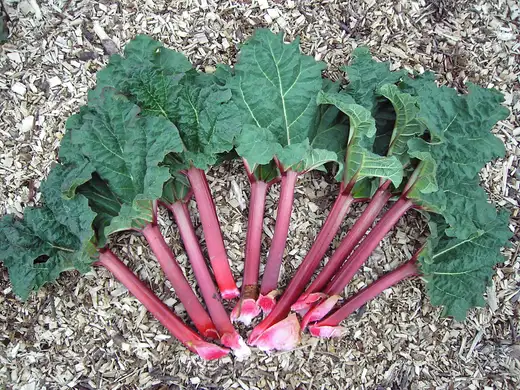
Only the stalks are food. The leaf blades contain high levels of oxalic acid, which Utah State says can cause serious illness and kidney failure; the stalks contain very little. NC State’s plant database lists abdominal cramps, burning in the mouth and throat, nausea and vomiting as symptoms, notes that serious poisoning takes large quantities, and lists rhubarb as a problem for dogs, cats and horses. The leaves are safe to compost: Ohio State says the oxalic acid breaks down quickly in the pile.
Growing rhubarb as a winter annual in Texas
Texas A&M AgriLife’s Travis County office describes growing rhubarb as a winter annual around Austin. Sow seed indoors in mid to late August (‘Victoria’ is easiest to find as seed), set plants out in late September or early October when they have three to five leaves, shade them through any lingering heat, and harvest from about March through May before removing the plants. Expect mostly green stalks, partly because of the warm climate and partly because the reddest varieties aren’t sold as seed.
Questions
Are rhubarb leaves poisonous?
Yes. The leaf blades hold high levels of oxalic acid and soluble oxalates and can cause cramps, nausea, vomiting and kidney damage; NC State lists the leaves and roots as the most toxic parts. Eat only the stalks, and keep leaves away from pets and livestock. The leaves are safe to compost.
Should I cut off rhubarb flower stalks?
Yes, as soon as they appear. Seed stalks draw on the reserves stored in the crown and can reduce next year's buds and stalks.
Can I grow rhubarb from seed?
Arkansas and Oregon State advise against it. Seedlings take longer to establish and don't come true to the parent's color and size, so buy crowns or divisions instead. In Texas, where rhubarb is grown as a winter annual, seed is the practical choice.
Why are my rhubarb stalks thin?
Overharvesting, crowding, low fertility, drought and age all shrink stalks. Oregon State suggests dividing when a plant makes 25 to 30 small stalks instead of 12 to 18 large ones, usually around the fifth or sixth year.
Why are my rhubarb stalks green instead of red?
Color depends on both variety and temperature. Red color develops best with cool nights; in warm climates, and in summer heat, stalks stay greener. Green stalks are not lower in quality, and Wisconsin notes that green types are generally more productive.
When should I divide rhubarb?
Every 5 to 10 years, in early spring before growth starts, or whenever the clump gets crowded and stalks turn thin. Leave at least one strong bud on each piece.
Sources
- How to Grow Rhubarb in Your Garden · Utah State University Extension
- Growing Rhubarb in the Home Garden (HYG-1631) · The Ohio State University Extension
- Home Gardening Series: Rhubarb (FSA6076) · University of Arkansas Cooperative Extension Service
- Grow Your Own Rhubarb (EC 797) · Oregon State University Extension Service
- Rhubarb, Rheum rhabarbarum · University of Wisconsin-Madison Extension
- Rhubarb (Rheum rhabarbarum) plant record · Red Butte Garden, University of Utah
- Rhubarb - Texas Style · Texas A&M AgriLife Extension, Travis County
- Rhubarb (Specialty Crops of Texas) · Texas A&M AgriLife Extension, Aggie Horticulture
- Rheum rhabarbarum (Pie Plant, Rhubarb) · North Carolina State Extension Gardener Plant Toolbox