How to Grow Radishes
Sow radish seed 1/2 inch deep in cool weather, from a few weeks before the last spring frost and again from late summer into fall. Thin the seedlings to 1-2 inches apart, keep the soil evenly moist, and pull spring radishes 3-4 weeks after sowing, while red types are still under an inch across. Heat, dry soil and waiting too long are what make radishes hot, pithy or split.

Your dates for radishes
Set your ZIP code at the top of the page and we will work out when to plant radishes where you live, from the frost records of the nearest NOAA weather station. Your ZIP code is remembered on this device only.
Radishes at a glance
- Botanical name
- Raphanus sativus
- Light
- full sun (6+ hours); tolerates partial shade
- Frost tolerance
- Half-hardy: takes a light frost
- Soil temperature to plant
- At least 40°F (best 55–75°F)
- Germination
- 3–10 days
- Days to harvest
- 20–30 days from seed
- Planting depth
- 0.5 inches
- Spacing
- 1–3 inches apart, rows 10–18 inches apart
- Succession sowing
- Every 1.5 weeks
- Containers
- Yes, at least 1 gallon
When to plant radishes
| Zone | Sow outdoors | Fall planting |
|---|---|---|
| Zone 2a | Apr 21 to May 5 | Jun 27 to Aug 8 |
| Zone 3a | Apr 28 to May 12 | Jul 6 to Aug 17 |
| Zone 3b | Apr 19 to May 3 | Jul 16 to Aug 27 |
| Zone 4a | Apr 15 to 29 | Jul 20 to Aug 31 |
| Zone 4b | Apr 10 to 24 | Jul 23 to Sep 3 |
| Zone 5a | Apr 5 to 19 | Jul 26 to Sep 6 |
| Zone 5b | Apr 3 to 17 | Aug 1 to Sep 12 |
| Zone 6a | Apr 1 to 15 | Aug 8 to Sep 19 |
| Zone 6b | Mar 26 to Apr 9 | Aug 13 to Sep 24 |
| Zone 7a | Mar 19 to Apr 2 | Aug 16 to Sep 27 |
| Zone 7b | Mar 8 to 22 | Aug 23 to Oct 4 |
| Zone 8a | Mar 1 to 15 | Aug 29 to Oct 10 |
| Zone 8b | Feb 17 to Mar 3 | Sep 4 to Oct 16 |
| Zone 9a | Feb 2 to 16 | Sep 17 to Oct 29 |
| Zone 9b | Jan 3 to 17 | Sep 30 to Nov 11 |
Spring dates before the last frost assume the soil has thawed and is dry enough to work. After a late or wet spring, wait for that even if the date has passed.
A fast crop that rewards cool weather
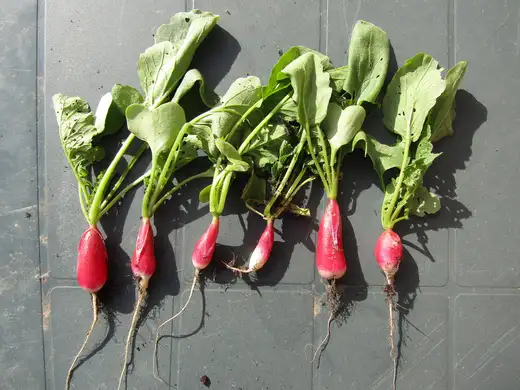
Spring radishes go from seed to harvest in about 3-4 weeks. Clemson gives 21-30 days and Wisconsin 20-25. Utah State’s range of 25-45 days covers larger and slower varieties. The speed makes them easy, but it also leaves little room for error. A radish that grows quickly in cool, moist soil is crisp and mild. One that grows slowly in heat or dry soil turns hot, pithy and split.
Clemson puts the best growing temperature at 50-65°F, and Utah State says radishes grow best below 80°F. Warmer weather speeds radishes up, but cooler weather gives a milder root (Clemson). Hot weather also triggers bolting (Utah State). Once a flower stalk forms, the root goes pithy and strong.
Spring, summer and winter types
Wisconsin groups radishes by season:
- Spring radishes: small, round, red, white, pink or purple roots ready in about 25-30 days. These are the standard salad radishes.
- Summer radishes: similar but larger and slower.
- Winter radishes: including daikon and other Asian types. Summer and winter types take 50-60 days. Winter types prefer cool temperatures and short days, so Wisconsin sows them for fall.
Varieties by region
Extension services name these for their own states:
- South Carolina (Clemson): red Scarlet Globe, Cherry Belle and Cherriette; white April Cross and Summer Cross; Red Flame, a French Breakfast type.
- Florida (UF/IFAS): Cherry Belle, White Icicle, Sparkler, Champion and Daikon.
- Texas (Texas A&M): red Champion, Cherry Belle, Early Scarlet and Early Scarlet Globe; white Chinese White Winter, Summer Cross and White Icicle.
- Utah (Utah State): Champion, Cherry Belle, Daikon Long White, Icicle and Easter Egg.
- Wisconsin: spring types Cherry Belle and Early Scarlet Globe; summer types French Breakfast, Snow Belle, White Icicle and Red Meat; winter types April Cross and Round Black Spanish.
Sowing and thinning
Radishes go in early. Utah State sows about 2-3 weeks before the last spring frost, and Colorado State allows 2-4 weeks. Sources disagree on how much cold radishes take. Colorado State, Purdue and Maryland class them as hardy, and Maryland says they survive heavy frosts. Illinois puts them a step lower, among its frost-tolerant crops. The dates for your zone above give the spring and fall windows. Seed sprouts in soil as cool as 40°F and usually emerges within 3-10 days.
- Work the soil loose and smooth. Radishes need loose, well-drained ground so the roots can swell, and Clemson favors sandy to sandy loam soils.
- Sow 1/2 inch deep, about 1 inch apart, in rows 10-12 inches apart (Utah State) or in a wide band.
- Keep the surface moist until the seedlings are up.
- Thin early to 1-2 inches apart (Utah State). Clemson thins broadcast beds to 2-3 inches at the one- or two-true-leaf stage. Maryland leaves 2-4 inches depending on the variety. Wisconsin spaces winter radishes 2 inches apart, against 1 inch for spring types.
Thinning is the step that makes or breaks the crop. Crowded radishes make leaves and no roots.
Water and fertilizer
Even moisture keeps radishes mild. Utah State links moisture swings to cracking and to hot, bitter roots. Clemson notes that water stress makes radishes strong-flavored and woody. A heavy watering after a dry spell can split roots that are already full size. Mulch and drip irrigation make steady moisture easier.
Radishes need little fertilizer. Maryland rates their needs as low and warns that extra nitrogen grows tops instead of roots. Wisconsin gives the same warning. Utah State side-dresses lightly with about 1/4 cup of 21-0-0 per 10 feet of row, 3-4 weeks after emergence.
Succession and interplanting
Radishes come in over a short window and don’t hold well, so sow little and often while the weather stays cool. Clemson, Utah State and Wisconsin space sowings 7-14 days apart, UF/IFAS every two weeks, and Maryland as little as five days.
Their speed makes them a useful filler. Sow a few seeds in rows of slow carrots to mark the row and break crusted soil (Utah State). Wisconsin and UF/IFAS tuck radishes between slower crops such as late cabbage, peppers and tomatoes, pulling them before the main crop needs the space. This is practical space-sharing, not pest control. Washington State University finds little evidence that companion planting controls pests.
Regional notes
Cold North. Spring and fall are both good seasons. Wisconsin sows every 10-14 days in spring and again for fall. Pull radishes before hard freezes (Utah State).
Arid West. Utah State waits until mid- to late August for fall sowings, after the worst heat, and recommends drip irrigation and mulch.
Humid South. Clemson sows in both spring and fall across South Carolina and notes that late-spring sowings bolt as the weather warms. Fall is the longer window there.
Warm-winter areas (zones 9-11). Radishes are a fall-through-spring crop in Florida, South Texas and the low desert. Skip midsummer, when heat makes them bolt, crack and taste hot. UF/IFAS notes that daikon and other winter radishes also grow well in Florida.
Problems and fixes
- All tops, no root: crowding, heat or too much shade. Thin early and grow in sun (Utah State).
- Hot, pithy or split roots: heat, moisture stress or over-maturity. Sow in cool weather, water steadily and harvest on time.
- Tiny holes in leaves: flea beetles. Cover seedbeds with floating row cover.
- Tunnels in the roots: root maggots. Use row covers and rotate. Wisconsin notes that later plantings, around mid-June there, usually take less damage than early ones.
- Seedlings cut off at the soil line: cutworms. Press cardboard or metal collars an inch into the soil around plants (Clemson).
- Swollen, clubbed side roots: clubroot, a soil disease of the cabbage family. Wisconsin recommends long rotations away from cabbage-family crops and good drainage.
Harvest and storage
Check radishes every few days once they approach size, because the window is short. Clemson pulls round red radishes before they reach 1 inch across and white types before about 3/4 inch. Maryland harvests at about 1 inch and notes that maturing radishes push up out of the soil. Oversized radishes split and turn pithy and hot.
Trim off the tops and the thin root tail, wash and dry them, and refrigerate in a plastic bag. Sources give 1-2 weeks (Maryland), about 2 weeks (Clemson) and 2-4 weeks (Utah State). Winter radishes keep longer: Wisconsin gives daikon 6-10 weeks in a cooler.
Questions
Why are my radishes all leaves and no root?
Usually crowding. Radishes that aren't thinned to 1-2 inches apart make tops but no bulbs. Hot weather, too much shade and too much nitrogen also push leaf growth at the expense of the root.
Why are my radishes so hot?
Heat, dry soil and age. Radishes that grow slowly, go short of water or stay in the ground too long develop more bite. Cool weather and steady moisture give the mildest roots.
How often should I plant radishes?
Sow small batches every 1-2 weeks while the weather is cool. Clemson sows every 7-10 days, Utah State every 10 days and Wisconsin every 10-14 days. Maryland sows a few seeds as often as every five days.
Can radishes grow in partial shade?
They tolerate some shade, but Utah State lists too much shade as one reason roots fail to fill out. Give them at least 6 hours of sun.
When do you plant daikon and other winter radishes?
Sow them in late summer for fall harvest. Winter radishes take 50-60 days and form roots best in cool, shortening days. Wisconsin grows them as a fall crop.
Sources
- Radishes · University of Maryland Extension
- Home Vegetable Gardening in Washington (EM057E) · Washington State University Extension
- Florida Vegetable Gardening Guide (SP 103/VH021) · University of Florida IFAS Extension
- Carrot, Beet, Radish & Parsnip (HGIC 1305) · Clemson Cooperative Extension Home & Garden Information Center
- How to Grow Radishes in Your Garden · Utah State University Extension
- Vegetable Planting Guide · Colorado State University Extension
- Vegetable Planting Calendar for Maricopa County (AZ1005) · University of Arizona Cooperative Extension
- Vegetable Crops of the Lower Rio Grande Valley (planting guide) · Texas A&M AgriLife Extension, Cameron County
- Growing carrots, beets, radishes, and other root crops in Wisconsin (A3686) · University of Wisconsin Extension
- Plan Now for a Fall Vegetable Garden · University of Illinois Extension
- The Fall Vegetable Garden (HO-66-W) · Purdue University Extension
- Root crops (beets, carrots, radishes, turnips) presentation · Texas A&M AgriLife Extension, Leon County
- Types of Containers for Growing Vegetables · University of Maryland Extension
- Container Gardening Basics · Oregon State University Extension Service
- Growing Vegetables in Containers · University of Wisconsin-Madison Extension