How to Care for a Peperomia
Peperomia wants bright, indirect light, a small pot of fast-draining mix, and water only after the mix has dried. Its root system is tiny, so overwatering, especially in winter, is what kills most plants. Feed lightly in spring and summer, keep it out of cold drafts, and expect to leave it in the same pot for several years.

Peperomias at a glance
- Botanical name
- Peperomia spp. (e.g. Peperomia obtusifolia)
- Light
- bright indirect light (east or south window); tolerates fairly low light; direct sun scorches leaves
- Hardiness zones
- 10-11
- Spacing
- 12–18 inches apart
- Containers
- Yes
When to repot and propagate peperomias
Peperomia is a genus of more than 1,000 small tropical plants in the black pepper family. Many grow wild as epiphytes, perched in trees with very little soil around their roots. That explains almost everything about their care: they have small root systems, they store water in fleshy leaves, and they rot quickly if the mix stays wet.
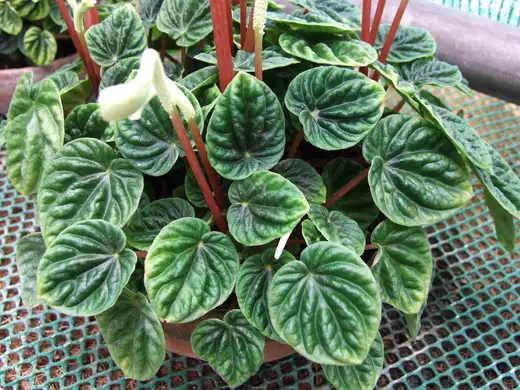
Houseplant peperomias come in three basic shapes. Bushy types such as baby rubber plant (P. obtusifolia) have thick, glossy leaves on upright stems. Rosette types such as P. caperata and watermelon peperomia (P. argyreia) form tight clumps of ridged or striped leaves. Trailing types suit hanging baskets, and some small species fit in terrariums. Care is much the same for all of them.
Light
Give peperomia bright, indirect light. Clemson Extension suggests an east or south window, with the plant out of the path of direct sun, which scorches the leaves. It will tolerate less: Clemson says a spot near a large north window works, and NC State says baby rubber plant handles low light for several months without stress, especially the plain green forms. Variegated kinds hold their color best in brighter light.
Watering
Overwatering is the most common way to lose a peperomia. Clemson calls root rot from too much water the most common disease, and NC State lists yellowing leaves, curling leaves and root rot as its signs.
Water only after the potting mix has dried. Pour water through until it runs from the drainage hole, let the pot drain completely, and then put it back on its saucer. Never leave it standing in water. UF/IFAS advises erring on the dry side.
Winter is the dangerous season. Growth slows, the small root system takes up very little water, and a pot that stayed damp for two days in July can stay wet for a week in January. Check the mix with a finger before every watering and cut back sharply from late fall to spring.
Potting mix and pot
Use a well-drained houseplant mix or cactus mix, as Clemson recommends. NC State describes the ideal as moist but well drained, based on loam and sand. The pot matters as much as the mix: choose one only slightly larger than the nursery pot, with a drainage hole. A big pot holds far more wet soil than the roots can use, which is how rot starts. University of Arkansas Extension also favors relatively small pots.
Temperature and humidity
The common name radiator plant points to its liking for warmth. Keep it away from cold drafts from doors and winter windows. Most homes have enough humidity; NC State and Clemson both suggest a humidifier only if your house is very dry in winter. UF/IFAS notes that baby rubber plant prefers high humidity outdoors but still needs sharp drainage to avoid stem and root rot.
Feeding
Fertilize only while the plant is actively growing in spring and summer. Clemson recommends either an occasional low-strength liquid fertilizer or one application of slow-release granules a year. Skip feeding in fall and winter, when the plant is barely growing.
Repotting
Peperomias are slow growers, and NC State says they rarely need repotting. Clemson notes a plant can stay in the same pot for several years. When roots finally fill the pot, wait for spring, as Arkansas Extension advises, and move it up only one small size, into fresh mix at the same depth it grew before.
Propagation
Clemson describes three ways:
- Stem cuttings. Cut a 3- to 5-inch piece, strip the leaves from the lower third, dip the end in rooting hormone, insert it in moist mix, and cover with plastic in indirect light.
- Leaf cuttings. Take a leaf with at least an inch of petiole (leaf stem) and insert the petiole in mix. New plants form at its base.
- Water rooting. Baby rubber plant roots from 4- to 6-inch cuttings cut just below a leaf node. Remove the lower leaves, stand the stems in water, and pot them once roots and new leaves appear.
Division works for some clump-forming species, according to NC State.
Pruning and grooming
Pinch or cut stems just above a leaf node to make the plant branch and stay bushy. Arkansas Extension says occasional pinching keeps the bushy types compact, and suggests waiting for spring for any serious cutting back. Remove old leaves as they fade. The slender flower spikes are a matter of taste; Clemson suggests removing them.
Pests and problems
- Yellow or curling leaves, leaf drop, mushy stems: overwatering and root rot. Let the mix dry, empty the saucer, and water less often. A plant with rotted roots may only be saved by rooting healthy stem tips.
- Spots on the leaves: leaf spot diseases. Water the soil rather than the foliage and give the plant good air movement.
- Brown, scorched patches: direct sun. Move it back from the window or behind a sheer curtain.
- Mealybugs, spider mites, scale, whiteflies, aphids, fungus gnats: all reported by NC State and Clemson. UF/IFAS names mites as the main pest. Check leaf undersides and stems regularly and treat early. Fungus gnats are a sign the mix is staying too wet.
Pets and toxicity
The ASPCA lists baby rubber plant as non-toxic to dogs and cats, and Clemson says most peperomias are considered pet safe. The ASPCA rating is for P. obtusifolia only, so check the species if you have a plant-chewing pet.
Summering outdoors and warm-winter gardens
Peperomia enjoys a summer outside in a shaded spot. Clemson says to wait until nights stay at 60°F or higher, usually May in South Carolina. Start it in deep shade so it can adjust, then keep it in bright shade with no direct sun all summer. Bring it in before nights drop below that 60°F mark.
Baby rubber plant is native to Florida, where it grows in the Everglades. UF/IFAS rates it for zones 10 and 11 and says it can be planted year-round there as a shade groundcover, in raised planters or spilling over a wall. Give it partial to deep shade and well-drained soil, and set plants 12 to 18 inches apart for quick cover.
Questions
How often should I water a peperomia?
There is no fixed schedule. Water when the potting mix has dried, let the pot drain fully, and water even less in winter when growth slows. Yellow, curling or dropping leaves usually mean it is getting too much.
Is peperomia safe for cats and dogs?
The ASPCA lists baby rubber plant (Peperomia obtusifolia) as non-toxic to dogs and cats, and Clemson Extension says most peperomias are considered pet safe. The ASPCA rating covers only that one species.
Can peperomia grow in low light?
It copes for a while. NC State says baby rubber plant tolerates low light for several months, and Clemson says peperomia can manage near a large north window, but bright indirect light keeps it compact and well colored.
Should I remove peperomia flower spikes?
You can. The cream, rat-tail spikes are not showy, and Clemson suggests cutting them off so the plant puts its energy into leaves.
How do I propagate peperomia?
Root 3- to 5-inch stem cuttings, or a single leaf with at least an inch of leaf stem attached. Baby rubber plant also roots from 4- to 6-inch cuttings in water. Some species are easier to divide.
Sources
- Peperomia (Radiator Plant) · North Carolina Extension Gardener Plant Toolbox, NC State University
- Peperomia obtusifolia (Baby Rubber Plant) · North Carolina Extension Gardener Plant Toolbox, NC State University
- Peperomia (Peperomia spp.) Indoor Plant Care and Growing Guide (HGIC 1567) · Clemson Cooperative Extension, Home & Garden Information Center
- Peperomia obtusifolia Peperomia, Baby Rubber Plant (FPS466) · UF/IFAS Extension (EDIS)
- Plant of the Week: Peperomia · University of Arkansas System Division of Agriculture, Cooperative Extension Service
- Baby Rubber Plant (Peperomia obtusifolia) - Toxic and Non-Toxic Plants · ASPCA Animal Poison Control Center