How to Grow Parsley
Parsley is easy to grow once it is up, but its seed is slow and erratic, so most gardeners either start it indoors 8 to 10 weeks before the last spring frost or buy transplants. Soak seed overnight before sowing, give plants rich, moist soil, and cut outer stems once they reach about 8 inches. Grow it as an annual and replant each year.

Your dates for parsley
Set your ZIP code at the top of the page and we will work out when to plant parsley where you live, from the frost records of the nearest NOAA weather station. Your ZIP code is remembered on this device only.
Parsley at a glance
- Botanical name
- Petroselinum crispum
- Light
- full sun to partial shade; afternoon shade helps in hot climates
- Frost tolerance
- Hardy: takes a hard frost
- Soil temperature to plant
- At least 40°F (best 50–85°F)
- Germination
- 7–42 days
- Days to harvest
- 70–90 days from seed
- Planting depth
- 0.25 inches
- Spacing
- 6–12 inches apart, rows 12–18 inches apart
- Containers
- Yes
When to plant parsley
| Zone | Start indoors | Plant out | Sow outdoors |
|---|---|---|---|
| Zone 2a | Mar 10 to 24 | May 19 to Jun 2 | Apr 28 to May 26 |
| Zone 3a | Mar 17 to 31 | May 26 to Jun 9 | May 5 to Jun 2 |
| Zone 3b | Mar 8 to 22 | May 17 to 31 | Apr 26 to May 24 |
| Zone 4a | Mar 4 to 18 | May 13 to 27 | Apr 22 to May 20 |
| Zone 4b | Feb 27 to Mar 13 | May 8 to 22 | Apr 17 to May 15 |
| Zone 5a | Feb 22 to Mar 8 | May 3 to 17 | Apr 12 to May 10 |
| Zone 5b | Feb 20 to Mar 6 | May 1 to 15 | Apr 10 to May 8 |
| Zone 6a | Feb 18 to Mar 4 | Apr 29 to May 13 | Apr 8 to May 6 |
| Zone 6b | Feb 12 to 26 | Apr 23 to May 7 | Apr 2 to 30 |
| Zone 7a | Feb 5 to 19 | Apr 16 to 30 | Mar 26 to Apr 23 |
| Zone 7b | Jan 25 to Feb 8 | Apr 5 to 19 | Mar 15 to Apr 12 |
| Zone 8a | Jan 18 to Feb 1 | Mar 29 to Apr 12 | Mar 8 to Apr 5 |
| Zone 8b | Jan 6 to 20 | Mar 17 to 31 | Feb 24 to Mar 24 |
| Zone 9a | Dec 22 to Jan 5 | Mar 2 to 16 | Feb 9 to Mar 9 |
| Zone 9b | Nov 22 to Dec 6 | Jan 31 to Feb 14 | Jan 10 to Feb 7 |
Getting parsley started
Germination is the hard part. UW-Madison notes that parsley seed, like that of other members of the carrot family, has an erratic and low germination rate even under good conditions. Purdue’s germination table gives 40°F as the minimum soil temperature, 50 to 85°F as the useful range and 75°F as the optimum. Cold soil is one reason early outdoor sowings can sit for weeks.
Three things improve your odds:
- Soak the seed overnight before sowing. UW-Madison, Illinois, Colorado State and UF/IFAS all recommend it.
- Start indoors or buy plants. UW-Madison suggests sowing indoors 8 to 10 weeks before the last spring frost; Colorado State says about six weeks before transplanting. NC State notes that parsley is easier to grow from seedlings because the germination period is long, and Texas A&M AgriLife agrees that transplants are easier.
- Mark the row. Illinois suggests sowing a few radish seeds with the parsley. The radishes come up quickly and show where the row is, so you do not hoe out parsley seedlings by mistake.
Sow about ¼ inch deep and keep the seedbed evenly moist until seedlings appear. Weed carefully around them; young parsley grows slowly and is easy to lose among weeds.
Parsley has a taproot and does not move well, so disturb the roots as little as possible when transplanting. Set plants out around or just after the last frost; the dates for your zone above show when that is.
When to plant outdoors
Direct-sowing advice varies. Maryland and Texas A&M AgriLife say to sow in early spring; Colorado State says after frost danger has passed, and UW-Madison says once the soil has warmed. Both work, but seed sown into warmer soil comes up faster.
For a longer harvest, UW-Madison suggests a few sequential plantings through midsummer, and NC State also lists midsummer as a time to sow outdoors. Colorado State advises avoiding excessively hot periods. A fall sowing sometimes overwinters for an early spring harvest, though UW-Madison says second-season leaves do not taste as good.
Regional notes
- Florida and the Gulf Coast: parsley is a cool-season annual. UF/IFAS says to plant in fall and winter; plants grow through winter, then flower and die in late spring. Light afternoon shade can extend their life. NC State notes parsley does better in cool-summer areas and can wilt in the hot, humid Deep South. The Galveston County AgriLife office names October as a planting month.
- Desert Southwest: University of Arizona Extension in Tucson gives October to November and February to April. The Yuma County calendar runs from September to January, with harvest from December to March.
- California: UC Cooperative Extension Sacramento says to sow in spring and fall, and a UC Master Gardener chart recommends full sun with some afternoon shade.
- Colorado and the cold North: Colorado State says parsley generally overwinters in Colorado and gives a second crop the next season, before it goes to seed.
Soil, spacing and care
Unlike many herbs, parsley prefers relatively fertile soil. UW-Madison and Illinois recommend moderately rich, moist, well-drained ground, and it grows in full sun or partial shade.
Spacing recommendations range from 4 to 6 inches (Colorado State) and 6 inches (UF/IFAS, Maryland) to 6 to 12 inches (UW-Madison), 8 to 12 inches (NC State) and 1 foot (UC Sacramento). Colorado State spaces rows 12 to 18 inches apart.
Keep the soil consistently moist. NC State recommends fertilizing outdoor plants twice during the growing season and indoor plants more often.
Parsley grows well in containers, including window boxes and mixed herb pots. A UC Master Gardener chart gives 8 inches as the minimum soil depth. To keep it through winter indoors, Illinois suggests digging plants in fall, potting them up and growing them in bright light in a cool spot, then discarding them in spring and starting new transplants.
Varieties
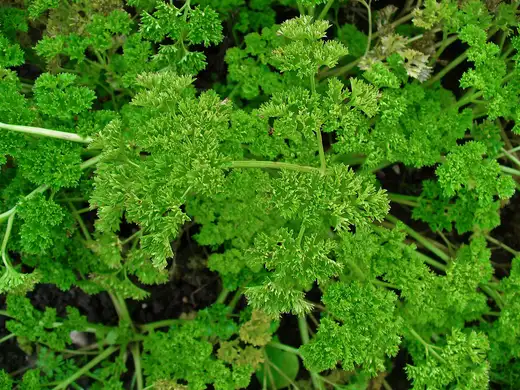
Parsley comes in three types: curly (var. crispum), flat-leaf or Italian (var. neapolitanum), and Hamburg or root parsley (var. tuberosum), which UF/IFAS describes as having white roots like small parsnips. UW-Madison says flat-leaf types have the stronger flavor and may overwinter better than curly ones.
Illinois Extension names ‘Banquet’ as the standard finely curled variety, ‘Plain Italian Dark Green’ as the standard flat-leaf type, and ‘Argon’ as an improved, upright flat-leaf variety.
Harvesting and storing
Colorado State and the UF/IFAS Osceola County calendar both give 70 to 90 days from seed to harvest. Begin when stems are about 8 inches long (NC State, UC Sacramento). Cut the outer stalks near the base and let the center keep growing; for larger amounts, or at the end of the season, cut the whole plant.
To store fresh parsley, Illinois recommends washing it, letting it drip dry and refrigerating it in a plastic bag; Colorado State suggests standing stems in water in the refrigerator. It also freezes well. On drying, the sources disagree: UW-Madison says the leaves keep their flavor when dried, UC Sacramento says they lose flavor, and UF/IFAS says flavor and color hold if the leaves are dried rapidly. Dig Hamburg parsley roots in late fall.
The second year
Parsley is a biennial. Plants that survive winter send up a flower stalk early in their second season, and Illinois notes that the leaves then turn tough and bitter. Start new plants every year, and treat the flowers of old plants as a bonus: UF/IFAS notes that bees and other pollinators visit them.
Problems
- Slow, patchy germination. Soak seed, keep the bed moist, sow into warmer soil or use transplants.
- Septoria leaf spot. UW-Madison calls it the most common parsley disease. It can be carried on seed, so buy quality seed.
- Aphids. The most common insect pest. Natural predators and parasites often control them; hosing plants off keeps numbers down.
- Black swallowtail caterpillars. Parsley is a host plant. UW-Madison says they are seldom numerous enough to do serious damage and can be handpicked or moved to other carrot-family plants such as fennel or Queen Anne’s lace. UF/IFAS notes that even parsley you never harvest feeds the caterpillars.
- Other pests. NC State also lists stem rot, carrot weevil, flea beetles, leafhoppers and tarnished plant bugs.
Questions
Why won't my parsley seeds germinate?
Parsley seed germinates slowly and unevenly even in good conditions. Estimates run from 7 to 12 days (UF/IFAS) to 3 to 6 weeks (UC Cooperative Extension Sacramento), and UW-Madison notes it can take several weeks in cool, wet soil. Soak seed overnight, keep the bed evenly moist and be patient.
Is flat-leaf or curly parsley better?
For cooking, flat-leaf. UW-Madison notes that flat-leaf types contain more essential oil and have a stronger, sweeter flavor, while curly parsley is used mostly as a garnish. Flat-leaf types may also overwinter better.
Does parsley come back the second year?
It often survives winter (Colorado State says it generally does in Colorado), but the second year is short. Parsley is a biennial, so an overwintered plant soon sends up a flower stalk, and Illinois Extension notes its leaves become tough and bitter. That is why most gardeners replant every year.
Can I grow parsley indoors in winter?
Yes. Pot up a garden plant in fall or start new ones, then give them bright light, a cool spot, steady water and regular feeding. NC State recommends bringing parsley inside before temperatures drop into the 20s.
How do I harvest parsley without killing it?
Cut the outer stalks near the base and leave the center to keep producing. NC State says plants are ready when they are about 8 inches tall.
Sources
- Herbs and Spices in the Florida Garden (VH020/CIR570) · UF/IFAS Extension (EDIS)
- Parsley · UF/IFAS Gardening Solutions
- Culinary Herbs to Plant This Fall · UF/IFAS Gardening Solutions
- Osceola County, FL Planting Calendar for Herbs, Spices & Edible Flowers · UF/IFAS Extension Osceola County
- Planting and Harvesting Calendar for Gardeners in Yuma County (az1615) · University of Arizona Cooperative Extension
- Growing Herbs in Tucson (az2061) · University of Arizona Cooperative Extension
- Flavorful Herbs Are Easy to Grow (Oct. 3, 2018) · Texas A&M AgriLife Extension, Galveston County
- Growing Herbs in Texas (E-561) · Texas A&M AgriLife Extension
- Culinary Herb Profiles (EHN 70) · UC Cooperative Extension Sacramento County
- Basic Herbs for a Kitchen Garden · UC Cooperative Extension Tulare/Kings Master Gardeners
- Parsley, Petroselinum crispum · University of Wisconsin-Madison Extension
- Parsley · Colorado State University Extension PlantTalk
- Parsley · University of Illinois Extension
- Parsley · University of Maryland Extension
- Petroselinum crispum (Parsley) · NC State Extension Gardener Plant Toolbox
- Indiana Vegetable Planting Calendar (HO-186-W) · Purdue University Extension