How to Care for Orchids (Phalaenopsis)
Water a moth orchid in the morning by running warm water through its bark until it drains freely, then let the bark dry slightly before the next watering, usually about once a week. Give it bright, indirect light from an east window, days of 70-80°F and nights of 60-70°F. Low light is the most common reason it won't bloom again.
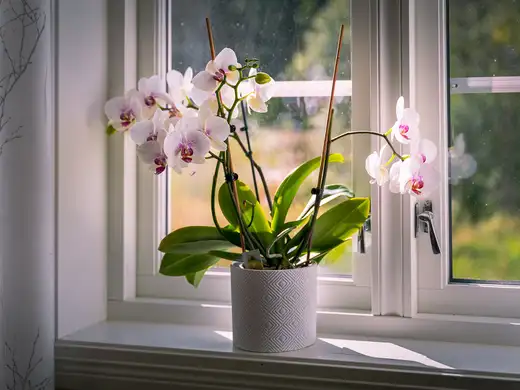

Orchids at a glance
- Botanical name
- Phalaenopsis spp. and hybrids (moth orchid); this guide covers common indoor orchids, mainly Phalaenopsis
- Light
- bright indirect light; an east window is ideal
- Hardiness zones
- 10-11
- Containers
- Yes
This guide covers Phalaenopsis, the moth orchid sold in supermarkets and garden centers, which is the most widely available houseplant orchid. Other orchids, such as Cattleya, Dendrobium and Oncidium, need different light, watering and temperatures. Many of them store water in thick pseudobulbs, which moth orchids lack.
In the wild, moth orchids grow on tree trunks and branches in the tropics, clinging to the bark with their roots. Most of the care below follows from that: roots that need air as much as water, a coarse bark mix instead of soil, and shade rather than full sun.
Light
Give moth orchids bright, indirect light. Iowa State recommends an east or north window and warns that direct sun can damage the leaves, so a south window needs a sheer curtain. NC State also rates an east windowsill best but says well-shaded west and south windows work. University of Maryland adds that in winter’s short days you can move the plant into direct light or a south window.
Leaf color tells you whether the light is right. Light green leaves are what you want. Dark green, stiff leaves mean too little light, and yellow-green leaves with reddish edges mean too much. Under fluorescent lights, Iowa State suggests keeping the tubes 6 to 8 inches above the plant for 12 to 16 hours a day.
Watering
Watering is where moth orchid care most often goes wrong, and the usual mistake is too much. Iowa State warns that plants watered too often are prone to root rot and death; the roots need air around them as much as water.
Water in the morning, in the sink. Run lukewarm water through the bark and over the roots until it flows out the bottom. University of Maryland suggests three or four soakings over about 10 minutes so the bark has time to absorb water. Then let the pot drain completely before it goes back on its saucer. Silvery or white roots turn pale green when they have taken up enough water.
Let the mix dry slightly before the next watering. Under normal room conditions that is about once a week. NC State says to water more often in summer heat, and Iowa State adds more water while the plant is growing actively or in bloom.
Many store-bought plants come potted in sphagnum moss, which stays wet much longer than bark and is hard to rewet once it dries out. Water those plants less often, and NC State recommends moving them into a bark-based orchid mix.
Pot and potting mix
Use a fast-draining orchid bark mix, never regular potting soil, in a pot with excellent drainage. Clear plastic pots are popular because moth orchid roots contain chlorophyll and photosynthesize. Roots that climb over the edge of the pot are normal and shouldn’t be cut off.
Temperature and humidity
Iowa State gives daytime temperatures of 70 to 80°F and nights of 60 to 70°F, and says to avoid temperatures below 55°F. Ordinary room temperatures suit the plant.
Humidity is harder. Moth orchids want 40 to 60 percent relative humidity, and winter air in most homes is well below that. A room humidifier helps, or set the pot on a tray of pebbles and water with the bottom of the pot above the waterline, so the roots don’t sit wet. University of Maryland notes that misting alone doesn’t add enough moisture.
Feeding
Feed lightly while the plant is growing and blooming. NC State recommends a balanced fertilizer at half strength twice a month or at quarter strength weekly. University of Maryland suggests an orchid fertilizer every third or fourth watering, mixed according to the label. Skip feeding in winter. Too much fertilizer produces lush leaves at the expense of flowers.
Getting it to bloom again
With good care, a moth orchid blooms once a year, and the flowers last from a month to four months or more.
- Light first. University of Maryland says low light is the most common reason plants fail to rebloom. Move the plant to a brighter window, or put it outdoors in a shady spot for summer.
- Cool fall nights. Iowa State says nights of 55 to 60°F in fall help start flower spikes. NC State notes that the large white, spring-blooming types need about a week of roughly 55°F nights in autumn, while modern dwarf hybrids bred from summer-blooming species don’t need the chill.
- Cut the old spike. After the flowers fall, NC State suggests cutting just above the first node below the faded flowers, while University of Maryland suggests about 1/2 inch above the second node. Either cut often, though not always, gives a side branch with more flowers. Cut a spike that has turned yellow or brown off at the base.
- Stake tall spikes. Push a thin bamboo, wood or metal stake into the mix, avoiding the roots, and attach the spike loosely with small clips.
Repotting
Replace the bark every year or two, before it breaks down. Repot sooner if the bark looks like mulch, drains poorly and stays wet, or the plant has outgrown its pot. University of Maryland says the best time is when new growth starts, not necessarily right after blooming; NC State says after the flowers fade or as new leaves appear.
Soak the plant if roots cling to the old pot so you can free them without breaking them. Rinse off the old bark, cut away dead or mushy roots, and hold the plant over the new pot while you fill in fresh bark around the roots. Water to settle the bark.
Propagation
Iowa State lists moth orchids among the houseplants best propagated by offsets. If a small plantlet forms on the plant, separate it when it has its own leaves and roots and pot it in fresh orchid bark, ideally when you repot. Store-bought plants come from commercial growers, mostly in Taiwan and the Netherlands.
Problems
- Buds drop before opening (bud blast): a sudden change in temperature, humidity, watering, fertilizer or location. Keep conditions steady once buds form, and avoid moving the plant.
- Wrinkled, limp leaves: not enough water reaching the leaves. The mix may be too dry, the air too dry, or the roots rotted by soggy mix. Check the roots: healthy ones are firm, rotted ones are brown and mushy.
- No flowers: too little light, or for large white types, no cool fall nights.
- Scale and mealybugs: the pests most likely to appear. Look along leaf undersides and where leaves join.
- Spots on the flowers: Botrytis, a fungal disease of the blooms. Remove spotted flowers.
Pets and children
The ASPCA lists Phalaenopsis as non-toxic to dogs, cats and horses.
Outdoors
NC State rates moth orchids hardy in zones 10-12 (its plant data lists 10a-11b), so elsewhere they are grown as houseplants or in greenhouses. In colder climates, a plant that isn’t reblooming can spend summer outdoors in a shady spot. University of Maryland says to bring it back in when evening temperatures dip into the 50s; letting it feel those cooler fall nights first helps it set buds.
Questions
How often should I water a Phalaenopsis orchid?
About once a week for a mature plant under normal room conditions, more often in summer heat or while it is blooming. Let the bark dry slightly between waterings and never leave the pot standing in water.
Where should I cut the flower spike after blooming?
NC State says to cut just above the first node below the faded flowers; University of Maryland suggests about 1/2 inch above the second node. Either cut can produce a side branch with more flowers. Cut a spike that has turned yellow or brown off at the base.
Why won't my orchid bloom again?
Usually too little light. Move it to a brighter window or, in summer, outdoors to a shady spot. Cool fall nights of about 55-60°F also help large-flowered types start new spikes.
Should I cut off the roots growing outside the pot?
No. Moth orchids naturally grow on tree bark and send out aerial roots, and roots that sprawl over the pot edge are normal. Only trim roots that are dead or rotted when you repot.
Are orchids poisonous to cats and dogs?
The ASPCA lists Phalaenopsis as non-toxic to dogs, cats and horses.
Why are my orchid's leaves wrinkled?
The leaves aren't getting enough water. Either the bark has been kept too dry, the air is too dry, or the roots have rotted in soggy mix and can no longer take up water.
Sources
- How to Propagate Houseplants by Division and Offsets · Iowa State University Extension and Outreach
- Phalaenopsis (Moon Orchid, Moth Orchid) · NC State Extension, North Carolina Extension Gardener Plant Toolbox
- Care of Phalaenopsis Orchids (Moth Orchids) · University of Maryland Extension
- What is the proper care for a moth orchid? · Iowa State University Extension and Outreach, Yard and Garden
- Toxic and Non-toxic Plants: Phalaenopsis Orchid · ASPCA Animal Poison Control Center