How to Grow Okra
Sow okra in full sun 2 to 3 weeks after the last frost, once the soil is at least 65°F at 4 inches deep, and soak the seed first to speed germination. Plants bear about 60 to 70 days after sowing. Pick pods at 2 to 4 inches long every day or two until frost.

Your dates for okra
Set your ZIP code at the top of the page and we will work out when to plant okra where you live, from the frost records of the nearest NOAA weather station. Your ZIP code is remembered on this device only.
Okra at a glance
- Botanical name
- Abelmoschus esculentus
- Light
- full sun (6-8+ hours)
- Frost tolerance
- Tender: killed by frost
- Soil temperature to plant
- At least 65°F (best 70–95°F)
- Germination
- 7–13 days
- Days to harvest
- 60–70 days from seed; 50–60 days from transplanting
- Planting depth
- 1 inch
- Spacing
- 12–18 inches apart, rows 36–48 inches apart
- Containers
- Yes, at least 5 gallons
When to plant okra
| Zone | Start indoors | Plant out | Sow outdoors |
|---|---|---|---|
| Zone 2a | Apr 7 to 21 | May 19 to Jun 9 | Jun 2 to 9 |
| Zone 3a | May 28 to Jun 11 | Jul 9 to 30 | Jul 9 to 16 |
| Zone 3b | May 18 to Jun 1 | Jun 29 to Jul 20 | Jun 29 to Jul 6 |
| Zone 4a | May 8 to 22 | Jun 19 to Jul 10 | Jun 19 to 26 |
| Zone 4b | May 1 to 15 | Jun 12 to Jul 3 | Jun 12 to 19 |
| Zone 5a | Apr 26 to May 10 | Jun 7 to 28 | Jun 7 to 14 |
| Zone 5b | Apr 25 to May 9 | Jun 6 to 27 | Jun 6 to 13 |
| Zone 6a | Apr 23 to May 7 | Jun 4 to 25 | Jun 4 to 11 |
| Zone 6b | Apr 18 to May 2 | May 30 to Jun 20 | May 30 to Jun 6 |
| Zone 7a | Apr 12 to 26 | May 24 to Jun 14 | May 24 to 31 |
| Zone 7b | Apr 2 to 16 | May 14 to Jun 4 | May 14 to 21 |
| Zone 8a | Mar 20 to Apr 3 | May 1 to 22 | May 1 to 8 |
| Zone 8b | Mar 10 to 24 | Apr 21 to May 12 | Apr 21 to 28 |
| Zone 9a | Feb 23 to Mar 9 | Apr 6 to 27 | Apr 6 to 13 |
| Zone 9b | Feb 16 to Mar 2 | Mar 30 to Apr 20 | Mar 30 to Apr 6 |
Heat is the whole game
Okra is a hibiscus relative from Africa that thrives where summers are long and hot. Clemson gives 75 to 90°F as its best growing range, and Utah State notes that yields are highest when temperatures stay above 65°F. Frost injures it, and cold soil does more damage than gardeners expect: root rots and damping-off in cold, wet ground are the most serious okra problems, according to Clemson.
Give it full sun and well-drained soil. Sandy loam rich in organic matter is ideal, but nearly any soil works if it doesn’t stay wet. Clemson targets a pH of 5.8 to 6.5, and Utah State 6.0 to 7.0. In Utah’s alkaline soils (pH 7.0 to 8.5), Utah State suggests sulfur or peat moss to bring the pH down. Alabama advises amending unimproved sandy or heavy clay soil with organic matter.
Planting
Sow outdoors 2 to 3 weeks after your last frost (see the dates for your zone above). Clemson and Maryland want the soil at least 65°F, and Clemson checks it at 4 inches deep; Utah State waits for 75°F. Clemson’s germination optimum is 70 to 95°F. The when to plant okra page covers regional windows in more detail.
Okra’s hard seed coat causes slow, uneven emergence. Soak seed before planting: Alabama soaks for 6 hours, Utah State overnight and Maryland 12 to 24 hours. Maryland also suggests scratching the seed with sandpaper. Clemson warns that soaking helps but won’t prevent seedling death in cold soil.
Plant ¾ inch deep (Clemson) to 1 inch (Utah State, Alabama). Many gardeners drop two or three seeds per spot and thin to the strongest. Final spacing depends on the source and the plant size:
- Clemson: 9 to 12 inches apart in rows 3 to 6 feet apart.
- Maryland: 12 to 18 inches apart in rows 3 to 4 feet apart.
- Utah State: 1 to 2 feet apart, depending on variety size, in rows 3 feet apart.
Clemson stresses that you should leave only one plant per spot, because crowding severely cuts yields.
In short-season areas, start transplants indoors: 5 to 6 weeks before frost danger ends (Maryland), 4 to 5 weeks before transplanting (Utah State) or up to 6 to 8 weeks (Alabama). Alabama transplants at 3 or 4 leaves after a week of hardening off. Black plastic mulch raises soil temperature and controls weeds, and Utah State credits it with better growth and production.
Varieties
- South Carolina (Clemson): Clemson Spineless 80, Lee, Annie Oakley II, Cajun Delight and the red-podded Burgundy, which turns green when cooked.
- Florida (UF/IFAS): Clemson Spineless, Emerald, Annie Oakley II and Cajun Delight.
- Utah and other cool, short-season areas (Utah State): Annie Oakley II, a compact hybrid, or other dwarf or early varieties.
- Containers (Wisconsin Extension): Carmine Splendor, Clemson Spineless and Porch Pick.
Feeding and watering
Okra balances leaf growth against pod production, and early nitrogen tips it toward leaves. Without a soil test, Clemson applies 25 to 50 pounds of 10-10-10 per 1,000 square feet before planting, and Utah State uses 2 to 3 pounds per 100 square feet. Then side-dress:
- Clemson: 1 to 2 pounds of calcium nitrate per 100 feet of row at 3 to 4 weeks and again at 6 to 8 weeks after planting, with more later if rain is heavy or the harvest runs long.
- Utah State: ¼ pound of 21-0-0 per 100 square feet when pods begin to size, repeated 4 weeks later.
- Alabama: an all-purpose fertilizer 4 to 6 inches from the stem after the first harvest.
Okra handles dry spells better than most vegetables, but water increases yield. Alabama recommends 1 to 2 inches a week, more in hot weather, and Utah State 1½ to 2 inches every 7 to 10 days for maximum yields. Clemson wants the soil moistened 6 inches deep, since light watering keeps roots shallow, and calls pod set and development the critical period. Water in the morning, ideally by drip. A 2- to 3-inch organic mulch conserves moisture and smothers weeds.
Maryland pinches the growing tips when plants reach 24 inches to encourage branching and more pods.
Ratooning in the South
Where summers are long, production often slows in the hottest, driest weeks. Between mid-July and mid-August, Clemson suggests cutting plants back to 6 to 12 inches above the ground, applying 2 to 3 pounds per 100 feet of row of a fertilizer with a 1:2 nitrogen-to-potassium ratio (such as 5-0-10), and watering frequently. Expect new pods in about 4 to 6 weeks, continuing until frost.
Problems
- Root-knot nematodes: stunted, yellowing plants with galled roots, a serious problem in sandy soils. Pull suspect plants to check, remove infested roots, and don’t plant okra after tomatoes, peppers, squash or sweet potatoes (Clemson).
- Aphids: cluster under leaves and leave sticky honeydew, often tended by ants. Knock them off with a strong water spray or use insecticidal soap. Clemson notes that limiting nitrogen helps.
- Stink bugs and leaffooted bugs: cause twisted, distorted pods. Corn earworms feed on pods.
- Small pods rotting after the flower drops: the cause is unknown, but Clemson says full sun, good air movement and proper spacing reduce it.
- Seedlings dying after emergence: root rot or damping-off from cold, wet soil. Plant later, in well-drained beds.
Harvest
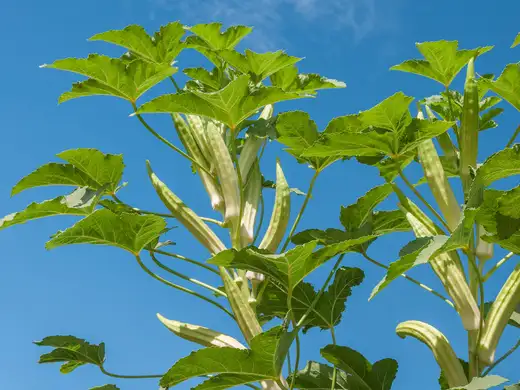
Pods are ready 1 to 3 days after the flower opens, at about 2 to 4 inches long (Clemson prefers 2 to 3 inches). They grow fast, so pick at least every other day. A missed pod becomes woody and restricts further flowering, so cut off any overgrown pods even if you won’t eat them. Round-podded varieties stay tender at larger sizes.
Many plants have spines, so wear gloves and cut pods with pruners or a knife; the branches are brittle and break easily. Properly fed, watered and picked, plants bear for up to about 12 weeks (Clemson), and Maryland expects 10 to 15 pounds per 10-foot row. Store pods unwashed in a bag in the refrigerator at 45 to 50°F, and use them within a week, before they pit and darken.
Questions
Should I soak okra seeds before planting?
Yes. The hard seed coat slows germination. Alabama Extension soaks seed for 6 hours, Utah State overnight and Maryland 12 to 24 hours, and Maryland also suggests nicking the coat with sandpaper. Soaking won't save seed planted into cold soil, though.
How big should okra be when you pick it?
About 2 to 4 inches long, usually 1 to 3 days after the flower opens. Larger pods turn tough and fibrous, although round-podded varieties stay tender longer.
Why did my okra stop producing?
Pods left on the plant to mature stop new flowering, so remove every overgrown pod. Production can also stall in the hottest, driest part of summer, when Clemson suggests ratooning (cutting back) the plants.
How many okra plants do I need?
Utah State says four or five plants supply most families, plus a plant or two if you plan to freeze okra. Clemson suggests 25 to 50 feet of row to feed a family for a few months.
Can you grow okra in a container?
Yes. Alabama Extension recommends one plant per 5- to 7-gallon container and suggests dwarf varieties, which are less likely to topple.
Sources
- Okra in the Garden · Utah State University Extension
- Growing Okra in a Home Garden · University of Maryland Extension
- Okra (HGIC factsheet) · Clemson Cooperative Extension Home & Garden Information Center
- Florida Vegetable Gardening Guide (SP103/VH021) · University of Florida IFAS Extension
- Vegetable Planting Calendar for Maricopa County (AZ1005) · University of Arizona Cooperative Extension
- GN 154: Soil Temperature Conditions for Vegetable Seed Germination (Harrington emergence table) · UC Cooperative Extension, Sacramento County (UC ANR)
- Grow More, Give More: Okra (ANR-2876-A) · Alabama Cooperative Extension System
- Vegetable Varieties for Containers · University of Wisconsin-Madison Extension, Bayfield County