How to Grow Mushrooms at Home
Oyster mushrooms are the fastest home crop: a ready-made kit fruits 7-10 days after soaking, and a bag of pasteurized straw gives its first flush about 25 days after you add spawn. Shiitake on freshly cut hardwood logs takes 6-18 months to start but then fruits for 3-5 years. Neither needs frost dates, direct sun or garden soil, only the right substrate, moisture and temperature.
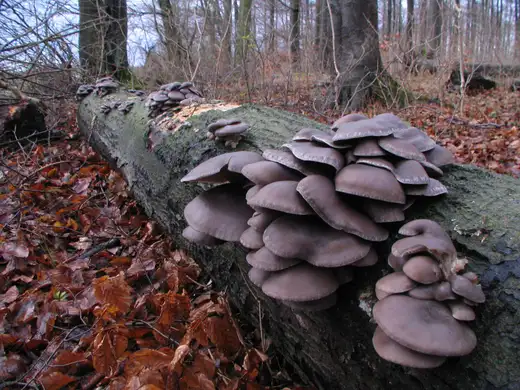

Mushrooms at a glance
- Botanical name
- Pleurotus ostreatus (oyster), Lentinula edodes (shiitake)
- Light
- No sunlight needed for growth (fungi do not photosynthesize); oyster mushrooms need some light to start fruiting, and outdoor shiitake logs belong in shade
- Containers
- Yes
Pick the right mushroom for your space
Mushrooms are the fruiting bodies of fungi. They cannot make their own food, so they live by digesting a substrate: straw, sawdust, wood or other plant material rich in cellulose. Growing them is mostly about giving the fungus clean food, steady moisture and the right temperature, then triggering it to fruit.
Two species suit beginners, and UF/IFAS recommends both as the easiest to start with:
- Oyster mushrooms (Pleurotus ostreatus) grow fast on straw indoors, in a closet, basement or spare room. They are delicate and ship poorly, which is why they are less common in stores (UF/IFAS).
- Shiitake (Lentinula edodes) grow slowly on hardwood logs outdoors in shade, or on sawdust blocks indoors. A log is a multi-year investment that rewards patience.
UF/IFAS warns against the golden oyster mushroom (Pleurotus citrinopileatus), which has become invasive. Check the species name before you buy a kit or spawn.
UF also notes that indoor growing gives more continuous and predictable fruiting than outdoor growing. If you want mushrooms this month, start with oysters. If you have shade, a supply of fresh hardwood and a year to wait, add shiitake logs.
Start with a kit
A kit is the surest first step. A typical oyster kit is a perforated plastic bag of straw already fully colonized by mycelium, the white threadlike body of the fungus. UF/IFAS says you soak the bag, set it somewhere suitable, and mushrooms form on the outside in about 7-10 days.
Shiitake kits usually come as a “mushroom block” of hardwood sawdust and cellulose such as soy hulls, often pre-inoculated. Follow the instructions that come with the kit, since methods vary by supplier.
A kit teaches you what healthy mycelium looks and smells like and what the pinhead stage looks like. That makes your first homemade straw bag far more likely to succeed.
Grow oyster mushrooms on straw
Once a kit has worked, buying spawn (living mycelium on grain or sawdust, the mushroom equivalent of seed) and making your own bags is cheap. UF/IFAS lists wheat straw as an excellent substrate, along with rice stalks, corn cobs, coffee grounds, peanut shells, cotton pulp, banana leaves and paper. Their step-by-step method:
- Cut straw into 4- to 5-inch pieces and soak it overnight.
- Drain it, then pasteurize it by holding it in a 165°F water bath for 1-2 hours. Pasteurizing kills most competing molds and bacteria without sterilizing the straw.
- Drain for about an hour. Clean your work table and room now, because contamination usually enters between pasteurizing and sealing the bag. Inoculate as soon as the straw has cooled.
- Mix in spawn at 5-10% of the straw by volume or weight, either all at once or in alternating layers as you fill the bags.
- Pack bags about 10-12 by 20-24 inches tightly, with no large air gaps, until each feels like a firm pillow. Tie them shut and cut 10-15 small cross-shaped slits, about 1/4 inch long and 4-6 inches apart, in two rings near the top and bottom.
- Incubate the bags in a clean, dark place at 75-77°F and 80-90% relative humidity, raised off the floor on blocks. An upturned plastic bin with wet towels or cups of water underneath works.
- After 2-3 weeks the whole bag should be white. Move it to fruiting conditions: about 68°F, 90% humidity, some light, and enough fresh air that carbon dioxide does not build up. UF/IFAS shows a laundry hamper used as a fruiting chamber.
Pinheads appear at the slits and expand into clusters. In the UF/IFAS guide, the first flush was ready about 25 days after the bags went into incubation, and a bag gives 2-4 more flushes depending on strain and conditions.
The two temperature stages matter. Mycelium grows fastest in warmth and darkness, while the drop to about 68°F, plus light, is what tells oysters to fruit. A bag left warm and dark stays a block of white mycelium.
Choose and cut shiitake logs
Log quality decides most shiitake success or failure. Ohio State traces many pest and disease problems back to logs that were not freshly cut, because every week a log sits, wild fungi move in and later outcompete the shiitake.
Species. Oak is the standard. Ohio State prefers white oaks for their thicker bark, and rates sugar maple, sweetgum, American beech and ironwood as excellent too. Illinois Extension calls sugar maple the best widely available wood in central Illinois, and UF/IFAS names oak as the best choice for Florida. Sources differ on lighter woods: UF lists sweetgum, red maple and poplar as usable in Florida, while Ohio State calls poplar unsuitable and red maple suitable only with warm-weather strains. Conifers, fruit trees, walnut, ash, locust and elm do not work.
Size. Illinois recommends logs 4-6 inches across and no more than 3 feet long, and Ohio State uses 4-6 inches by 3-4 feet. UF accepts 2-7 inches across and 3-4 feet long. Large logs take longer to colonize. Look for intact bark and a thick layer of sapwood, since sapwood stores the sugars the fungus feeds on.
Timing. Cut trees while they are dormant, after leaf drop and before buds swell. In Florida, UF says that means December to early February. Dormant wood holds the most stored carbohydrate. Ohio State says many suppliers now recommend inoculating from one day to three weeks after felling, though winter-cut logs keep longer. Illinois puts the outer limit at about 4 months, and Ohio State warns that logs left more than 90 days are more likely to fail. Keep cut logs shaded, out of the wind and off the ground until you inoculate.
Inoculate the logs
Use plug (wooden dowel), sawdust or thimble spawn for logs. Ohio State says grain spawn is meant for indoor sterilized substrates, not logs. Good spawn is moist, white and fuzzy, and smells earthy. Pink or green patches or a moldy smell mean contamination. Store it in the refrigerator at about 40°F, never in the freezer, and use it within the supplier’s time limit.
Drill holes in offset rows to form a diamond pattern. Illinois spaces holes 4-6 inches apart and about 1 inch deep. Ohio State goes tighter, about 3 inches apart along rows 3-4 inches apart, and about 1¼ inches deep. Closer holes cost more spawn but colonize faster, so the shiitake gets ahead of wild fungi. Mycelium runs easily along the grain and poorly across it, which is why holes sit closer within a row than between rows.
Fill each hole immediately, tap plugs in with a hammer, and seal every hole with melted food-grade, cheese or paraffin wax. Also seal branch stubs and bark wounds. Ohio State advises against waxing the cut ends of the log, which locks out moisture. Wipe the drill bit with rubbing alcohol between logs, and tag each log with the strain and wood species.
Strain choice matters as much as wood. Cold-weather strains fruit in early spring and late fall and colonize slowly. Warm-weather strains fruit in summer and early fall. Wide-range strains colonize quickly and fruit across a broad span of temperatures. Ohio State suggests pairing a cold-weather strain for spring and fall with a heat-tolerant one for summer.
Keep logs alive during the spawn run
The months between inoculation and the first mushroom are the spawn run. The goal is to keep the log moist and shaded while the mycelium spreads. Ohio State says logs that drop below about 25% moisture lose the fungus, and the mycelium grows best at log temperatures of 72-77°F. Temperatures above 105°F generally kill it.
Stack logs in deep shade with good air movement but no strong wind. Ohio State likes the north side of a building or a spot under conifers, which shade year-round. Illinois suggests stacking logs tightly under a tree and covering them with a fruiting blanket or old sheet for the first 4-6 months. Water weekly if rain does not do it, and soak logs during hot, dry spells. Ohio State finds occasional thorough soakings better than frequent light sprinkles, which only wet the bark. Moisture meters read shiitake logs poorly, so weigh a few logs right after inoculation and compare their weight during dry weather.
Too much water is a problem too. UF warns that a log kept constantly wet will rot, so water only when it starts to dry out. Keep logs off bare soil on pallets, gravel or spare logs to reduce weed fungi and termites.
Signs that a log is nearly ready: spongy bark, a dull thud instead of a ring when you knock it, and white mycelium showing on the cut ends.
Get logs to fruit
The first flush usually comes on its own after a soaking rain or a temperature swing, and Ohio State recommends letting it happen naturally. After that, wide-range strains can be “forced” by soaking logs in cold, clean water. Ohio State’s soak times are 6-24 hours in summer and 2-3 days in spring or fall, because the closer the water temperature is to the air temperature, the longer the soak needs to be. Cold-weather strains and some warm-weather strains do not respond to forcing, and frequent forcing shortens a log’s productive life.
Pins appear 3-5 days after soaking. They form best at 55-65°F with relative humidity of at least 85%. Stand logs upright in an A-frame or lean them against a fence so you can reach every side. Light is needed now: Ohio State’s guide is enough to read a newspaper at arm’s length. Shield pinning logs from rain, because shiitake soak up water like sponges and turn soggy.
Each flush lasts one to two weeks. Then rest the log. Ohio State rests logs 1-3 months, and UF says 2-4 months, before soaking again. A well-made log produces for 3-5 years by UF’s count, or 3-4 years by Ohio State’s.
Try a wine cap bed outdoors
Illinois Extension describes a third method: outdoor beds of straw, wood chips, finished compost and sometimes leaves or topsoil, layered with colonized grain or sawdust spawn. Wine cap, also called king stropharia or garden giant (Stropharia rugosoannulata), is the main species grown this way. Like logs, beds fruit after rain or a weather swing. Extension guidance on bed depth and timing is still thin, so follow your spawn supplier’s directions. Whatever you grow outdoors, Ohio State’s rule applies: confirm the species of every mushroom before you eat it.
Harvest and storage
Pick oysters while the caps are still rounded at the edges, before they flatten. UF says young oysters are the most tender and mild. Twist clusters off gently or cut them flush with the bag.
Pick shiitake when the cap is 50-75% open and the rim is still rolled under. Ohio State finds that fully opened caps store poorly, delay the next flush and attract pests. Hold mushrooms by the stem, since bruised caps and gills darken fast. Harvest from the bottom of the log upward so bark flecks don’t fall onto unpicked mushrooms.
Put the harvest in a basket, a paper bag or a vented box, never sealed plastic, and chill it quickly. Ohio State aims for 33-35°F and notes that frost-free refrigerators dry mushrooms out. Utah State suggests a paper bag in the refrigerator, with about 5 days of shelf life. For longer storage, Utah State says to cook mushrooms before freezing rather than freezing them raw.
Regional notes
Cold North and Midwest. Cold-weather strains suit long, cool springs and falls. Cut logs in winter and inoculate in late winter or spring. Ohio State suggests a trick for cool sites: in a lean-to stack, raise the north ends of the logs so they catch more sun, which speeds colonization and stretches the season. Indoor oyster bags fill the winter gap.
Humid South and Gulf Coast. UF/IFAS favors indoor growing in Florida. Outdoors, use oak, a heat-tolerant strain and deep shade, and watch for rot, since humid air and rain keep logs wet. In very warm climates, Ohio State suggests raising the south ends of lean-to logs to reduce sun on the bark. Slugs are worst in wet weather.
Arid West and desert Southwest. Dry wind is the enemy. Ohio State says open, sunny, windy sites need frequent watering and windbreaks or covers, and recommends low stacking angles in dry climates because air near the ground is calmer and more humid. Indoor bags and blocks avoid the problem entirely.
Warm-winter zones 9-11. Cold-weather strains are a poor match without a real cool season, and because temperatures above 105°F kill shiitake mycelium, logs need the deepest shade you have. Indoor oyster bags in air-conditioned space are the most reliable choice. UF/IFAS even suggests an air conditioner to hold a fruiting chamber near 68°F.
Problems and fixes
- Green, blue, black or yellow spots on oyster bags. These are contaminants such as Trichoderma, which shows as fast green growth. Causes are short pasteurization, a dirty work area or delay before inoculating. Discard heavily contaminated bags. UF says a lightly affected bag may still give one flush.
- Bag stays white, no mushrooms. It is still too warm or too dark, or the air is stale. Drop it to about 68°F, add light and fresh air, and keep humidity near 90%.
- Other fungi on logs. Turkey tail, false turkey tail, split gill and violet-toothed polypore are signs of a log cut too long before inoculation or one that touched soil. The fix is fresh logs next time. Some look-alikes such as Galerina marginata are poisonous.
- Long stems, small caps on shiitake. Too little fresh air or too much shade. Open up the stack or thin the canopy.
- Wide, flat caps. Picked too late. Check logs daily during a flush.
- Waterlogged mushrooms. Rain during fruiting. Cover logs with a tarp or fruiting blanket once pins form.
- Log never fruits. Possible causes: it dried below about 25% moisture, the wood species was wrong, it was a cold-weather strain you tried to force, or it simply needs more time. Large logs can take up to two years.
- Slugs. These are the most damaging log pest in wet weather. Lay wet cardboard or boards near logs, check each morning and destroy the slugs. Iron phosphate baits work, and gravel under the logs helps.
- Termites and boring beetles. Keep logs off the ground and away from buildings, and cover logs during beetle egg-laying periods.
- Squirrels and other wildlife. Harvest promptly. Fencing or other barriers help where losses are heavy.
Questions
What is the easiest mushroom to grow at home?
Oyster mushrooms from a ready-made kit. UF/IFAS says the colonized straw bag only needs soaking, and mushrooms are ready about 7-10 days later.
How long does a shiitake log take to produce mushrooms?
Usually 6-18 months after inoculation according to UF/IFAS, and 6-12 months according to Illinois Extension. Ohio State gives a wider range of six months to two years, with large logs taking longest.
Do mushrooms need light to grow?
They do not need light to feed, because fungi do not photosynthesize. Oyster bags need some light to start fruiting, and Ohio State says shiitake logs need about enough light to read a newspaper at arm's length.
Can I use any wood for shiitake logs?
No. Oak, sugar maple and sweetgum work best. Ohio State lists conifers, fruit trees, walnut, ash, locust and elm as unsuitable, and the logs must come from healthy, freshly cut trees.
Why is my oyster mushroom bag turning green?
Green growth is usually Trichoderma mold, a contaminant that comes from incomplete pasteurization or a dirty work area. UF/IFAS advises discarding heavily contaminated bags.
How do I store homegrown mushrooms?
Refrigerate them in a paper bag or a vented container, not airtight plastic. Utah State says they keep about 5 days, and Ohio State recommends cooling shiitake to 33-35°F as fast as possible.
Sources
- Shiitake Mushroom Production: Inoculating Logs with Spawn (F-0040) · Ohio State University Extension (Ohioline)
- Shiitake Mushroom Production: Logs and Laying Yards (F-0041) · Ohio State University Extension (Ohioline)
- Shiitake Mushroom Production: Fruiting, Harvesting, and Storage (F-0042) · Ohio State University CFAES
- Shiitake mushroom production: Steps to cultivation and considerations for production (F-0039) · Ohio State University CFAES
- Bed Farming (Mushrooms) · University of Illinois Extension
- Growing Mushrooms at Home · UF/IFAS Gardening Solutions
- D.I.Y. FunGuide: Grow Your Own Oyster Mushrooms at Home (SS662) · UF/IFAS Extension (EDIS)
- Your guide to growing shiitake mushrooms at home · University of Illinois Extension
- Shiitake Mushroom Production: Troubleshooting · Ohio State University CFAES (Ohioline F-0105)
- Fruit and Vegetable Guide Series: Mushrooms · Utah State University Extension