How to Grow Microgreens
Microgreens are vegetable and herb seedlings cut at 1.5-3 inches tall, usually 7-21 days after sowing. Sow seed thickly on moist seed-starting mix or coir in a shallow tray, keep it covered and dark for a few days, then give bright light and a fan. Radish and pea shoots are ready first, and they grow indoors in every month and every climate.
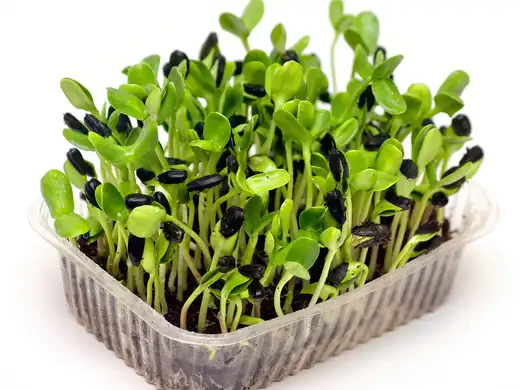

Microgreens at a glance
- Botanical name
- Various (e.g. Brassica, Raphanus, Pisum, Ocimum spp.)
- Light
- Low-light crop: bright window or grow lights (USU suggests about 18 hours of light per day; Penn State puts daily light needs below 20 mol/m2/day)
- Soil temperature to plant
- At least 60°F (best 60–75°F)
- Days to harvest
- 7–21 days from seed
- Containers
- Yes
What to grow
Almost any vegetable or herb with tasty seedlings works. Penn State lists more than 30, from amaranth and arugula to shiso and tatsoi, the University of Kentucky adds buckwheat, nasturtium and popcorn, and Utah State grows sunflower. Lettuce is usually too delicate. Grow one crop per tray, because crops germinate and grow at different speeds. If you want a mix, sow crops with similar timing together or combine them after harvest.
Mississippi State groups crops by speed, which is the most practical way to plan:
- 7-10 days: pea shoots and radish.
- 10-15 days: arugula, broccoli, cress, cabbage, kale, mustard, pac choi and kohlrabi.
- 16-25 days: amaranth, basil, beet, carrot, cilantro, parsley, scallion and Swiss chard. Utah State puts cilantro at 21-28 days.
For Mississippi home gardeners, MSU recommends varieties including ‘Dwarf Grey Sugar’ pea, ‘Hong Vit’ and ‘Red Rambo’ radish, ‘Ruby Streaks’ mustard, ‘Red Russian’ and ‘Blue Curly’ kale, ‘Red Garnet’ amaranth, ‘Bull’s Blood’ beet, ‘Santo Monogerm’ cilantro and ‘Evergreen Hardy White’ scallion. The list was written for Mississippi, but indoor trays make local climate far less important than it is for garden crops.
Buy untreated seed, ideally sold for microgreens. The University of Kentucky warns that fungicide-treated seed can leave chemical residue in seedlings, and Penn State notes that some seed coats stay attached and get eaten. MSU suggests buying in bulk, since garden-center packets are too small to be economical.
Trays and growing media
Use a shallow tray with drainage holes. A standard 10-by-20-inch “1020” flat is the norm, but Utah State says pie tins and takeout containers work too. Fill it with an inch or two of seed-starting mix or coconut coir, or use a hydroponic grow mat. Mats give the cleanest harvest because there is no loose soil to stick to the stems. Penn State recommends fresh media for every crop to limit disease. Kentucky calls sterile soilless media essential.
Moisten the media before sowing. Utah State wets coir until a squeezed handful drips nothing but leaves your hand wet. Then it sets the tray in a second, solid tray holding 2 cups of water for 30 minutes and pours off whatever is left.
Sowing
Microgreens are sown far more thickly than garden seed. You want a dense carpet, but not so dense that the seedlings stretch and rot.
Rates vary by source and seed size. Penn State has good results with 10-15 grams of seed per standard 10-row seeding flat (about 12 by 20 inches) for most crops, and notes that a tablespoon of brassica seed weighs about 11-12 grams. Utah State uses heavier rates per 1020 tray: 10 grams for arugula, 28 for broccoli, kale and basil, 42 for radish, 48 for sunflower and 150 for pea. Penn State advises lighter seeding in summer than in winter.
Soak big seeds first. Utah State soaks peas about 6 hours and sunflower about 12. Small seeds go on dry. Scatter seed evenly. Penn State starts at the edges and works inward so the corners aren’t bare. A thin dusting of mix or vermiculite over the seed keeps moisture even and gives a more uniform stand.
Blackout, then light
Utah State’s method produces straight, even stands:
- Set a second 1020 tray directly on the seed and weight it with 2-5 pounds, such as a piece of plywood cut to fit. The weight keeps seed in contact with the media so roots drive down instead of lifting the seed.
- Halfway through the dark period, flip the top tray over so it covers the seedlings without touching them. They stretch a little in the dark, which makes them easier to cut.
- Then uncover and give light. Covered time runs 1-2 days for arugula, kale and radish, 3 days for pea and sunflower, 4-7 days for basil and up to 7-14 days for cilantro.
Microgreens are a low-light crop by Penn State’s measure, and they tolerate less-than-ideal conditions because they grow for such a short time. A sunny south window works. Grow lights on an 18-hour timer give the most control. Penn State gives ideal temperatures of 60-75°F for the media and 60-70°F for the air. Utah State germinates at 74°F, then holds 72°F with lights on and 68°F with lights off.
Water and airflow
Water from below. Set the tray in a tub of shallow water until the media is wet, then lift it out. Penn State stresses keeping leaves and stems dry, because wet foliage in a dense stand is how disease starts. Run a small fan on gentle for constant airflow, as Utah State advises, especially in a hot, sunny window.
Harvest and storage
Cut when the seed leaves are fully open and the first true leaves are just appearing, at roughly 1.5-3 inches tall. Utah State suggests experimenting, since you can cut earlier if you like the flavor. Use sharp scissors and cut well above the media, leaving the roots behind. Penn State found that electric clippers tear stems and shorten storage life. Pick hard seed hulls off beet and chard microgreens before eating (Mississippi State).
Penn State averaged about 0.3 pound of greens per tray on a two-week cycle. Microgreens are highly perishable. Rinse and chill them right away. Penn State reports 10-14 days of storage in the dark at 41°F versus 2-4 days at room temperature. For a steady supply, sow new trays on a regular schedule. The University of Kentucky notes that growers need continuous succession plantings to keep microgreens coming.
Climate notes
Microgreens ignore frost dates, so they grow indoors in every month and in every zone. In winter, short days in the North make grow lights more important. In hot regions such as the Gulf Coast, desert Southwest and zones 9-11, keep trays out of direct afternoon heat and run the fan, because warm, humid, crowded trays are exactly what damping-off fungi favor.
Problems and fixes
- Seedlings collapse at the base (damping-off). Pythium, Phytophthora, Rhizoctonia or Botrytis, favored by warmth, humidity and crowding. Sow thinner, use fresh sterile media, water from below and keep air moving. Penn State found damping-off was the only disease problem in its trays.
- Gray fuzz or rot on the stand. Botrytis or Sclerotinia. Improve sanitation and air circulation.
- Tall, floppy, pale stems. Too little light or seed sown too thickly.
- Uneven germination. Seed lost contact with dry media. Pre-moisten the media, weight the cover tray, and dust a little mix over the seed.
- Grit in the harvest. Cut higher, or switch to grow mats, and wash before eating.
- Aphids or thrips. These turn up occasionally in greenhouses and high tunnels.
Questions
What is the difference between microgreens and sprouts?
Sprouts are germinated seeds eaten whole, before true leaves form. Microgreens grow in a medium with light and are cut above the roots at about the first true-leaf stage (University of Kentucky).
Do microgreens need grow lights?
Not always. A bright south-facing window works, but Utah State notes that winter days can be as short as 8 hours there and suggests lights on a timer for 18 hours a day for the most control.
Can you regrow microgreens after cutting?
Most crops do not regrow, so trays are cut once. Mississippi State says pea shoots can be recut once and scallions several times at about 2-week intervals.
How long do microgreens last in the refrigerator?
Penn State reports 10-14 days in dark storage at 41°F, compared with 2-4 days at room temperature. Avoid temperature swings, which cause condensation and spoilage.
Do microgreens need fertilizer?
Fast crops such as radish, broccoli and other brassicas need none (University of Kentucky). Slower crops can benefit from a weak feed, and Penn State uses a solution of 50-100 ppm nitrogen.
Sources
- Growing Microgreens · Penn State Extension
- Grow Your Own Microgreens · Utah State University Extension
- Microgreen Varieties for the Mississippi Gardener (P2884) · Mississippi State University Extension
- Microgreens - Crop Profile (CCD-CP-104) · University of Kentucky Center for Crop Diversification