How to Grow Marigolds
Marigolds want full sun, well-drained soil of only moderate fertility, and a spot that won't get frost. Sow seed 1/4 inch deep after your last frost, or start it indoors 4 to 6 weeks earlier (8 weeks for tall African types). Deadhead regularly and go easy on nitrogen, and the plants will bloom from early summer until a hard frost.

Your dates for marigolds
Set your ZIP code at the top of the page and we will work out when to plant marigolds where you live, from the frost records of the nearest NOAA weather station. Your ZIP code is remembered on this device only.
Marigolds at a glance
- Botanical name
- Tagetes erecta, Tagetes patula (and Tagetes tenuifolia)
- Light
- full sun (6+ hours)
- Frost tolerance
- Tender: killed by frost
- Germination
- 4–7 days
- Days to harvest
- 30–60 days from seed
- Planting depth
- 0.25 inches
- Spacing
- 6–18 inches apart, rows 12–18 inches apart
- Containers
- Yes
When to plant marigolds
| Zone | Start indoors | Plant out | Sow outdoors |
|---|---|---|---|
| Zone 2a | Mar 24 to Apr 21 | May 19 to Jun 2 | May 19 to Jun 2 |
| Zone 3a | Mar 31 to Apr 28 | May 26 to Jun 9 | May 26 to Jun 9 |
| Zone 3b | Mar 22 to Apr 19 | May 17 to 31 | May 17 to 31 |
| Zone 4a | Mar 18 to Apr 15 | May 13 to 27 | May 13 to 27 |
| Zone 4b | Mar 13 to Apr 10 | May 8 to 22 | May 8 to 22 |
| Zone 5a | Mar 8 to Apr 5 | May 3 to 17 | May 3 to 17 |
| Zone 5b | Mar 6 to Apr 3 | May 1 to 15 | May 1 to 15 |
| Zone 6a | Mar 4 to Apr 1 | Apr 29 to May 13 | Apr 29 to May 13 |
| Zone 6b | Feb 26 to Mar 26 | Apr 23 to May 7 | Apr 23 to May 7 |
| Zone 7a | Feb 19 to Mar 19 | Apr 16 to 30 | Apr 16 to 30 |
| Zone 7b | Feb 8 to Mar 8 | Apr 5 to 19 | Apr 5 to 19 |
| Zone 8a | Feb 1 to Mar 1 | Mar 29 to Apr 12 | Mar 29 to Apr 12 |
| Zone 8b | Jan 20 to Feb 17 | Mar 17 to 31 | Mar 17 to 31 |
| Zone 9a | Jan 5 to Feb 2 | Mar 2 to 16 | Mar 2 to 16 |
| Zone 9b | Dec 6 to Jan 3 | Jan 31 to Feb 14 | Jan 31 to Feb 14 |
Choose the right marigold
Most garden marigolds belong to one of three groups, and they behave differently enough that it pays to know which one you’re buying.
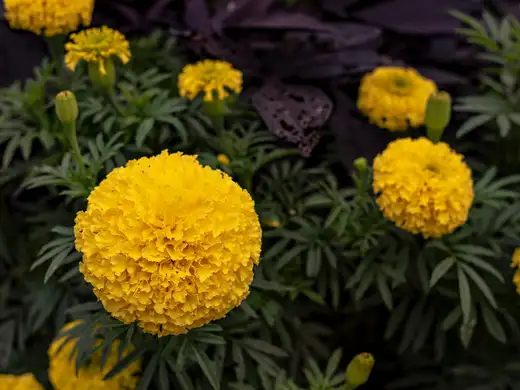
African marigolds (Tagetes erecta), also called American marigolds, are the tall ones. They have big double flowers up to 4 or 5 inches across and grow 10 to 36 inches tall, and Penn State puts the tallest at 3 to 4 feet. They are the slowest to bloom, usually flowering from midsummer to frost, and storms can knock the tall ones over.
French marigolds (T. patula) are compact and bushy, 6 to 18 inches tall, with flowers up to 2 inches across. They bloom longer than African types and stand up better to rain, which makes them the better choice for humid, stormy climates. UF/IFAS says French marigolds do well year-round in Florida, while African types are best for spring there.
Signet marigolds (T. tenuifolia) are small, lacy plants that get covered in single flowers and have a lemony scent. They make good edging and window-box plants.
Triploid or “mule” marigolds are African-French crosses that cannot set seed, so they keep blooming through hot weather. The catch is that only about half their seed germinates, so sow extra.
Extension services name varieties that have done well in their own states. In Iowa, Iowa State suggests the Inca and Perfection series (African), ‘Queen Sophia’ and ‘Golden Gate’ (French), and ‘Golden Gem’ and ‘Lemon Gem’ (signet). For South Carolina, Clemson points to the ‘Big Duck’ African hybrids for heat tolerance and the 7-inch ‘Hot Pak’ French series for heat and humidity. Mississippi State found the Giant series to be an excellent cut flower on the Mississippi coast.
Where to plant
Pick a spot in full sun with well-drained soil. Marigolds grow in almost any soil, but they do best in moderately fertile loam with a pH of about 5.5 to 7.0. Clemson warns that below pH 5.5 the leaves can develop a bronze speckling caused by manganese or iron toxicity, so lime acidic soils according to a soil test. Wet, poorly drained ground leads to stem rot.
Work some organic matter into the top 6 inches of soil before planting. If you don’t have a soil test, mix in a slow-release fertilizer made for annuals at planting time and leave it at that.
Planting from seed or transplants
Marigolds are one of the easiest flowers to grow from seed. You can sow them directly once the soil has warmed and frost danger is over. Cover the seed about 1/4 inch deep and keep the soil moist. In warm soil, sprouts appear in 4 to 7 days. Mississippi State gives 75 to 80°F as the outdoor germination range.
For earlier flowers, start seed indoors at 70 to 75°F. Recommended lead times vary: Mississippi State uses 4 weeks, Iowa State 6, and Clemson 4 to 6, with 8 weeks for African types because they take longest to bloom. Harden seedlings off before planting them out after the last frost. The dates for your zone above show both windows.
Spacing depends on type. Clemson and Penn State space French and signet marigolds 8 to 10 inches apart (Iowa State allows 6 to 9), and African marigolds 12 to 16 inches apart, up to 18 inches for the tallest varieties. Crowded plants hold moisture in their foliage and get more disease.
Water and feeding
Water well at planting and keep the soil evenly moist for the first couple of weeks. Once the plants are established, they need about 1 inch of water a week. When rain falls short, water deeply once a week and let the soil dry slightly in between. Water at the base, not over the foliage. Mulch between plants holds moisture and keeps weeds down.
Go light on fertilizer. Nitrogen produces leaves at the expense of flowers, so use a balanced product or one with a higher middle (phosphorus) number.
Pinching, deadheading and staking
Once young plants are established, pinch out the growing tips so they branch and stay compact. Through the season, remove spent flowers to keep new ones coming. Stake tall African marigolds, or plant them where a fence or sturdier neighbors can shelter them, so summer storms don’t flatten them.
Expect a lull in the South during peak July-August heat. Mississippi State notes that plants can stall and bloom less for a while, then pick up again as temperatures ease. If signet marigolds slow down in midsummer, Clemson suggests shearing them back by one-third to push a fresh flush when the weather cools.
Common problems
- Spider mites: worst in hot, dry weather. Leaves look stippled and may show fine webbing. Hose the foliage often or use insecticidal soap.
- Aster yellows: yellowed, distorted growth, sometimes with leafy tufts where flowers should be. Leafhoppers spread it and there is no cure, so pull affected plants and throw them out rather than composting them.
- Powdery mildew and gray mold (Botrytis): these show up in shade, crowding and wet, humid weather. Grow in sun, space properly and water at the soil line.
- Slugs, leafminers, aphids, whiteflies, thrips and grasshoppers: occasional pests. Check plants regularly and act early.
- Stem and root rot: a sign of poorly drained soil.
What marigolds do (and don’t do) for pests
Marigolds are famous as a pest repellent, and the evidence only partly backs that up. Iowa State reports that research found marigolds don’t reduce insect damage on vegetable crops. Clemson notes that some insects are actually attracted to them.
Nematodes are where marigolds really help, but only when they’re used a particular way. Some French and African marigolds produce a root chemical that suppresses root-knot nematodes. Penn State’s method is to plant a thick stand in spring, grow it for several months, and then till or dig the plants into the soil. Clemson names the French cultivars ‘Tangerine’ and ‘Single Gold’ as resistant to several root-knot nematode species. Marigolds scattered among tomatoes or other crops do not protect them.
Cutting and drying
Cut marigolds for the vase when the flowers are just starting to open. Strip any leaves that would sit underwater and put the stems in water right away. Mississippi State holds cut stems at 36 to 41°F and finds they last a week or more without any preservative. To dry them, cut perfect blooms, strip the leaves and hang the stems upside down until they are dry.
Questions
Do marigolds need full sun?
Yes. Give them at least 6 hours of direct sun a day. In shade and cool, damp spots they bloom poorly and tend to get powdery mildew.
Why are my marigolds all leaves and no flowers?
The usual cause is too much nitrogen, often from a high-nitrogen fertilizer. Switch to a balanced fertilizer or one with a higher middle number, and stop feeding beds that are already fertile.
Should I deadhead marigolds?
Yes. Pinching off faded flowers keeps the plants putting energy into new blooms instead of seed. It also makes them look much tidier.
Do marigolds keep pests out of the vegetable garden?
Not in the way people hope. Research summarized by Iowa State found marigolds did not reduce insect damage on nearby vegetables, and UF/IFAS and Clemson say that planting them between crops does not control nematodes. A dense marigold cover crop that is later turned into the soil can suppress root-knot nematodes.
Are marigold flowers edible?
Sources disagree. Clemson and Iowa State describe signet marigold flowers as edible with a spicy, tarragon-like flavor, while Penn State says Tagetes flowers are generally considered inedible. UF/IFAS notes that much of the confusion comes from calendula, the "pot marigold," which is widely accepted as edible.
Sources
- How to Grow and Care for Marigolds in South Carolina (HGIC 1168) · Clemson Cooperative Extension Home & Garden Information Center
- Marigolds (Yard and Garden, March 15, 1996) · Iowa State University Extension and Outreach
- Marigolds: From Folklore to the Home Garden · Penn State Extension
- Marigolds (Tagetes erecta) for the Farmer Florist (Publication 3362) · Mississippi State University Extension
- 1036 - Marigold (PlantTalk Colorado) · Colorado State University Extension
- Marigolds · UF/IFAS Extension Gardening Solutions
- Flowers to Plant in Florida: Text (month-by-month calendar for North, Central and South Florida) · UF/IFAS Extension Gardening Solutions
- Flower Planting Guide for the Low Desert (AZ1100) · University of Arizona Cooperative Extension, Maricopa County
- Sowing Annual Seeds · Penn State Extension
- May 21, 2005 Timely Tips (Bexar County gardening calendar) · Texas A&M AgriLife Extension, Bexar County