How to Grow Lilies
Plant lily bulbs in early fall or in spring after frost, about three times as deep as the bulb is wide (roughly 6 to 8 inches for large bulbs) and a foot apart, in well-drained soil. Give the leaves sun and keep the roots cool with mulch. Asiatic lilies bloom in early summer, most others in July, and Orientals in mid- to late summer.

Your dates for lilies
Set your ZIP code at the top of the page and we will work out when to plant lilies where you live, from the frost records of the nearest NOAA weather station. Your ZIP code is remembered on this device only.
Lilies at a glance
- Botanical name
- Lilium spp. (Asiatic, Oriental, trumpet and other hybrids)
- Light
- full sun (6+ hours) to part sun; roots like shade or mulch
- Frost tolerance
- Hardy: takes a hard frost
- Hardiness zones
- 3-8
- Planting depth
- 6 inches
- Spacing
- 12 inches apart
- Containers
- Yes
When to plant lilies
| Zone | Sow outdoors | Fall planting |
|---|---|---|
| Zone 2a * | May 19 to Jun 2 | Jul 25 to Sep 5 |
| Zone 3a | May 26 to Jun 9 | Aug 3 to Sep 14 |
| Zone 3b | May 17 to 31 | Aug 13 to Sep 24 |
| Zone 4a | May 13 to 27 | Aug 17 to Sep 28 |
| Zone 4b | May 8 to 22 | Aug 20 to Oct 1 |
| Zone 5a | May 3 to 17 | Aug 23 to Oct 4 |
| Zone 5b | May 1 to 15 | Aug 29 to Oct 10 |
| Zone 6a | Apr 29 to May 13 | Sep 5 to Oct 17 |
| Zone 6b | Apr 23 to May 7 | Sep 10 to Oct 22 |
| Zone 7a | Apr 16 to 30 | Sep 13 to Oct 25 |
| Zone 7b | Apr 5 to 19 | Sep 20 to Nov 1 |
| Zone 8a | Mar 29 to Apr 12 | Sep 26 to Nov 7 |
| Zone 8b | Mar 17 to 31 | Oct 2 to Nov 13 |
| Zone 9a * | Mar 2 to 16 | Oct 15 to Nov 26 |
| Zone 9b * | Jan 31 to Feb 14 | Oct 28 to Dec 9 |
* Outside zones 3 to 8, the hardiness range our sources give for lilies. Plants there may not survive the winter or get enough winter chill, and are usually grown as annuals or in pots.
True lilies (Lilium) are hardy bulbs that come back each summer with tall stems of large, often fragrant flowers, typically 3 to 6 inches across. They are easy if you meet two needs: drainage good enough that the bulbs never sit wet, and roots kept cool. Don’t confuse them with daylilies, which grow from fleshy roots, not bulbs, and belong to a different family.
Lily groups to know
NC State and South Dakota State describe the main garden groups:
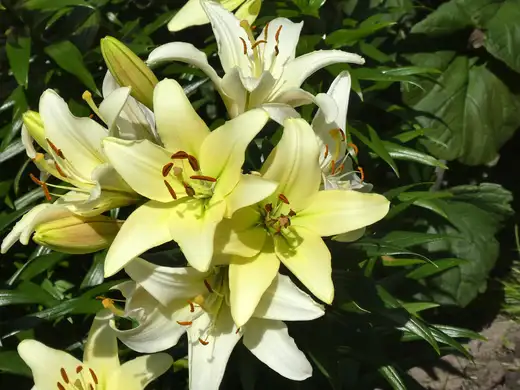
- Asiatic hybrids. The earliest and easiest, flowering in early summer, usually under 3 feet, in reds, oranges, yellows, pinks and white. Most have little or no fragrance. Colorado State rates them hardy to zone 3 or 4. Illinois Extension points to dwarf ‘Pixie’ types, 18 inches or less, for edging and pots.
- Oriental hybrids. The showiest and most fragrant, up to 8 feet tall, blooming mid- to late summer. They prefer acidic, humus-rich, moist soil and cool roots. Colorado State says they and trumpet lilies prefer milder winters but are said to survive in zone 4 with heavy mulch.
- Trumpet lilies. Tall, with outward-facing or hanging flowers.
- Orienpets (OT hybrids). Oriental-trumpet crosses: tall, fragrant and large-flowered.
- LA hybrids. Crosses of Easter lily with Asiatic lilies, Illinois Extension says, with large flowers and a slight scent.
- Martagon lilies. Many small, nodding flowers. They tolerate some shade and suit woodland gardens, but NC State notes they do poorly in hot, humid climates.
In much of the South, garden lilies are near the edge of their range; most are rated only to zone 8. In Florida, UF/IFAS suggests planting a potted Easter lily (L. longiflorum) outdoors after the holiday, once frost danger has passed. It will usually bloom naturally in summer.
Where to plant
Give lilies full sun to afternoon sun for the leaves, at least six hours, with the root zone shaded or mulched. NC State’s formula is sun on the leaves, shade for the roots. Interplanting with taller plants, South Dakota State notes, gives lily stems support and wind protection, and other flowers keep the bed interesting after the lilies finish.
Drainage is critical. Wet soil rots lily bulbs, but the soil shouldn’t dry out completely either. Illinois Extension amends beds with peat and compost, up to one-third of each by volume. In heavy soil, South Dakota State plants lilies in raised beds.
How to plant lily bulbs
Lily bulbs are planted in early fall, which Iowa State calls an excellent time, or in spring once frost danger has passed. Maryland Extension prefers late fall. See when to plant lilies and the dates for your zone above. Plant bulbs promptly after buying them. If they must wait, NC State suggests holding them in moist peat at about 35°F.
- Depth. Three times the bulb’s diameter (Iowa State): about 6 to 8 inches for large bulbs (Illinois). NC State plants 8 inches deep, South Dakota State about 6. Deep planting helps protect bulbs in winter and leaves room for the roots that grow from the buried stem.
- Spacing. At least 1 foot apart (Illinois).
- Grouping. Plant in groups of five or more for impact.
- Spring planting. Handle carefully; South Dakota State notes the developing shoot is fragile and easy to snap.
- Potted lilies can go in during spring or summer at the depth they grew in the pot.
After fall planting, add a few inches of mulch over the bed for winter protection.
Care through the season
Keep soil evenly moist but never soggy, and maintain mulch to keep roots cool. Stake tall varieties, especially in open, windy sites.
After flowering, snap or cut off the spent flower head just above the top leaves. Leave the stem and leaves until they turn yellow; South Dakota State calls the leaves the most important part of the plant, because they store food for next year.
For cutting, take Asiatic stems as the first buds show color and start to open. Illinois Extension finds they can last up to 10 days in a vase with floral preservative. Remove the pollen-bearing anthers as flowers open, since the pollen stains. Don’t take all the foliage with the cut stem; the plant needs leaves to rebuild the bulb.
Dividing lilies
Lily bulbs multiply, and crowded clumps flower less. South Dakota State divides in early fall, typically early September. Illinois Extension digs Asiatics in August, before the leaves yellow, then replants or stores the bulbs somewhere cool and dry until spring.
Problems
- Lily leaf beetle. A shiny scarlet beetle, about 1/4 to 3/8 inch long, from Eurasia. It was first found in the US in Massachusetts in 1992 and is believed to have arrived with imported bulbs, so be careful not to move it on transplants. Adults and slug-like larvae eat leaves and buds and can defoliate a plant. UConn recommends hand-picking adults and checking leaf undersides for reddish-orange egg masses; neem kills larvae if reapplied every five to seven days after eggs hatch. Lilies grown in containers and moved each year break the beetle’s life cycle.
- Bulb rot. Poorly drained soil. Use a raised bed or better site.
- Botrytis. A fungal blight of leaves and flowers. Improve air circulation and remove infected parts.
- Lily mosaic virus. Spread by aphids and incurable. Pull infected plants and control aphids.
- Rabbits and slugs. Rabbits eat spring shoots; slugs are worst in shady, damp sites.
Lilies are toxic to cats, NC State notes, so keep plants and bouquets out of their reach.
Questions
How deep should I plant lily bulbs?
About three times the bulb's diameter, Iowa State says, which works out to 6 to 8 inches for large bulbs. South Dakota State uses about 6 inches, partly because lilies root along the buried stem as well as from the bulb.
Do lilies come back every year?
Yes. Garden lilies are hardy perennials that stay in the ground over winter. Asiatics are among the hardiest; Colorado State rates them to zone 3 or 4.
Should I cut lilies back after they bloom?
Cut off just the spent flower head, above the top leaves, and leave the stem and leaves standing until they turn yellow. The leaves feed the bulb for next year.
What is eating my lily leaves?
If you see a bright red beetle or slug-like larvae, it's the lily leaf beetle, an imported pest first found in the US in Massachusetts in 1992; adults and larvae can strip a plant bare. Elsewhere, check for rabbits eating spring shoots and slugs in damp, shady spots.
Are lilies safe around cats?
No. NC State flags true lilies as a problem for cats. Keep lily plants and cut flowers away from them.
Sources
- Lily Leaf Beetle · University of Connecticut Home and Garden Education Center
- Bulbs: Summer Flowering (PlantTalk Colorado 1013) · Colorado State University Extension
- Bulbs · University of Maryland Extension
- When is the best time to plant lilies? · Iowa State University Extension and Outreach
- Growing Lilies in the Home Garden · South Dakota State University Extension
- Lilium (Plant Toolbox) · North Carolina State Extension Gardener Plant Toolbox
- Easter Lily · UF/IFAS Gardening Solutions
- Plant of the Week: Asiatic Lilies · University of Illinois Extension
- Bulbs (Backyard Farmer) · University of Nebraska-Lincoln Extension, Backyard Farmer
- Establishing perennials in the early fall · University of Illinois Extension