How to Grow Bearded Iris
Plant or divide bearded iris rhizomes in late summer, from about July through September, and finish at least six weeks before your first frost. Set each rhizome on a mound of soil with its top at or just below the surface, 12 to 18 inches apart, in full sun and well-drained soil. Planting too deep is the most common reason irises rot or stop blooming.

Your dates for bearded irises
Set your ZIP code at the top of the page and we will work out when to plant bearded irises where you live, from the frost records of the nearest NOAA weather station. Your ZIP code is remembered on this device only.
Bearded Irises at a glance
- Botanical name
- Iris germanica (bearded iris hybrids)
- Light
- full sun (at least 6 hours); flowering suffers in partial shade
- Frost tolerance
- Hardy: takes a hard frost
- Hardiness zones
- 3-10
- Planting depth
- 0 inches
- Spacing
- 12–18 inches apart
When to plant bearded irises
| Zone | Fall planting |
|---|---|
| Zone 2a * | Jun 13 to Jul 25 |
| Zone 3a | Jun 22 to Aug 3 |
| Zone 3b | Jul 2 to Aug 13 |
| Zone 4a | Jul 6 to Aug 17 |
| Zone 4b | Jul 9 to Aug 20 |
| Zone 5a | Jul 12 to Aug 23 |
| Zone 5b | Jul 18 to Aug 29 |
| Zone 6a | Jul 25 to Sep 5 |
| Zone 6b | Jul 30 to Sep 10 |
| Zone 7a | Aug 2 to Sep 13 |
| Zone 7b | Aug 9 to Sep 20 |
| Zone 8a | Aug 15 to Sep 26 |
| Zone 8b | Aug 21 to Oct 2 |
| Zone 9a | Sep 3 to Oct 15 |
| Zone 9b | Sep 16 to Oct 28 |
* Outside zones 3 to 10, the hardiness range our sources give for bearded irises. Plants there may not survive the winter or get enough winter chill, and are usually grown as annuals or in pots.
Bearded irises are among the easiest perennials to grow well, and among the easiest to kill with kindness. They want sun, sharp drainage, little fertilizer and almost no mulch. Give them that, plant them shallowly, and divide them every few years, and they’ll bloom for decades. Penn State rates German bearded iris (Iris germanica) for zones 3 to 10.
Know your bearded iris
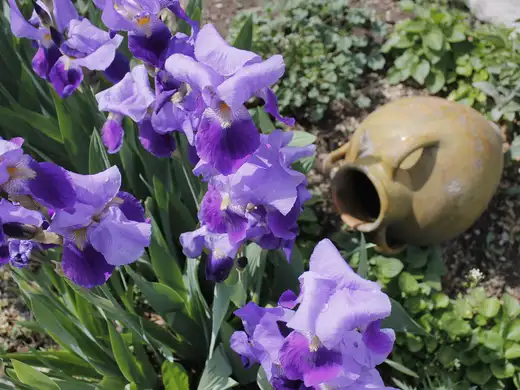
Bearded irises grow from rhizomes, thick horizontal stems that lie at the soil surface and send roots down and fans of sword-shaped leaves up. Each flower has three upright petals called standards and three drooping falls, each fall with a fuzzy “beard” down its center. A stalk carries one to a dozen buds that open one after another, each flower lasting three to five days.
Bearded irises are sold by height class, from small dwarf types up to the tall bearded types. Illinois Extension gives 18 to 36 inches for the common garden kinds. Penn State notes that shorter irises generally bloom earlier. Most bloom in late spring, but Penn State notes that breeders have produced many rebloomers.
Where to plant
Full sun is essential: at least six hours. Penn State finds flowering suffers in part shade. Equally important is drainage. Bearded iris will not tolerate soggy soil, and wet ground is the main trigger for rot. Work organic matter into heavy soil before planting.
Penn State gives 6.8 as the ideal pH but notes irises tolerate a range of soils; test before adjusting. Good air movement helps prevent leaf diseases, which is one reason not to crowd them.
When to plant iris rhizomes
Bearded iris rhizomes are planted in late summer, not spring. Clemson’s window is six to eight weeks after the plants finish blooming, or July through September, but no later than six weeks before the average first frost. Penn State wants new roots established four to six weeks before the first hard freeze. The dates for your zone above show that window.
In hot climates, let the worst heat pass first. Travis County Master Gardeners in central Texas wait until temperatures drop out of the 100s, typically September.
Potted irises from a garden center can go in whenever you buy them.
How to plant bearded iris
- Dig a hole about 4 to 6 inches deep and roughly 10 inches across.
- Build a cone or ridge of soil in the center.
- Set the rhizome on top of the mound and spread its roots down the sides.
- Fill in so the rhizome sits right at the surface. In clay, Clemson leaves it just above ground level; in sandy soil the top can be up to 1/2 inch below. Penn State’s advice: better too shallow than too deep.
- Firm the soil and water well. Without rain, water weekly until the plants are established. New growth often shows within two to three weeks.
Space rhizomes 12 to 18 inches apart. Clemson’s iris fact sheet allows 16 to 18 inches for better air circulation. For a natural clump, plant them in threes with the leaf fans pointing outward.
The rhizome tops need sun to set the next year’s flowers. Travis County notes that in central Texas heat, rhizomes can go about 1/4 inch deep, or sit on the surface under 1/4 inch of mulch, so they get light without baking.
Care through the year
Water. Once established, bearded iris is very drought tolerant. Overwatering does more harm than dry spells.
Fertilizer. Feed lightly with a low-nitrogen fertilizer such as 5-10-10 in early spring and again after bloom. Penn State uses about 1/2 cup around each clump, not on top of the rhizomes. Clemson warns that high nitrogen leads to soft, fast growth and soft rot.
After bloom. Cut flower stalks to the ground once the last bud fades, so the plant doesn’t put energy into seed. Leave the leaves green through summer; they are feeding next year’s flowers. Snip off brown tips only.
Fall cleanup. Penn State cuts spent leaves back to 3 to 6 inches in late fall and clears debris from the bed. This removes iris borer eggs laid on old foliage.
Dividing bearded iris
Clumps get crowded every three to five years; you’ll see fewer flowers and rhizomes pushing up out of the soil. Divide in late summer:
- Cut the leaves back by about two-thirds and lift the whole clump with a spading fork.
- Pull or cut the rhizomes apart. Keep young, firm pieces about as thick as your thumb, each with healthy roots and at least one fan of leaves.
- Throw away the old center rhizomes. Clemson notes they bloom only once and then stop flowering.
- Discard anything soft, smelly or tunneled by borers. Don’t compost it.
- Let cut ends dry in the shade for a few hours, then replant as above.
Problems
- Iris borer. Caterpillars hatch on the leaves, tunnel down into the rhizome, and leave wounds where soft rot gets in. Signs include water-soaked streaks in leaves, browning tips, and sawdust-like frass at the base. Crush young borers in the leaves in spring, dig and discard infested rhizomes, and clean up old foliage after a hard frost.
- Bacterial soft rot. The most common iris disease. Rhizomes turn mushy and smell foul. Bag and discard affected plants. Prevent it with good drainage, shallow planting, no mulch over the rhizomes, low nitrogen and timely division.
- Leaf spot and other fungal infections. Improve air circulation and remove infected leaves.
- Few or no flowers. Too much shade, deep planting or old, crowded rhizomes.
Deer generally leave bearded irises alone, Travis County Master Gardeners report.
Questions
How deep should I plant iris rhizomes?
Barely at all. In clay soil, Clemson sets the rhizome so it sits just above ground level; in sandy soil, the top can be up to 1/2 inch below. The roots go down into the soil, but the rhizome itself should be visible or nearly so.
Why are my irises not blooming?
The usual causes are too much shade, rhizomes planted too deep, or a crowded clump full of old center rhizomes, which bloom only once. Move irises to full sun, replant them shallowly, and divide clumps every three to five years.
When is the best time to divide irises?
Late summer, when plants are semi-dormant. Clemson divides six to eight weeks after bloom, from July through September, but no later than six weeks before the first frost. In central Texas, wait until highs drop below 100°F.
Should I mulch irises?
Not over the rhizomes. Mulch holds moisture against them and encourages soft rot. A thin layer around new divisions is fine if the rhizome tops stay uncovered.
Do bearded irises bloom more than once?
Most bloom once in spring, but breeders have developed many reblooming cultivars that flower again later in the season.
Sources
- Bearded Iris · Clemson Cooperative Extension, Home & Garden Information Center
- Give Your Bearded Irises Some Space - Divide Them · Clemson Cooperative Extension, Home & Garden Information Center
- German Bearded Iris · Penn State Extension
- Dividing Irises · Penn State Extension
- Growing irises: How to plant, grow and care for iris · University of Illinois Extension
- Iris Dividing Time · Texas A&M AgriLife Extension, Travis County