How to Grow Hyacinths
Plant hyacinth bulbs in fall once the soil is below 60°F, about 6 inches deep and 3 to 8 inches apart, in full sun and loose, well-drained soil. Wear gloves, because the bulbs can irritate skin. In the North they come back each spring with smaller, looser spikes; in mild-winter areas, chill the bulbs in the refrigerator first and treat them as one-season flowers.

Your dates for hyacinths
Set your ZIP code at the top of the page and we will work out when to plant hyacinths where you live, from the frost records of the nearest NOAA weather station. Your ZIP code is remembered on this device only.
Hyacinths at a glance
- Botanical name
- Hyacinthus orientalis
- Light
- full sun for the tallest, straightest spikes; tolerates partial shade
- Frost tolerance
- Hardy: takes a hard frost
- Hardiness zones
- 4-8 (NC State Extension). In coastal and warm-winter areas, use refrigerated bulbs as annuals.
- Planting depth
- 6 inches
- Spacing
- 3–8 inches apart
- Containers
- Yes
When to plant hyacinths
| Zone | Fall planting |
|---|---|
| Zone 2a * | Aug 8 to Sep 19 |
| Zone 3a * | Aug 17 to Sep 28 |
| Zone 3b * | Aug 27 to Oct 8 |
| Zone 4a | Aug 31 to Oct 12 |
| Zone 4b | Sep 3 to Oct 15 |
| Zone 5a | Sep 6 to Oct 18 |
| Zone 5b | Sep 12 to Oct 24 |
| Zone 6a | Sep 19 to Oct 31 |
| Zone 6b | Sep 24 to Nov 5 |
| Zone 7a | Sep 27 to Nov 8 |
| Zone 7b | Oct 4 to Nov 15 |
| Zone 8a | Oct 10 to Nov 21 |
| Zone 8b | Oct 16 to Nov 27 |
| Zone 9a * | Oct 29 to Dec 10 |
| Zone 9b * | Nov 11 to Dec 23 |
* Outside zones 4 to 8, the hardiness range our sources give for hyacinths. Plants there may not survive the winter or get enough winter chill, and are usually grown as annuals or in pots.
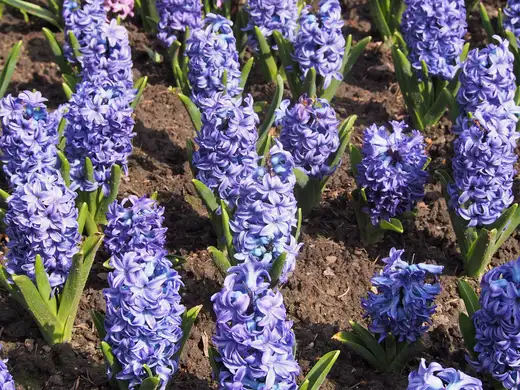
Hyacinths are grown for their dense, waxy flower spikes and a fragrance strong enough to scent a room. Each bulb normally sends up one spike in mid-spring, usually in bloom at the same time as daffodils, and it lasts two to three weeks. They are easy to grow, but they are less permanent than daffodils, and they need a real winter to bloom properly.
Where hyacinths grow best
The garden hyacinth (Hyacinthus orientalis) is native to the eastern Mediterranean and southern Turkey. NC State rates it for zones 4 to 8. In the cool North it behaves as a perennial. Nebraska Extension warns that high soil temperatures can make them short-lived even on the Plains, and in the Deep South they get too little winter cold to bloom well. Texas A&M AgriLife says San Antonio winters simply aren’t cold enough. Along the coast of South Carolina, Clemson treats them as a one-season flower grown from refrigerated bulbs.
Roman hyacinths (H. orientalis albulus) are the exception for southern gardeners. Their flowers are smaller and looser, but Clemson finds they persist better than the big Dutch hybrids.
Choosing a site
Full sun gives the tallest, straightest spikes, South Dakota State notes, though hyacinths tolerate part shade. More important is drainage: hyacinths need loose, organically rich soil that doesn’t stay wet, or the bulbs rot. Clemson keeps soil pH for bulbs between 6 and 7. If your soil is heavy, work 2 to 3 inches of compost or shredded pine bark into the bed 10 to 12 inches deep, or plant in a raised bed. Avoid beds watered by lawn sprinklers all summer.
Plant them where you’ll smell them: along a walk, near a door or under a window. They look best in groups of one color rather than dotted singly.
How to plant hyacinth bulbs
Wait until the soil at planting depth stays below about 60°F; see when to plant hyacinths and the dates for your zone above. Until then, keep bulbs somewhere cool and dry, away from ripening fruit.
- Put on gloves. The sap can irritate skin, and NC State notes the bulb holds the highest concentration of irritating compounds.
- Dig the bed or hole so the base of the bulb sits about 6 inches deep. Nebraska uses 6 inches; Clemson gives 4 to 6.
- Space bulbs 3 to 6 inches apart (Clemson) for a dense show, or up to 8 inches (Nebraska).
- Set each bulb pointed end up, cover, and firm the soil.
- Water thoroughly. Keep the soil moist while the roots establish, and in dry falls water deeply once a week until the ground freezes.
- Once the ground freezes, cover the bed with 2 to 3 inches of mulch to moderate soil temperature swings.
Care through the season
Hyacinths need little attention. Water during a dry spring to keep the flowers going. For bulbs you plan to keep, Clemson suggests a slow-release complete fertilizer at planting in fall, or 1 to 2 pounds of 10-10-10 per 100 square feet in fall and again as shoots emerge. Bulbs grown for one season need no fertilizer.
Cut off spent spikes as soon as they fade. Leave the leaves in place until they yellow, then remove them. Taper off watering after bloom as the bulbs go dormant.
Why hyacinth flowers shrink
A first-year hyacinth is a showpiece. In later years the bulb splits into smaller bulbs, and the spikes become shorter, looser and more widely spaced. This is normal. NC State notes that outdoor hyacinths give smaller, more widely spaced flowers each year. For a formal bed with full-size spikes, Clemson suggests digging the bulbs after the leaves wither, storing them dry and replanting them in fall, or simply buying fresh bulbs each fall. In an informal garden, the looser spikes of older plantings have their own charm.
Problems
- Short, stunted spikes. Not enough chilling. Buy pre-chilled bulbs or refrigerate them before planting in warm areas.
- Bulb rot. Wet, poorly drained soil. Improve drainage or use a raised bed.
- Skin irritation. Wear gloves when handling bulbs.
- Decline after a few years. Normal splitting of the bulbs. Replant or replace.
Squirrels and chipmunks generally leave hyacinths alone, because the bulbs are toxic to them. Wisconsin Extension suggests planting hyacinths and daffodils where rodents dig up tulips and crocus.
Forcing hyacinths indoors
Hyacinths are among the easiest bulbs to force. Rutgers fits three bulbs in a 6-inch pot, with the tips at the soil surface. Keep the pots at 35 to 48°F for at least 12 to 13 weeks. Once roots fill the pot and short shoots appear, bring them into a bright room at 55 to 60°F; they flower three to four weeks later. Forced bulbs seldom rebloom well outdoors, so most gardeners discard them afterward. Florist hyacinths, NC State notes, are not suited to growing long-term as houseplants.
Questions
Do hyacinths come back every year?
In cold-winter areas they usually do, but the spikes get smaller and more open each year as the bulbs split. Clemson recommends digging and storing them after the leaves wither, or buying new bulbs, if you want large flowers every spring. In hot climates they often fail after the first year.
Why did my hyacinths bloom right at ground level?
They didn't get enough cold. Without about 10 to 16 weeks below 45 to 50°F, the flower stalk barely stretches, and Arkansas Extension says flowers may stay only about an inch tall. In warm areas, buy pre-chilled bulbs or refrigerate them for 6 to 8 weeks before planting.
Are hyacinth bulbs poisonous?
Mildly. All parts can cause stomach upset if eaten, and the bulb has the highest concentration of irritants. The sap causes skin irritation in some people, so NC State and Wisconsin recommend gloves when planting.
Should I cut off hyacinth flowers after they bloom?
Yes. Cut off the spent spike promptly so the plant doesn't put energy into seed, but leave the leaves until they turn yellow. They are feeding the bulb for next year.
Sources
- Hyacinthus orientalis - North Carolina Extension Gardener Plant Toolbox · NC State Extension
- Spring-Flowering Bulbs (HGIC) · Clemson Cooperative Extension Home & Garden Information Center
- Hyacinth (Reference Desk Q&A) · University of Arkansas Cooperative Extension Service
- Spring Flowering Bulbs (FS1220) · Rutgers Cooperative Extension
- Spring Flowering Bulbs (G1742) · University of Nebraska-Lincoln Extension
- Plant Bulbs Now for Spring Color · University of Wisconsin-Madison Division of Extension
- Bulbs to Plant in the Fall · South Dakota State University Extension
- Autumn Planting For Next Year's Bulbs · Texas A&M AgriLife Extension, Bexar County
- Chill Out, Tulips! (Under the Solano Sun) · UC ANR, UC Master Gardeners of Solano County
- Plant Bulbs in the Fall for a Spring Celebration · Penn State Extension
- Bulbs (Backyard Farmer) · University of Nebraska-Lincoln Extension, Backyard Farmer
- How to plant flower bulbs for a colorful spring display · University of Illinois Extension