How to Grow Green Onions
Green onions are quick and forgiving: sow seed thickly 1/4 to 1/2 inch deep once the soil reaches about 50°F, or push sets into the ground in early spring, and keep the soil evenly moist. Start harvesting once the plants are about 6 inches tall, roughly 6 to 8 weeks after planting sets or 50 to 75 days from seed. True bunching onions don't normally form a bulb, so you can cut them and let them regrow, or sow a fresh row every few weeks for a steady supply.

Your dates for green onions
Set your ZIP code at the top of the page and we will work out when to plant green onions where you live, from the frost records of the nearest NOAA weather station. Your ZIP code is remembered on this device only.
Green Onions at a glance
- Botanical name
- Allium fistulosum (bunching onion); young Allium cepa is also harvested as green onions
- Light
- full sun preferred; tolerates part shade (about 5 hours of sun)
- Frost tolerance
- Hardy: takes a hard frost
- Soil temperature to plant
- At least 50°F (best 50–95°F)
- Germination
- 4–13 days
- Days to harvest
- 50–75 days from seed; 42–56 days from transplanting
- Planting depth
- 0.5 inches
- Spacing
- 1–2 inches apart, rows 12–24 inches apart
- Containers
- Yes
When to plant green onions
| Zone | Plant out | Sow outdoors |
|---|---|---|
| Zone 2a | May 21 to Jun 4 | May 21 to Jul 30 |
| Zone 3a | May 15 to 29 | May 15 to Jul 24 |
| Zone 3b | May 11 to 25 | May 11 to Jul 20 |
| Zone 4a | May 7 to 21 | May 7 to Jul 16 |
| Zone 4b | May 2 to 16 | May 2 to Jul 11 |
| Zone 5a | Apr 28 to May 12 | Apr 28 to Jul 7 |
| Zone 5b | Apr 26 to May 10 | Apr 26 to Jul 5 |
| Zone 6a | Apr 20 to May 4 | Apr 20 to Jun 29 |
| Zone 6b | Apr 13 to 27 | Apr 13 to Jun 22 |
| Zone 7a | Apr 4 to 18 | Apr 4 to Jun 13 |
| Zone 7b | Mar 25 to Apr 8 | Mar 25 to Jun 3 |
| Zone 8a | Mar 7 to 21 | Mar 7 to May 16 |
| Zone 8b | Feb 18 to Mar 4 | Feb 18 to Apr 29 |
| Zone 9a | Jan 19 to Feb 2 | Jan 19 to Mar 30 |
| Zone 9b | Dec 20 to Jan 3 | Dec 20 to Feb 28 |
Spring dates before the last frost assume the soil has thawed and is dry enough to work. After a late or wet spring, wait for that even if the date has passed.
Two kinds of green onion
“Green onion” covers two different plants, and knowing which one you have explains most of what follows.
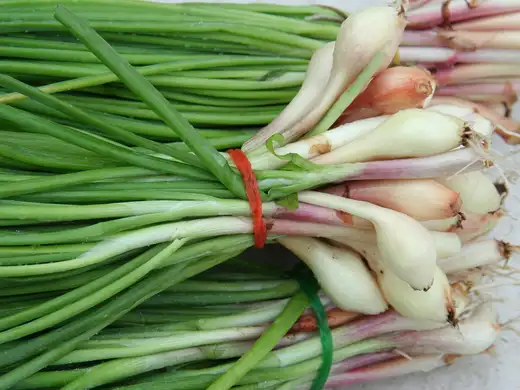
True bunching onions (Allium fistulosum, also called Welsh or Japanese bunching onions) grow as clumps of straight white shanks with hollow green leaves. Iowa State notes that they don’t normally form a bulb, are very hardy and are among the first plants up in spring. Because they don’t bulb, day length matters little, and Oregon State notes that the leaves regrow after cutting.
Young bulb onions (Allium cepa) pulled early. Clemson points out that any onion variety harvested before it bulbs is a green onion. Texas A&M says you can pull them from pencil thickness until bulbs begin to form. After that they turn into small bulb onions. This is how thinnings from a bulb-onion row get used, and it is the best use for oversized onion sets.
The flavor is the same in both: the green leaves are mild and sweet, and the white base is stronger (Oregon State).
Varieties recommended by region
Extension services name bunching varieties for their own areas:
- Oregon: He-shi-ko, Ishikura and White Lisbon (Oregon State).
- Florida: Evergreen Bunching and White Lisbon Bunching (UF/IFAS).
- South Carolina: Beltsville Bunching and Evergreen Bunching (Clemson).
- Utah: Evergreen White Bunching, described as a good mild green onion (Utah State).
- Tennessee: Evergreen White Bunching, ready in 60 to 70 days, and Ishikura, a long, slender green onion ready in 60 to 65 days (Tennessee Extension).
Evergreen-type bunching onions appear on extension lists from Utah to South Carolina and Florida.
Seed, sets or transplants
Seed is the cheapest way to grow onions (Texas A&M) and the usual way to grow true bunching types. Oregon State waits until the soil is at least 50°F before sowing outdoors. Germination is slow in cold soil and fast in warm soil. Oregon State’s data for onion seed shows about 13 days to emerge at 50°F, 7 days at 59°F and about 4 days at 77°F. Sow 1/4 to 1/2 inch deep and keep the surface moist until the seedlings are up (Maryland). Seed thickly, since you will thin as you harvest. Clemson sows 1 to 2 inches apart in rows 1 to 2 feet apart, and Oregon State’s minimum is 1 inch between plants. Seed can also be started indoors 8 to 10 weeks before your outdoor planting date (Oregon State).
Sets are the quickest route. Clemson says sets and transplants are ready in 6 to 8 weeks. Nebraska Extension explains why sets suit green onions so well. A set has already completed one short growing season, so it tends to flower rather than build a big bulb, which is a drawback for storage onions but doesn’t matter for scallions. Vermont’s planting guide suggests putting larger sets, those bigger than a dime, 1 inch deep and close enough to touch, and saving the small sets for bulbs.
Transplants are bundles of onion seedlings. Clemson recommends sets or transplants in spring for green onions in South Carolina. Space them closely, as with seed.
When to plant
Green onions are hardy and fit almost anywhere in the cool part of the year. In warm regions, planting stops only in the hottest months.
Cold-winter regions. Sow as soon as the soil can be worked and has warmed to about 50°F, and plant sets with your other very hardy crops, a few weeks before the last frost. The dates for your zone above give the window. Don’t stop after one sowing. The University of Rhode Island calendar, built around a mid-May last frost, shows green onion sowings from mid-March into June. Iowa State suggests a second sowing in midsummer, harvested in fall or held over for the following spring. Small sowings every few weeks give a continuous supply rather than one glut.
The Pacific Northwest. Oregon State gives local windows. On the coast, plant January through May for harvests from March to July. In the western valleys, plant March to May, and in the Columbia and Snake River valleys, February to April. In the high central and eastern areas, wait until May or June.
Florida and the Gulf Coast. UF/IFAS lists bunching onions from September through March in North and South Florida, and from August through March in Central Florida. That covers the whole cool season, with a break in the hot late spring and summer.
The low desert. The University of Arizona calendar for the Phoenix area runs green onion sowings from January to mid-April and again from August through December.
Sun, soil and spacing
Green onions are more forgiving than bulb onions. Maryland Extension says they get by on about 5 hours of direct sun, compared with 6 or more for bulbs. Oregon State and Virginia Tech both list part shade as acceptable. That makes them useful for the edge of a bed that loses afternoon sun.
They want fertile, well-drained soil with plenty of organic matter (Oregon State, Virginia Tech). Feed the bed before planting as you would for any onion crop. Maryland Extension’s onion fact sheet, which covers green onions too, rates onions as having a high nutrient requirement. Because you harvest leaves rather than bulbs, spacing can be tight. Maryland thins to 2 inches for green onions, compared with 4 to 8 inches for bulbs.
Watering, mulching and weeds
Onion roots are shallow (Maryland), so the top few inches of soil must stay evenly moist (Oregon State). Utah State notes that drought stress affects onion flavor. Oregon State suggests a mulch of chopped straw or shredded leaves between rows to hold moisture and keep weeds down. Weeding matters because onions compete poorly with weeds (Maryland). Pull weeds by hand or hoe very shallowly so you don’t cut the onion roots (Texas A&M).
Grow onions in a different spot each year. Oregon State lists rotation, along with good spacing and weeding, as a way to limit onion pests and diseases.
Harvesting
Start harvesting once the plants are about 6 inches tall. Oregon State and Maryland use 6 inches, and Clemson waits for 6 to 8. You can harvest in two ways:
- Cut and come again. With bunching onions, cut the leaves you need and let the plant regrow. Oregon State says the leaves come back several times in a season.
- Pull whole plants. Loosen the soil beside the row with a fork first, then lift and trim the roots (Oregon State). Take whole plants when thinning a crowded row, and when harvesting bulb-onion types before they bulb.
Timing from seed varies with variety and season. UF/IFAS gives 50 to 75 days, Utah State says green onions can be pulled as early as 50 days, and Tennessee gives 60 to 70 days for Evergreen White Bunching. The Rhode Island and Arizona calendars allow much longer, 90 to 100 days, so expect the timing to vary with your season and variety.
For storage, rinse, dry and refrigerate the onions in a plastic bag. Oregon State expects about a week of good quality and Clemson up to two. To freeze them for cooking, chop the onions, spread them on a baking sheet until firm, then pack them in a labeled container and use within 4 months (Oregon State).
Perennial patches
Bunching onions can be left in place as a permanent clump. Iowa State notes that Welsh onions are hardy enough to come back early each spring. Two related perennials are also grown mainly for their greens:
- Egyptian walking onions (Allium × proliferum) form small bulbils at the tops of the stalks instead of flowers. As the bulbils get heavy the stalks bend over, the bulbils root, and the patch spreads. Iowa State says to plant bulbs in early spring or bulbils in fall. Maryland Extension spaces them 9 inches apart and grows them chiefly for greens.
- Shallots and multiplier onions also give good green tops. Clemson cuts some shallot leaves at ground level as green onions. For green onions in Virginia, Virginia Tech plants Egyptian and yellow multiplier onion sets in late October or early November.
Growing in pots
Bunching onions are among the best vegetables for a container or a windowsill. Oregon State recommends a pot at least 6 inches deep with drainage holes. Set it outdoors in full or part sun, or indoors by a sunny window, and water often enough that the mix never dries out. Sow thickly, start snipping at 6 inches, and the pot keeps producing.
Problems and fixes
- Thrips. These tiny insects leave silvery streaks on the leaves. Wash them off with a strong spray of water and encourage natural enemies (Utah State).
- Onion maggots. White larvae feed on roots and the base of the plant. Rotate beds and pull infested plants (Utah State).
- Allium leafminer. Larvae tunnel inside the leaves. Rotate and keep the area weeded (Oregon State lists it as a key pest).
- Cutworms and slugs. Oregon State lists both among the main pests of bunching onions. Keep the bed and its edges free of weeds.
- Rust and powdery mildew. Leave space between plants for airflow and don’t grow onions in the same soil year after year (Oregon State).
- Scallions turning into bulbs. That means you planted bulb-onion types and the days have lengthened. Pull them now, or grow true bunching varieties for summer harvests.
- Flower stalks. Nebraska Extension notes that plants from sets often bloom by midsummer. Harvest set-grown onions early and keep fresh sowings coming.
Regional notes
Cold North. Grow green onions from early spring into fall. Overwintered bunching onions are one of the first fresh crops of the year.
Humid South. Grow them in fall, winter and spring, when heat-loving pests are fewer. UF/IFAS warns that anything planted in August or September in Florida faces hot-weather insects and diseases.
Arid West. Mulch and drip irrigation keep the shallow roots moist. In the low desert, sow within the Arizona calendar’s two windows rather than in late spring and early summer.
Warm-winter areas (zones 9-11). Green onions can be sown through most of the cool season, so plan successive sowings rather than one big planting.
Questions
Are green onions, scallions and spring onions the same thing?
In the garden, yes. Oregon State Extension uses all three names for bunching onions, and Clemson notes that any onion pulled before it bulbs can be eaten as a green onion.
Will green onions grow back after cutting?
Bunching onions will. Oregon State says you can cut leaves as needed and they regrow several times in a season. A bulb onion pulled whole as a scallion will not regrow.
How much sun do green onions need?
Full sun is best, but green onions manage with less than bulb onions. Maryland Extension says about 5 hours of direct sun a day is enough, and Oregon State and Virginia Tech both list part shade as acceptable.
Can I grow green onions in a pot or indoors?
Yes. Oregon State recommends a container at least 6 inches deep with drainage holes, set outdoors in sun or part sun or indoors by a sunny window, and watered often enough that the mix never dries out.
How long do fresh green onions keep?
About 1 to 2 weeks in a plastic bag in the refrigerator (Oregon State says about a week, Clemson up to two). For cooking, chop and freeze them; Oregon State suggests using frozen ones within 4 months.
Do I need short-day or long-day onions for scallions?
It matters much less than for bulbs, because you harvest before bulbing. True bunching onions don't normally bulb, and Tennessee Extension notes that intermediate or long-day types can be used for green onions.
Sources
- Onions, Leeks and Shallots for the Tennessee Vegetable Garden (D 127) · University of Tennessee Extension
- The Other Onions · Iowa State University Extension and Outreach
- Onions, Garlic, and Shallots (426-411) · Virginia Cooperative Extension
- Growing Onions - Sets, Plants or Seeds? · Nebraska Extension in Lancaster County
- Onions (Easy Gardening) · Texas A&M AgriLife Extension
- Onions (Bunching) · Oregon State University Extension Service
- Growing Onions in a Home Garden · University of Maryland Extension
- Onion, Leek, Shallot, & Garlic (HGIC) · Clemson Cooperative Extension Home & Garden Information Center
- How to Grow Onions in Your Garden · Utah State University Extension
- Planting the Garden · University of Vermont Extension
- Rhode Island Planting Calendar for Fruits and Vegetables · University of Rhode Island Cooperative Extension
- Soil temperature conditions for vegetable seed germination · Oregon State University Extension Service
- SP 103/VH021: Florida Vegetable Gardening Guide · University of Florida IFAS Extension
- Vegetable Planting Calendar for Maricopa County (AZ1005) · University of Arizona Cooperative Extension