How to Grow Gladiolus
Plant gladiolus corms pointed end up, about 4 to 6 inches deep and 4 to 6 inches apart, in full sun and well-drained soil, starting around your last frost. They bloom 8 to 10 weeks later. Plant a new batch every two weeks until early July for spikes all summer, and dig the corms in fall where winters freeze.

Your dates for gladioli
Set your ZIP code at the top of the page and we will work out when to plant gladioli where you live, from the frost records of the nearest NOAA weather station. Your ZIP code is remembered on this device only.
Gladioli at a glance
- Botanical name
- Gladiolus spp. (garden hybrids)
- Light
- full sun (at least 6 hours)
- Frost tolerance
- Tender: killed by frost
- Hardiness zones
- 7-10
- Days to harvest
- 56–100 days from transplanting
- Planting depth
- 4 inches
- Spacing
- 4–6 inches apart, rows 12–36 inches apart
- Succession sowing
- Every 2 weeks
- Containers
- Yes
When to plant gladioli
| Zone | Sow outdoors |
|---|---|
| Zone 2a * | Apr 21 to May 26 |
| Zone 3a * | Apr 28 to Jun 2 |
| Zone 3b * | Apr 19 to May 24 |
| Zone 4a * | Apr 15 to May 20 |
| Zone 4b * | Apr 10 to May 15 |
| Zone 5a * | Apr 5 to May 10 |
| Zone 5b * | Apr 3 to May 8 |
| Zone 6a * | Apr 1 to May 6 |
| Zone 6b * | Mar 26 to Apr 30 |
| Zone 7a | Mar 19 to Apr 23 |
| Zone 7b | Mar 8 to Apr 12 |
| Zone 8a | Mar 1 to Apr 5 |
| Zone 8b | Feb 17 to Mar 24 |
| Zone 9a | Feb 2 to Mar 9 |
| Zone 9b | Jan 3 to Feb 7 |
* Outside zones 7 to 10, the hardiness range our sources give for gladioli. Plants there may not survive the winter or get enough winter chill, and are usually grown as annuals or in pots.
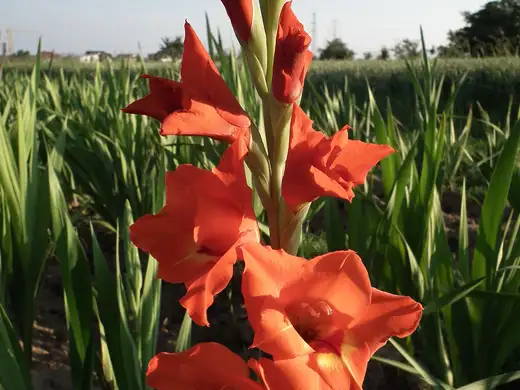
Gladiolus are grown mainly as cut flowers: tall, straight spikes of florets that open from the bottom up. They grow from corms, swollen underground stems, and belong to the iris family. The name comes from the Latin gladius, “sword,” for the blade-shaped leaves; older books call them sword lilies.
Types to choose
WSU Extension describes three main groups:
- Large-flowered (grandiflora) hybrids. Spikes of 4- to 6-inch flowers on plants 3 to 4 feet tall. Hardy in zones 7 to 10.
- Miniatures. The same ruffled, frilled flowers at 2 to 3 inches across, on stems 2 to 3 feet tall. These are the best choice for containers.
- Hardy Gladiolus nanus hybrids. Shorter, 18 to 24 inches, with fewer florets per spike, and reported to survive to zone 5 with winter mulch.
Mississippi State notes that corm size tracks flower size, so buy the largest corms you can. Iowa State finds corms 1½ to 2 inches across bloom best; smaller ones bloom less well.
Where to plant
Give gladiolus full sun, at least six hours, and a spot sheltered from strong wind but with good air circulation. The soil should be moist but well drained; gladiolus need steady water but won’t tolerate wet feet. WSU prefers medium fertility and a pH of 6.0 to 6.5, Mississippi State 6.5 to 7. Amend very sandy or heavy clay soil with compost.
WSU recommends moving gladiolus to a fresh bed after a few seasons, since they deplete the soil. It also says to keep them away from beans and peas, which it reports they can inhibit. Treat that as garden lore rather than tested fact.
How to plant gladiolus corms
Start planting around the last frost; the dates for your zone above show the window, and when to plant gladiolus explains how far ahead you can push it.
- Depth. Large corms go 4 to 6 inches deep (Iowa State); small ones about 3 inches. WSU’s rule is three to four times the corm’s diameter; Mississippi State plants 3 to 5 inches deep, and Colorado State 3 to 6.
- Spacing. Four to 6 inches apart, pointed end up. Illinois Extension crowds them to 2 to 3 inches for a cutting row but uses 6 inches in landscape beds. Space rows 12 to 36 inches apart (Mississippi State), or set corms in groups of five or more.
- Stakes. Put stakes in at planting for tall types, so you don’t spear corms later.
- Water thoroughly after planting.
- Repeat every two weeks until early July for continuous bloom.
Once shoots appear, mulch 2 to 4 inches deep to hold moisture and smother weeds.
Water, feeding and staking
Give about 1 inch of water a week during dry weather, and, as WSU advises, keep watering after bloom for as long as the leaves stay green.
WSU side-dresses with a complete fertilizer such as 5-10-5 or 10-10-10 twice: when plants are 6 to 10 inches tall, and again when flower spikes emerge from the leaves. Keep fertilizer 4 to 6 inches away from the stems.
Tie tall spikes loosely to their stakes every several inches as they grow.
Cutting gladiolus
For use at home, cut when the bottom two or three florets show color or the lowest one has opened. For flowers you need to hold for a few days, cut a little earlier, when the lowest buds are just coloring. Mississippi State makes a slanting cut above the second to fourth leaf, leaving the lower leaves on the plant. Stand cut spikes upright, since they bend toward vertical if laid flat, and keep them away from ripening fruit, as gladiolus are sensitive to ethylene.
Digging and storing corms
Where winters freeze, dig the corms in fall. In zones 8 to 10 large-flowered types can stay in the ground.
- Dig when the leaves begin to die back, usually six to eight weeks after flowering. Use a garden fork to avoid nicking the corms.
- Cut the stalks 1 to 2 inches above the corm. Throw away diseased or damaged corms.
- Cure in a single layer in a warm, dry place at 60 to 70°F for two to three weeks.
- Twist off and discard the shriveled old mother corm at the base. Leave the husks on.
- Store in mesh bags in a dry, airy, frost-free place at about 35 to 45°F, and check them over winter.
Save the tiny cormels too if you like. Planted 1 to 2 inches deep the next spring, they reach flowering size in two to three years.
Problems
- Gladiolus thrips. The most common pest. Look for silvery, streaked leaves, deformed buds or spikes that never open. Inspect leaf sheaths and buds with a magnifier.
- Corm and stem rots, including Fusarium yellows. Discard damaged corms at digging and plant in well-drained soil.
- Botrytis blight (gray mold) and bacterial scab. Common diseases noted by WSU; start with clean corms and good air movement.
- Squirrels and voles. Where they dig, WSU plants corms in hardware cloth cages.
Questions
How deep do you plant gladiolus bulbs?
Iowa State plants large corms 4 to 6 inches deep and small ones about 3 inches. WSU's rule is three to four times the corm's diameter.
How long do gladiolus take to bloom?
About 8 to 10 weeks from planting, according to Iowa State. WSU gives a wider range of 65 to 100 days, depending on variety and weather.
Do gladiolus come back every year?
Large-flowered gladiolus survive winter in the ground in zones 7 or 8 to 10. Farther north, dig the corms in fall and store them, or treat the plants as annuals. Hardy *Gladiolus nanus* hybrids are reported to survive to zone 5 with a good winter mulch.
When should I cut gladiolus for a vase?
When the lowest two or three florets show color or the bottom floret has opened. Mississippi State cuts above the second to fourth leaf, leaving the lower leaves on the plant.
Are gladiolus poisonous?
The corms are. WSU warns that eating them can make children, dogs, cats and horses sick, and handling the plants can irritate skin. Store corms out of reach.
Sources
- Tender bulbs make for summer delights · University of Illinois Extension
- Bulbs: Summer Flowering (PlantTalk Colorado 1013) · Colorado State University Extension
- When should I plant gladiolus bulbs outdoors? · Iowa State University Extension and Outreach
- How deep should I plant gladiolus bulbs? · Iowa State University Extension and Outreach
- Gladiolus (C049) · Washington State University Extension, Spokane County Master Gardeners
- Gladiolus for the Farmer Florist · Mississippi State University Extension
- Gladiolus (Home and Landscape) · UC Statewide IPM Program, UC ANR
- North Florida Gardening Calendar (ENH1190/EP451) · UF/IFAS Extension
- Central Florida Gardening Calendar (ENH1189/EP450) · UF/IFAS Extension
- South Florida Gardening Calendar (ENH1191) · UF/IFAS Extension (EDIS archive)