How to Grow Figs
Figs grow easily in zones 7 to 10 when they get full sun, a warm spot and little fertilizer. Hardy cultivars such as 'Chicago Hardy' and 'Celeste' can survive in zone 6 with winter protection or in a pot. Outside parts of California, grow only "common" figs, which set fruit without pollination, and expect the first real crop two to four years after planting.

Your dates for figs
Set your ZIP code at the top of the page and we will work out when to plant figs where you live, from the frost records of the nearest NOAA weather station. Your ZIP code is remembered on this device only.
Figs at a glance
- Botanical name
- Ficus carica
- Light
- full sun (all day)
- Frost tolerance
- Hardy: takes a hard frost
- Hardiness zones
- 7-10 (NC State lists Ficus carica for zones 7a-10b; hardiest cultivars such as 'Chicago Hardy' and 'Celeste' may survive in zone 6 with winter protection per UT; south Florida gets too few chill hours for good fruiting per UF/IFAS)
- Spacing
- 120–192 inches apart, rows 156–240 inches apart
- Containers
- Yes, at least 20 gallons
When to plant figs
| Zone | Plant out |
|---|---|
| Zone 2a | Apr 21 to May 19 |
| Zone 3a | Apr 28 to May 26 |
| Zone 3b | Apr 19 to May 17 |
| Zone 4a | Apr 15 to May 13 |
| Zone 4b | Apr 10 to May 8 |
| Zone 5a | Apr 5 to May 3 |
| Zone 5b | Apr 3 to May 1 |
| Zone 6a | Apr 1 to 29 |
| Zone 6b | Mar 26 to Apr 23 |
| Zone 7a | Mar 19 to Apr 16 |
| Zone 7b | Mar 8 to Apr 5 |
| Zone 8a | Mar 1 to 29 |
| Zone 8b | Feb 17 to Mar 17 |
| Zone 9a | Feb 2 to Mar 2 |
| Zone 9b | Jan 3 to 31 |
Spring dates before the last frost assume the soil has thawed and is dry enough to work. After a late or wet spring, wait for that even if the date has passed.
Grow common figs, and choose for cold hardiness
There are four kinds of fig, and three of them need a tiny wasp to pollinate the fruit. That wasp lives only in parts of California. Everywhere else, grow common figs, which set fruit without pollination. Clemson advises buying from reputable southeastern nurseries and never planting the wasp-dependent types sold for California.
Winter cold decides how big a fig gets in most of the country. NC State lists figs for zones 7a-10b. In Tennessee, damage to the top usually occurs somewhere between 5 and 20°F. Plants killed to the ground generally regrow from the roots, so in cooler areas a fig often grows as a multi-stemmed shrub rather than a tree.
Cultivars extension services name:
- Tennessee and other zone 6-7 areas (UT): ‘Chicago Hardy’ and ‘Celeste’ (both compact), ‘Brown Turkey’, ‘Ronde de Bordeaux’, ‘Brooklyn White’, ‘Marseilles’, ‘O’Rourke’, ‘Petite Negri’ and ‘Little Ruby’. UT says ‘Celeste’ is reportedly hardy to 0°F and ‘Brown Turkey’ to around 10°F. Penn State singles out ‘Chicago Hardy’ as the exception that handles temperatures below 15°F.
- South Carolina (Clemson): ‘Celeste’, ‘Brown Turkey’, ‘Alma’, ‘Hunt’, ‘Ischia Green’, ‘LSU Gold’ and ‘Magnolia’. Clemson calls ‘Celeste’ the best choice for the Piedmont because of its cold hardiness.
- Florida (UF/IFAS): ‘Celeste’, ‘Brown Turkey’ and ‘Ischia’ for north and central Florida. Figs need about 100 hours at or below 45°F to set fruit, which South Florida’s winters may not provide.
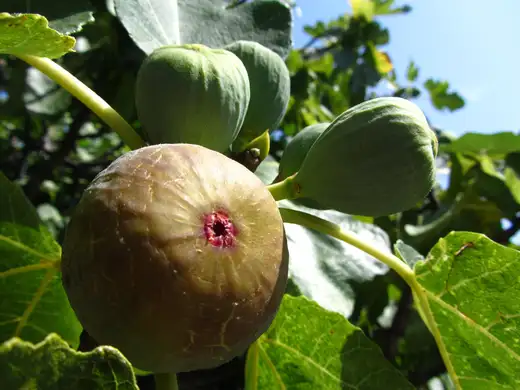
‘Mission’, the classic California fig, is not recommended in the Southeast or Tennessee because it is not hardy enough. In humid regions, choose cultivars with a closed “eye”, the small opening at the bottom of the fruit. A closed eye keeps out the insects and rain that make figs sour.
Site and soil
Give figs full sun. Clemson asks for at least 8 hours, and UF/IFAS for sun all day. Where winters are marginal, plant in the warmest spot you have, such as the south side of a building. Leave 3 to 4 feet between the plant and the wall (UT). Clemson adds that a site shaded from early-morning and late-evening winter sun reduces cold injury.
Soil type matters less than drainage and nematodes. Root-knot nematodes are the main pest of figs in sandy soils of the Coastal Plain, and infested trees cannot be cured. Clemson advises planting as far as possible from old vegetable garden sites. Keep figs away from drain fields and water lines, because the wide, shallow roots can clog pipes. UT suggests a pH between 6.0 and 6.5.
Planting
Plant bare-root figs while they are dormant. Container-grown figs can go in later in the season. In cold areas, wait until hard freezes are over in spring. In mild areas, plant bare-root trees in fall or early winter; in Florida that means December to late February. The when to plant figs page covers timing in detail, and the dates for your zone are above.
Plant at the same depth the fig grew in the nursery and mulch 2 to 3 inches deep. Water often in the first year. UF/IFAS gives a young tree about 10 gallons at least three times a week during establishment. Space figs 10 to 16 feet apart.
Watering and fertilizer
Figs bear best with steady moisture, about 1 inch of water a week in summer (Clemson). Mulch helps hold it. Drought-stressed trees fruit poorly and suffer more from nematodes. Uneven watering causes splitting, so water consistently, and cut back as the plant goes dormant in fall.
Feed lightly or not at all. A fig that grows fast and lush is the one most likely to freeze and drop its fruit. UF/IFAS fertilizes only when a year’s new growth is under about 1 foot, and UT uses 18 inches as its threshold. Finish feeding by midsummer, the end of July in Clemson’s schedule, so new growth has time to harden before frost. Near the mountains, Clemson recommends no fertilizer at all.
Pruning
Figs need little pruning. Most cultivars bear a light early crop, called the breba, on last year’s wood. The main crop comes in mid to late summer on the current season’s growth. Heavy winter pruning removes the breba crop and can cut deeply into the main crop as well.
In the Piedmont and colder areas, Clemson trains figs as a bush. Cut the young plant back by a third at planting. After the first season, keep three to eight well-spaced stems as permanent leaders. Prune in late winter, after the coldest weather but before growth starts. UT heads the plant back by a third to two-thirds each spring to control size. After a hard winter, wait until new growth shows which wood is alive before cutting out the dead.
Winter protection
In zone 6 and the colder parts of zone 7, protection decides whether a fig keeps its top growth. Penn State’s method for in-ground figs:
- After a hard frost, strip the remaining leaves and unripe fruit.
- Mulch the base 6 to 12 inches deep with leaves or straw.
- Shorten the branches, tie them together, and wrap them in burlap or another breathable fabric, not plastic.
- Fill the wrap loosely with straw and add a tarp on top to shed rain, leaving the bottom open for air.
Potted figs are easier. Move them into an unheated garage or cool basement when temperatures head toward 15 to 20°F. Water them lightly about once a month, and bring them back out in April.
Harvest
Ripe figs soften, the neck wilts a little, and the fruit droops on its stem. A ripe fig also comes away without white latex oozing from the stem. Most of the crop ripens from July to October, depending on cultivar. Fresh figs spoil fast at room temperature but keep up to a week or two in the refrigerator. The latex contains ficin, an enzyme that can irritate skin, so wear gloves if you are sensitive.
Common problems
- Fruit drops or never ripens: usually a young, overly vigorous plant or drought. Stop fertilizing, and water during dry spells. Clemson notes it can take three to four years for a fig to mature its first good crop.
- Fig rust: leaves turn yellow-brown and drop in late summer. It is rarely fatal, so spray only if it comes back every year, and rake up fallen leaves.
- Souring: fermented-smelling fruit, caused by yeasts that insects carry in through an open eye. Sprays don’t control it. Grow closed-eye cultivars.
- Root-knot nematodes: galled roots in sandy soil. Choose a clean site and mulch.
- Birds, squirrels and raccoons: net the plant as fruit begins to ripen.
Questions
Why does my fig tree drop its fruit before it ripens?
Clemson lists young, overly vigorous plants as the main cause, followed by hot, dry spells before ripening. Stop fertilizing a fast-growing tree, and water and mulch during droughts. 'Celeste' also tends to drop fruit in hot weather.
How cold can a fig tree get?
UF/IFAS says fully dormant figs are hardy to about 15 to 20°F. Tennessee notes damage to the top usually occurs somewhere between 5 and 20°F, depending on cultivar, but the roots typically resprout.
Should I prune my fig in winter?
Only lightly. UF/IFAS warns that heavy winter pruning can remove much of next year's crop. Cut out freeze-killed wood once new growth shows where the live wood starts.
Can I grow figs in a pot?
Yes. Tennessee recommends 20 gallons or more for mature, productive plants, root pruning every three to four years, and moving pots into a garage or other shelter when temperatures drop toward 15 to 20°F.
Do I need two fig trees for fruit?
No. The common figs grown in the East and South set fruit without pollination, so a single tree bears on its own.
Sources
- HS27/MG214: The Fig · UF/IFAS Extension
- Figs for Tennessee Gardens and Landscapes (D 234-B) · University of Tennessee Extension
- Figs: How to Grow and Care for Figs in South Carolina · Clemson Cooperative Extension Home & Garden Information Center
- Winterizing Your Fig Tree · Penn State Extension
- Figs · UF/IFAS Gardening Solutions
- Ficus carica (Common Fig) - NC State Extension Gardener Plant Toolbox · NC State Extension