How to Grow Eggplant
Eggplant is very sensitive to cold. Set transplants out only after frost, once the soil is at least 60°F and days reach about 65°F. Give the plants full sun, at least an inch of water a week and moderate feeding. Start picking 65 to 80 days after transplanting, while the skin is still glossy.

Your dates for eggplants
Set your ZIP code at the top of the page and we will work out when to plant eggplants where you live, from the frost records of the nearest NOAA weather station. Your ZIP code is remembered on this device only.
Eggplants at a glance
- Botanical name
- Solanum melongena
- Light
- full sun
- Frost tolerance
- Tender: killed by frost
- Soil temperature to plant
- At least 60°F (best 75–85°F)
- Germination
- 5–14 days
- Days to harvest
- 90–120 days from seed; 65–90 days from transplanting
- Planting depth
- 0.5 inches
- Spacing
- 24–36 inches apart, rows 24–48 inches apart
- Containers
- Yes, at least 5 gallons
When to plant eggplants
| Zone | Start indoors | Plant out |
|---|---|---|
| Zone 2a | Apr 15 to 29 | Jun 17 to Jul 1 |
| Zone 3a | Apr 9 to 23 | Jun 11 to 25 |
| Zone 3b | Apr 6 to 20 | Jun 8 to 22 |
| Zone 4a | Mar 31 to Apr 14 | Jun 2 to 16 |
| Zone 4b | Mar 26 to Apr 9 | May 28 to Jun 11 |
| Zone 5a | Mar 21 to Apr 4 | May 23 to Jun 6 |
| Zone 5b | Mar 21 to Apr 4 | May 23 to Jun 6 |
| Zone 6a | Mar 17 to 31 | May 19 to Jun 2 |
| Zone 6b | Mar 10 to 24 | May 12 to 26 |
| Zone 7a | Mar 3 to 17 | May 5 to 19 |
| Zone 7b | Feb 22 to Mar 8 | Apr 26 to May 10 |
| Zone 8a | Feb 8 to 22 | Apr 12 to 26 |
| Zone 8b | Jan 27 to Feb 10 | Mar 31 to Apr 14 |
| Zone 9a | Jan 10 to 24 | Mar 14 to 28 |
| Zone 9b | Jan 4 to 18 | Mar 8 to 22 |
Wait for real warmth
Eggplant grows fastest between 70 and 85°F, and Clemson and Utah State both stress that it grows poorly in cool weather. Texas A&M advises waiting until frost risk is past and daytime temperatures reach at least 65°F; Utah State wants the soil at 60°F. Treat the dates for your zone above as the earliest you should plant, not a target.
Most gardeners buy transplants. If you grow your own, sow 6 to 8 weeks before planting out (Clemson, Texas A&M) or allow 8 to 10 weeks (Utah State). Eggplant seed needs heat. Texas A&M says it sprouts in about 5 days at 86°F but can take 14 days at 65°F, and UC’s table shows similar figures. Utah State germinates seed at 80°F, then grows seedlings at 65 to 75°F under lights for 14 to 16 hours a day. Plant out stocky, dark green transplants 5 to 8 inches tall with 6 to 9 leaves and no blossoms, since flowering transplants establish slowly and yield less.
In short-season areas such as Utah, the northern states and the mountain West, Utah State recommends planting through black plastic and covering young plants with row covers or hot caps. Vent covers when the air inside goes above 80°F.
Varieties
Extension services list these for their regions:
- South Carolina (Clemson): Italian types Black Magic, Classic, Dusky, Epic, Night Shadow and Santana; Asian types Ichiban, Calliope and Kermit; specialty types Casper, Ghostbuster, Gretel, Hansel and Millionaire.
- Texas (Texas A&M): Black Bell, Black Magic, Epic, Classic, Florida High Bush, Florida Market and Night Shadow, plus the Asian types Ichibon and Tycoon.
- Utah (Utah State): Black Beauty, Black Bell, Black Magic, Classic, Dusky, Little Fingers and Orient Express, and the specialty types Calliope, Fairy Tale and Ichiban.
- Florida (UF/IFAS): Black Beauty, Dusky, Long, Ichiban and Cloud Nine.
Planting
Choose full sun and fertile, well-drained soil. Clemson recommends a pH of 6.0 to 6.5, and Texas A&M accepts 5.5 to 7.2. Work in compost: Texas A&M suggests a 3- to 4-inch layer. Rotate away from beds that grew tomatoes, peppers, potatoes or eggplant recently, which matters especially for Verticillium wilt.
The plants reach 2 to 4 feet and branch widely, so give them room. Utah State spaces them 24 inches apart, Clemson 24 to 30 inches in rows 3 to 4 feet apart, and Texas A&M 24 to 36 inches. Heavy-fruited plants may need a stake.
Water, mulch and feeding
Eggplant needs steady moisture. Texas A&M calls for at least an inch a week, given as one thorough soaking rather than several light sprinklings that keep roots shallow; Utah State suggests 1 to 2 inches by drip. Clemson advises wetting the soil at least 6 inches deep and says moisture matters most while fruit is setting and growing. Uneven watering makes fruit tough and leathery. Hot wind and sandy soil raise water needs.
Mulch helps hold moisture, but wait until the soil is above 75°F before adding organic mulch, because it keeps cool soil cool.
Feeding should be moderate. Clemson side-dresses ½ pound of calcium nitrate per 100 square feet 3 to 4 weeks after planting and again 3 to 4 weeks later. Utah State uses ½ tablespoon of 21-0-0 per plant at 4 and 8 weeks. Texas A&M applies half the fertilizer before planting and half after the first fruits appear. Overfeeding gives leafy plants that are slow to flower.
Regional notes
Cold North: Utah State recommends transplants, black plastic and row covers in cooler areas, because eggplant is killed by light frost and grows poorly in cool weather. Southeast: Clemson lists an August planting for a fall crop on the South Carolina coast but does not recommend one in the Piedmont. Florida and zones 9 to 11: UF/IFAS plants in late winter and late summer in central Florida, and from late summer through winter in south Florida, and notes that spring plantings bear into summer. Low desert around Phoenix: the University of Arizona calendar lists eggplant as a spring transplant only. UF/IFAS warns that high temperatures and drought make fruit bitter, so steady watering matters most in hot regions.
Pests and problems
- Flea beetles: the main early pest, chewing pinholes in seedlings and young leaves and sometimes killing small plants. Utah State recommends a labeled insecticide at planting or emergence; Texas A&M lists spinosad, neem oil and diatomaceous earth among options.
- Colorado potato beetles, aphids, whiteflies and spider mites: handpick beetles; use strong water sprays or insecticidal soap for mites and soft-bodied insects.
- Verticillium wilt: lower leaves yellow and wither, and the stem shows brown streaks inside. Utah State notes there are no resistant varieties, so rely on rotation and soil solarization.
- Phomopsis blight and other fruit rots: favored by wet conditions. Avoid overhead watering late in the day.
- Tough or bitter fruit: Utah State links tough skin to nights below 55°F, days above 95°F, water stress and overmature fruit.
- Sunscald: keep plants leafy and well watered; shade plants in extreme heat.
Harvest and storage
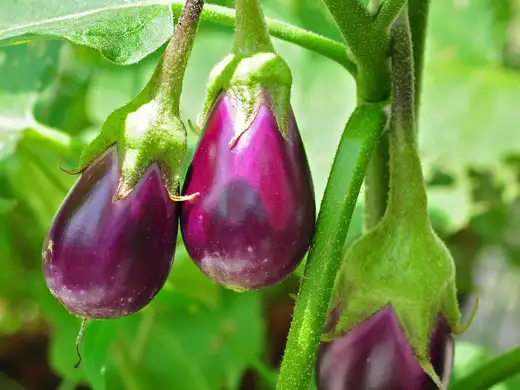
Clemson gives 65 to 80 days from transplanting to harvest. Fruit reaches full size 10 to 20 days after flowering. Italian types are ready at 6 to 8 inches, glossy and evenly colored, and Asian types can be picked at about the size of a finger or hot dog. Texas A&M notes that fruit can be harvested anywhere from one-third to full size. Use the thumbnail test: a light press that leaves a dent means it’s ready. Pick before the skin dulls and the seeds harden, once or twice a week. The stems are tough and prickly, so wear gloves and cut fruit off with pruners rather than twisting.
Clemson and Texas A&M recommend storing eggplant at 45 to 50°F with high humidity for about a week. Utah State suggests 50 to 55°F and warns that fruit kept in the refrigerator can suffer chilling injury. Eggplant can be frozen but is not suited to canning or drying, according to Utah State.
Questions
How do I know when an eggplant is ready to pick?
Press the side of the fruit lightly with your thumbnail. If the dent stays, it is ready. The skin should be glossy and evenly colored; dull skin means it is overmature, seedy and likely bitter.
Why is my eggplant bitter?
Heat, drought stress and overmature fruit all cause bitterness and toughness. Keep watering steady and pick fruit while the skin is still shiny.
What is eating small holes in my eggplant leaves?
Flea beetles, tiny jumping beetles that chew pinholes in seedlings and young leaves and can kill small plants. Utah State recommends a labeled insecticide at planting or soon after emergence.
How many eggplants should I plant?
Utah State suggests 1 to 2 plants per person for fresh use, depending on the variety and fruit size.
Can I grow eggplant in a container?
Yes. Texas A&M recommends a 5-gallon container per plant and lists Florida Market, Black Beauty and Long Tom for Texas containers; University of Maryland suggests 8 to 10 gallons for full-size plants and 4 to 6 gallons for dwarf types.
Sources
- Eggplant (HGIC 1310) · Clemson Cooperative Extension, Home & Garden Information Center
- How to Grow Eggplant in Your Garden · Utah State University Extension
- Easy Gardening: Eggplant (EHT-036) · Texas A&M AgriLife Extension Service
- Florida Vegetable Gardening Guide (SP 103/VH021) · UF/IFAS Extension
- Vegetable Planting Calendar for Maricopa County (AZ1005) · University of Arizona Cooperative Extension
- Soil Temperature Conditions for Vegetable Seed Germination (Garden Notes GN 154) · UC Cooperative Extension Sacramento County (UC ANR)
- Solanum melongena · NC State Extension Gardener Plant Toolbox
- Vegetable Gardening in Containers (E-545) · Texas A&M AgriLife Extension Service
- Types of Containers for Growing Vegetables · University of Maryland Extension