How to Grow Dragon Fruit
Dragon fruit is a climbing cactus for nearly frost-free climates such as South Florida, Hawaii and coastal Southern California. Root a cured stem cutting, plant it at the base of a sturdy post with a frame on top, and train one stem to the top before letting it branch. Plant two or three genetically different types for good fruit set. Rooted cuttings can fruit in six to nine months.
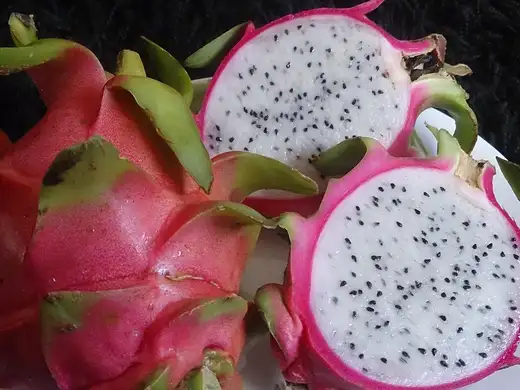

Dragon fruit at a glance
- Botanical name
- Hylocereus undatus (also H. polyrhizus, H. costaricensis and hybrids)
- Light
- full or nearly full sun (about 30% shade for new plantings where sun is intense)
- Frost tolerance
- Tender: killed by frost
- Spacing
- 108–180 inches apart
Where dragon fruit grows
Dragon fruit, also called pitaya, is a vining cactus from tropical America with three-sided, jointed green stems that climb by aerial roots. It suits tropical and subtropical areas that are nearly free of frost. In the US that means South Florida, Hawaii and coastal Southern California. There, University of California Cooperative Extension has trialed cultivars and found that the plant adapts well and needs less water than citrus or avocados.
Cold is one limit and harsh sun is the other. UF/IFAS reports damage from long freezes below about 31°F, though plants recover quickly from a light frost. Very high heat is also a problem. UF/IFAS says temperatures should not go above about 100°F, and University of Hawaii Extension says the plant does not suit areas above 102°F with intense sun. Stems sunburn in low humidity or strong light. UF/IFAS recommends about 30 percent shade for the first three to four months after planting, but too much shade cuts the crop.
Choosing plants
Start from rooted cuttings, not seed. Seedlings vary and can take up to 7 years to fruit. Because many cultivars are self-incompatible, plant two or three genetically different types rather than several cuttings of one clone. UF/IFAS notes that self-compatibility is poorly documented for many named cultivars, which makes firm recommendations hard. Buy from a source that tells you which types it has.
Clean stock matters too. UC researchers found Cactus virus X in most of the pitaya samples they tested in California. It spreads through pruning tools, handling and propagation, so start with clean cuttings and disinfect your tools. All the cultivars UC tested were also susceptible to the southern root-knot nematode.
Rooting cuttings
UF/IFAS uses stem pieces 6 to 15 inches long, cut on a slant at the base. Let them cure in a dry, shady spot for about a week (CTAHR says 5 to 7 days) so the cut seals. You can plant cured cuttings straight into the ground. UF/IFAS recommends rooting them in pots of well-drained mix for 4 to 6 months first, then planting them out. Longer cuttings reach the top of the trellis sooner.
Planting and the trellis
Mature plants become heavy and sprawling, so build the support before planting. UF/IFAS suggests a pressure-treated post 4 to 6 inches in diameter with a strong metal grid, such as rebar, on top, set 10 to 15 feet from other plants and buildings. A mature plant can weigh several hundred pounds, and weak trellises buckle. Avoid bare wire, which cuts the stems, or cover it with plastic hose. In Taiwan, CTAHR reports commercial pillars about 78 inches tall set 9 by 15 feet apart. Never plant next to a utility pole.
Pick the warmest spot in the yard that never stays wet after rain. Pitaya tolerates many soils if they drain, and it does best with plenty of organic matter. In South Florida you can plant any month if you can water. Otherwise, UF/IFAS suggests planting at the start of the warm, rainy season. Where the water table is high, plant on a mound of native soil 2 to 3 feet high. Set the plant at its pot depth and keep mulch 8 to 12 inches from the stem.
Training and pruning
Tie one main stem to the post and remove side shoots until it reaches the top. Then cut the tip so it branches, and drape the new branches over the frame, where they will flower and fruit.
After that, prune one to three times a year, soon after harvest. Remove damaged, dead or crowded stems and any that touch the ground. An unpruned plant becomes a dense tangle that stays wet and invites disease. Pruning also encourages flowering.
Water and fertilizer
Despite being a cactus, pitaya needs fairly regular water, but soggy soil causes stem and root rot. UF/IFAS says a drier winter and early spring helps trigger bloom. From flowering through harvest, water regularly, because uneven moisture splits the fruit. Hawaii’s guide recommends irrigating about twice a week during production.
UF/IFAS waits about a month after planting, or until growth starts, before feeding. In the first year it gives light applications every two months, about a quarter pound per plant of a balanced fertilizer such as 6-6-6 with magnesium. It adds compost or well-rotted manure around the base, not touching the stem. Rates increase gradually in later years. Plants on alkaline soils may need chelated iron.
Flowers and pollination
The flowers are spectacular: up to 14 inches long, fragrant, and open for a single night. CTAHR describes them opening in early evening and closing by daybreak. Moths and bats are the natural pollinators, but UF/IFAS notes they are not often seen at work. If fruit set is poor, hand-pollinate at night or early morning. Collect pollen from one flower and brush it onto the stigma of a flower on a different type. Hand-pollination also improves fruit size.
Harvest
The main season runs from June to November in Florida for H. undatus. Pick only fruit with full color, since it does not ripen further off the plant. Fruit can be harvested 30 days after pollination. Hawaii Extension reports fruit picked at about 50 days averaged 50 percent heavier and was sweeter. Use hand clippers, and wear gloves for spiny types. Dragon fruit keeps only 4 to 5 days at room temperature. In perforated plastic bags in the refrigerator it lasts several weeks; CTAHR gives 25 to 30 days at 40°F.
Common problems
- Stem and fruit canker, stem rots: keep plants open and sunny so stems dry quickly after rain.
- Sunburn: scorched, yellowing stems in strong sun. Shade new plantings.
- Flowers but no fruit: self-incompatibility. Add a different type, or hand-pollinate.
- Split fruit: uneven watering during fruiting.
- Pests and animals: mites, thrips, scales, mealybugs and ants, plus raccoons, rats and birds. Check plants year-round.
Questions
Why is my dragon fruit flowering but not fruiting?
Many cultivars are self-incompatible and need pollen from a different type. UF/IFAS recommends planting two or three genetically different types, or hand-pollinating at night by moving pollen from one flower to another.
How long does dragon fruit take to fruit?
UF/IFAS reports cuttings can fruit 6 to 9 months after planting. University of Hawaii Extension expects the first crop in year two and full production by year five. Seedlings can take up to 7 years.
How cold can dragon fruit tolerate?
UF/IFAS says long exposure below about 31°F causes damage, though plants recover quickly from light frost. In colder areas, protect plants on frosty nights.
How do I know when dragon fruit is ripe?
The skin is fully colored for its type. University of Hawaii Extension says fruit can be picked 30 days after the flower is pollinated, but waiting up to about 50 days gives bigger, sweeter fruit. It does not ripen further after picking.
Sources
- Pitahaya or Dragon Fruit (Hylocereus spp.): A New Water Efficient Crop for Southern California Small Scale Farmers · University of California Cooperative Extension (UC ANR)
- HS1068/HS303: Pitaya (Dragonfruit) Growing in the Florida Home Landscape · UF/IFAS Extension
- Pitaya (Dragon Fruit, Strawberry Pear) F&N-9 · University of Hawaii CTAHR Cooperative Extension