How to Grow Crocus
Plant crocus corms in fall once the soil is below about 60°F, 3 to 4 inches deep and 2 to 4 inches apart, in gritty, well-drained soil and full sun. Plant them in groups of a dozen or more. They are among the first flowers of late winter, and in the right spot a clump spreads for years with almost no care.

Your dates for crocuses
Set your ZIP code at the top of the page and we will work out when to plant crocuses where you live, from the frost records of the nearest NOAA weather station. Your ZIP code is remembered on this device only.
Crocuses at a glance
- Botanical name
- Crocus spp. (Dutch crocus C. vernus, snow crocus C. chrysanthus, C. tommasinianus and others)
- Light
- full sun to partial shade; full sun gives better flowers
- Frost tolerance
- Hardy: takes a hard frost
- Hardiness zones
- 3-8 (NC State Extension). Grown in California zones 7-9 (UC Riverside) and zones 9-10 in Marin County with pre-chilled corms (UC ANR).
- Planting depth
- 3 inches
- Spacing
- 2–4 inches apart
- Containers
- Yes
When to plant crocuses
| Zone | Fall planting |
|---|---|
| Zone 2a * | Jul 25 to Sep 19 |
| Zone 3a | Aug 3 to Sep 28 |
| Zone 3b | Aug 13 to Oct 8 |
| Zone 4a | Aug 17 to Oct 12 |
| Zone 4b | Aug 20 to Oct 15 |
| Zone 5a | Aug 23 to Oct 18 |
| Zone 5b | Aug 29 to Oct 24 |
| Zone 6a | Sep 5 to Oct 31 |
| Zone 6b | Sep 10 to Nov 5 |
| Zone 7a | Sep 13 to Nov 8 |
| Zone 7b | Sep 20 to Nov 15 |
| Zone 8a | Sep 26 to Nov 21 |
| Zone 8b | Oct 2 to Nov 27 |
| Zone 9a * | Oct 15 to Dec 10 |
| Zone 9b * | Oct 28 to Dec 23 |
* Outside zones 3 to 8, the hardiness range our sources give for crocuses. Plants there may not survive the winter or get enough winter chill, and are usually grown as annuals or in pots.
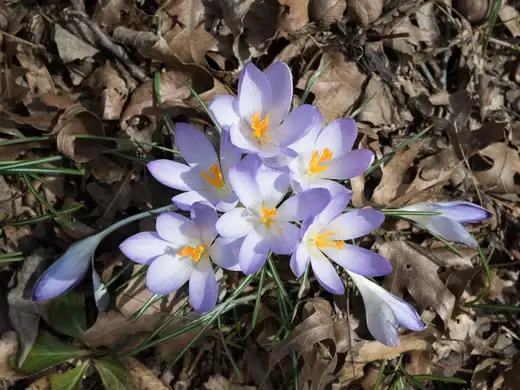
Crocus are small, cheap and among the very first flowers of the year, often opening in February or March and sometimes through snow. They belong to the iris family and grow from corms, flattened underground stems that are replaced by a new corm every year. The flowers open in morning sun and close at night and on cloudy days.
Which crocus to grow
Most garden centers sell three groups:
- Dutch crocus (C. vernus) are the large hybrids, with flowers in white, yellow, purple and stripes. They are the showiest but, according to Clemson, don’t naturalize as well as the species.
- Snow crocus (C. chrysanthus) bloom earlier, with smaller flowers in many colors.
- C. tommasinianus (“tommies”) have slender lavender flowers. University of Maryland Extension calls them one of the best crocus for lawns and compacted soil under trees, and says they spread even where rodents are a problem. NC State, which also calls this species snow crocus, says it can bloom with snow on the ground and is reportedly resistant to squirrels.
For South Carolina, Clemson recommends cloth of gold crocus (C. angustifolius), snow crocus and tommies, along with their cultivars, over Dutch crocus.
Fall-blooming crocus, including saffron crocus (C. sativus), are planted at a different time of year. More than 4,000 dried stigmas go into one ounce of saffron, UC Riverside notes. Don’t confuse any of these with colchicums, the highly poisonous “autumn crocus.” Colchicums have six stamens; crocus have three.
Where to plant crocus
Choose full sun or light shade; full sun gives better flowers. Because crocus finish before trees leaf out, they work well under deciduous trees, along paths, in rock gardens, and in lawns.
Soil is the key. NC State recommends gritty, well-drained soil, ideally a sandy loam with compost, and says to avoid heavy clay. Crocus like moisture in fall and spring while growing, but a dry, warm spot in summer while dormant.
How to plant crocus corms
Plant in fall once the soil has cooled below about 60°F. In the North that is mid-September through October; Clemson plants in November in South Carolina. The dates for your zone above show the window.
- Depth. Set corms about 3 to 4 inches deep (Clemson, Rutgers, Illinois). NC State uses about 2½ inches and Arkansas about 2 inches.
- Spacing. Two to 4 inches apart. NC State fits 35 to 70 corms in a square foot for a carpet effect.
- Grouping. Plant in clusters, not lines. Arkansas plants 6 to 12 corms together, Illinois at least 25, and South Dakota State suggests groups of 20 to 30.
- Feeding. UC Riverside recommends a small amount of fertilizer at planting and warns that too much produces leaves instead of flowers.
- Mulch. Rutgers mulches small early bulbs only lightly so the mulch doesn’t get in the way of the shoots.
Arkansas Extension tucks corms under creeping phlox or dianthus, so the same patch of ground flowers twice.
Care after bloom
Leave the grassy leaves for about six weeks after flowering (NC State) so the new corm can store food. In a lawn, that means holding off on mowing those areas until the crocus leaves turn yellow.
Well-sited clumps persist and spread for years. Some species also self-sow. When flowering drops off because of crowding, dig the clump after the leaves wither, separate the corms and replant. NC State suggests dividing about every four years.
Squirrels and other pests
Wildlife is the biggest problem. Clemson and Rutgers both list crocus among the bulbs animals dig up and eat (Rutgers names voles, squirrels, rabbits and deer), and NC State calls squirrels particularly good at finding fresh corms. South Dakota State is the exception, reporting that crocus are among the last bulbs animals bother in its area. Where diggers are a problem:
- Lay chicken wire or hardware cloth over new plantings, anchored with staples or bricks, and remove it before spring growth or let shoots grow through.
- Plant among daffodils, which animals avoid.
- Choose C. tommasinianus, which rodents bother less.
The other common problem is corm rot in wet or heavy clay soil. Choose a gritty, well-drained spot or a raised bed.
Crocus in warm-winter areas
Crocus are rated for zones 3 to 8 by NC State, but they grow in mild California too. UC Riverside reports they do well in urban California in zones 7 through 9 and plants corms in late October or November. Sources differ on chilling: UC Marin Master Gardeners, in zones 9 and 10, recommend pre-chilling corms in the refrigerator at 35 to 45°F for one to three months before planting, or buying pre-chilled corms, while Napa County Master Gardeners, citing a Northern California trial, consider chilling optional in the Bay Area. Expect short-lived flowers during warm spells.
Crocus in pots
Crocus force easily. Rutgers fits about 15 corms in a 6-inch pot. Hold them at 35 to 48°F for at least 12 to 13 weeks, then bring them into a bright, cool room to bloom three to four weeks later.
Questions
How deep do you plant crocus bulbs?
About 3 to 4 inches deep is the common recommendation (Clemson, Rutgers, Illinois). NC State goes a little shallower at about 2½ inches. Crocus grow from corms, which are small, so they don't go as deep as tulips or daffodils.
Can I plant crocus in my lawn?
Yes. Snow crocus and *C. tommasinianus* naturalize well in lawns. The catch is mowing: leave the grass until the crocus leaves turn yellow, about six weeks after bloom.
Why didn't my crocus come up?
Squirrels, chipmunks, mice and voles are the most common reason; they dig up and eat newly planted corms. Rot in heavy, wet clay is the other. Cover new plantings with wire mesh and plant in gritty, well-drained soil.
Is autumn crocus the same as crocus?
Not always. True fall-blooming crocus, including saffron crocus, are crocus. But plants sold as "autumn crocus" or "meadow saffron" are often colchicums, which are highly poisonous. Crocus flowers have three stamens, colchicums six.
Do crocus need chilling in warm climates?
Not always. Napa County Master Gardeners, citing a Northern California trial, consider chilling optional in the Bay Area, while UC Marin Master Gardeners recommend pre-chilling corms for one to three months at 35 to 45°F in zones 9 and 10. UC Riverside reports crocus doing well in urban California in zones 7 through 9.
Sources
- Bulbs · University of Maryland Extension
- Flowering Bulbs: Basic Care · University of California Cooperative Extension, Napa County Master Gardeners
- Crocus - North Carolina Extension Gardener Plant Toolbox · NC State Extension
- Crocus tommasinianus - North Carolina Extension Gardener Plant Toolbox · NC State Extension
- Crocus (fact sheet, Center for Landscape and Urban Horticulture) · University of California Cooperative Extension, Riverside
- Focus on Crocus · UC ANR, UC Marin Master Gardeners
- Crocus (Plant of the Week) · University of Arkansas Cooperative Extension Service
- Spring-Flowering Bulbs (HGIC) · Clemson Cooperative Extension Home & Garden Information Center
- Bulbs to Plant in the Fall · South Dakota State University Extension
- Spring Flowering Bulbs (FS1220) · Rutgers Cooperative Extension
- Spring Flowering Bulbs (G1742) · University of Nebraska-Lincoln Extension
- Bulbs · UF/IFAS Extension Leon County
- Plant Bulbs in the Fall for a Spring Celebration · Penn State Extension
- Bulbs (Backyard Farmer) · University of Nebraska-Lincoln Extension, Backyard Farmer
- How to plant flower bulbs for a colorful spring display · University of Illinois Extension