How to Grow Creeping Phlox
Creeping phlox (Phlox subulata) is a tough, evergreen groundcover for sunny, well-drained spots, hardy in zones 3 to 9. Plant it where water never stands, water only until it is established, and shear the stems back by a third to a half right after the spring bloom every year to keep the mat dense. Poor, sandy or gravelly soil suits it fine.
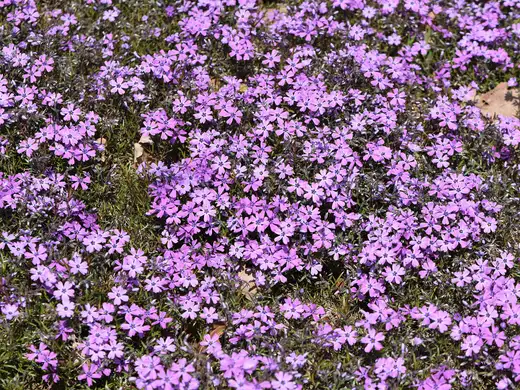

Creeping Phlox at a glance
- Botanical name
- Phlox subulata
- Light
- full sun (6+ hours); light shade tolerated, and dappled afternoon shade helps in hot, humid summers
- Frost tolerance
- Hardy: takes a hard frost
- Hardiness zones
- 3-9
What creeping phlox is good for
Phlox subulata is native to eastern and central North America, where it grows on rocky ledges, slopes and sandy clearings. It forms a mat of stiff, needle-like evergreen leaves 4 to 6 inches tall. NC State gives a mature spread of 2 to 3 feet, while the University of Georgia describes 12 to 18 inches for ‘Emerald Blue’. In spring the mat disappears under small, five-petaled, notched flowers in pink, lavender, blue-purple, magenta, red, white or stripes.
Use it where few other plants thrive: sunny slopes, rock gardens, the tops of low walls it can spill over, path and driveway edges, and foundation beds. Clemson notes it controls erosion well on slopes once the plants have grown together. It is not a plant for foot traffic, so lay stepping stones if you need to cross a planting.
Do not confuse it with Phlox stolonifera, also sold as creeping phlox. That species has oval leaves, spreads by runners and wants moist soil in partial shade. Penn State advises checking the botanical name.
Choosing a site
Sun: full sun, at least 6 hours, gives the heaviest bloom. NC State notes that in hot, humid summers the plant appreciates some dappled shade. Clemson warns that real shade makes the mats thin out.
Drainage: this matters more than anything else. Creeping phlox tolerates poor, sandy, gravelly and dry soils, and Ohio State notes it adapts to acidic soils even though it prefers neutral to slightly alkaline ones. It will not tolerate soil that stays wet. Water-holding sites cause root rot, and Clemson says the plant cannot take excessive moisture. On heavy clay, plant on a slope, a berm or a raised bed.
Weeds: clear perennial weeds thoroughly before planting. Missouri State notes creeping phlox does not compete well with weeds, so keep plantings weeded while the mat fills in.
Planting
Creeping phlox is almost always bought as container plants. Space them with the mature spread in mind, closer for quick cover and wider if you can wait for them to knit together. Water as needed until the roots take hold. Ohio State notes that stem cuttings rooted in autumn are overwintered indoors and planted out in spring.
Watering and feeding
Once established, creeping phlox is drought tolerant. Water only during long dry spells, and water at the base. The UF/IFAS Escambia County agent warns that routine overhead watering invites disease, and Ohio State links foliar nematodes to foliage that stays wet. The plant thrives in thin, poor soils, so rich feeding is unnecessary.
Shear it every year
The most important job comes right after flowering. Shear or clip the stems back by one-third to one-half. Ohio State explains why: it pushes out lush new foliage, keeps the plant vigorous, balances the top growth against the shallow roots and reduces pest infestations. The University of Maryland and Iowa State note it can bring a second flush of flowers. Mats that are never sheared develop woody, bare stems, and Ohio State says they often die out in patches with age.
Bloom season
Expect flowers in early to mid-spring. NC State and Ohio State put the show at late April to early May. In South Carolina, Clemson sees bloom from February on the coast to early April in the upper Piedmont and mountains. Sources disagree on how long the display lasts: Ohio State says about two weeks, while UGA says 3 to 4 weeks for ‘Emerald Blue’. The flowers feed bees, butterflies, skippers and hummingbirds.
Regional notes
Cold North (zones 3 to 5): the plant is hardy to zone 3, but its evergreen leaves and shallow roots can winter-burn in the coldest weeks. Ohio State recommends snow cover or a layer of evergreen boughs for protection.
Hot South (zones 8 and 9): zone 9 is the edge of its range. The UF/IFAS Escambia County agent has kept a Panhandle planting going for more than 24 years and recommends a spot with spring sun and summer shade from trees, in soil that does not hold water. Missouri State notes the plant may go dormant in very hot summers.
Varieties
Iowa State recommends ‘Amazing Grace’ (white with magenta eye), ‘Candy Stripe’ (pink and white), ‘Drummond’s Pink’, ‘Emerald Blue’ (lavender-blue), ‘Emerald Pink’, ‘Purple Beauty’, ‘Scarlet Flame’ and ‘White Delight’ for Iowa landscapes. Penn State also highlights ‘Emerald Blue’ and ‘Amazing Grace’.
Propagation
Creeping phlox is easy to multiply. Divide clumps, dig and replant trailing stems that have rooted where they touch the soil, or take stem cuttings. Clemson suggests carefully separating the rooted stems along the edges of a plant, which leaves the main mat undisturbed.
Common problems
- Spider mites: worst in hot, dry weather, and they can kill whole patches. Shearing after bloom helps reduce infestations.
- Foliar nematodes: damage leaves when foliage stays wet or humidity is high. Improve air circulation and avoid overhead watering.
- Root rot: caused by wet, poorly drained sites. Move plants to better-drained ground.
- Dead, woody centers: mats that go unsheared age poorly. Shear yearly and fill gaps with rooted pieces.
- Rabbits: they eat the foliage, though deer usually leave it alone.
Unlike most phlox, P. subulata resists powdery mildew, according to NC State.
Questions
Is creeping phlox the same as moss phlox?
Yes. Phlox subulata is sold as creeping phlox, moss phlox, moss pink and thrift. Another species, Phlox stolonifera, is also called creeping phlox, but it has oval leaves and wants partial shade and moist soil, so check the botanical name when buying.
When does creeping phlox bloom?
In early to mid-spring. NC State and Ohio State give late April to early May for the mid-Atlantic and Ohio, while Clemson reports bloom from February on the South Carolina coast to early April in the upper Piedmont and mountains.
Should I cut back creeping phlox after it blooms?
Yes. Shear the stems back by one-third to one-half once flowering ends. It keeps the mat dense, reduces pest problems and sometimes brings a second, smaller flush of flowers. Clemson notes a mower on a high setting works on large plantings.
Why is my creeping phlox dying in the middle?
Older stems turn woody and bare, especially in mats that are never sheared, and spider mites or foliar nematodes can kill patches. Shear every year after bloom, and replant bare spots with rooted stems from the healthy edges.
Is creeping phlox deer resistant?
Mostly. NC State and the University of Maryland describe it as tolerant of deer, which tend to avoid it, but rabbits do eat the foliage.
Sources
- Phlox (HGIC 1181) · Clemson Cooperative Extension Home & Garden Information Center
- Creeping Phlox - Phlox subulata · North Carolina State University Extension, Extension Gardener Plant Toolbox
- Moss Phlox · University of Maryland Extension, Home & Garden Information Center
- Phlox subulata (PlantFacts) · The Ohio State University
- Phlox in the Home Garden · Penn State Extension
- Growing Phlox in Iowa · Iowa State University Extension and Outreach
- 'Emerald Blue' Phlox · University of Georgia Extension
- A Plant from My Past · UF/IFAS Extension Escambia County
- Creeping Phlox · Missouri State University