How to Grow Chives
Chives are a hardy perennial, cold-hardy to zone 4, that come back every spring and need little more than sun, well-drained soil and steady moisture. The fastest start is a division from an established clump, planted in early spring; seed works too but takes about 60 days to a first cutting. Snip leaves once they are about 6 inches tall and divide clumps every 2 to 3 years.

Your dates for chives
Set your ZIP code at the top of the page and we will work out when to plant chives where you live, from the frost records of the nearest NOAA weather station. Your ZIP code is remembered on this device only.
Chives at a glance
- Botanical name
- Allium schoenoprasum
- Light
- full sun (6+ hours); tolerates partial shade, with fewer flowers
- Frost tolerance
- Hardy: takes a hard frost
- Hardiness zones
- 4-8
- Germination
- 7 days
- Days to harvest
- 60–85 days from seed; 30 days from transplanting
- Planting depth
- 0.25 inches
- Spacing
- 4–12 inches apart, rows 12 inches apart
- Containers
- Yes
When to plant chives
| Zone | Start indoors | Plant out | Sow outdoors |
|---|---|---|---|
| Zone 2a * | Mar 24 to Apr 7 | Apr 21 to May 19 | Apr 21 to May 26 |
| Zone 3a * | Mar 31 to Apr 14 | Apr 28 to May 26 | Apr 28 to Jun 2 |
| Zone 3b * | Mar 22 to Apr 5 | Apr 19 to May 17 | Apr 19 to May 24 |
| Zone 4a | Mar 18 to Apr 1 | Apr 15 to May 13 | Apr 15 to May 20 |
| Zone 4b | Mar 13 to 27 | Apr 10 to May 8 | Apr 10 to May 15 |
| Zone 5a | Mar 8 to 22 | Apr 5 to May 3 | Apr 5 to May 10 |
| Zone 5b | Mar 6 to 20 | Apr 3 to May 1 | Apr 3 to May 8 |
| Zone 6a | Mar 4 to 18 | Apr 1 to 29 | Apr 1 to May 6 |
| Zone 6b | Feb 26 to Mar 12 | Mar 26 to Apr 23 | Mar 26 to Apr 30 |
| Zone 7a | Feb 19 to Mar 5 | Mar 19 to Apr 16 | Mar 19 to Apr 23 |
| Zone 7b | Feb 8 to 22 | Mar 8 to Apr 5 | Mar 8 to Apr 12 |
| Zone 8a | Feb 1 to 15 | Mar 1 to 29 | Mar 1 to Apr 5 |
| Zone 8b | Jan 20 to Feb 3 | Feb 17 to Mar 17 | Feb 17 to Mar 24 |
| Zone 9a * | Jan 5 to 19 | Feb 2 to Mar 2 | Feb 2 to Mar 9 |
| Zone 9b * | Dec 6 to 20 | Jan 3 to 31 | Jan 3 to Feb 7 |
Spring dates before the last frost assume the soil has thawed and is dry enough to work. After a late or wet spring, wait for that even if the date has passed.
* Outside zones 4 to 8, the hardiness range our sources give for chives. Plants there may not survive the winter or get enough winter chill, and are usually grown as annuals or in pots.
Getting started: division, transplants or seed
Chives grow in dense clumps of small bulbs, and the easiest way to start is with a piece of someone else’s clump. Illinois Extension calls division in early spring the most common method; each division should contain about 4 to 6 bulbs, and UW-Madison says divisions establish quickly when they have at least 5. Penn State suggests cutting leaves back to about 4 inches before digging and replanting divisions about ½ inch deeper than before. Utah State suggests planting transplants or divisions in late April or early May in Utah.
Chives also grow readily from seed, though seed is slower. Indoor start times vary: about 4 weeks before the last frost (Penn State), 6 to 8 weeks of growth before planting out (Utah State) or 8 to 10 weeks before the last frost (NC State). Penn State says seedlings emerge in about 7 days and are ready to transplant, after hardening off, at about 4 weeks old. Outdoors, Utah State says to sow as early as possible in spring, while NC State and UW-Madison wait until after the last frost, when the soil has warmed. The dates for your zone above reflect that range. Sow seed about ¼ inch deep (Utah State); Penn State uses ½ inch for indoor flats.
Expect a first harvest about 60 days after seeding or 30 days after transplanting, according to Utah State.
Site and soil
Chives do best in full sun and well-drained soil rich in organic matter, though they tolerate most soil types and light shade. UW-Madison notes that shade can reduce flowering. Penn State gives a pH of 6 to 7 as ideal, and NC State warns that root rot can develop in poorly drained soil.
Spacing advice varies widely. Utah State spaces plants 4 to 6 inches apart in all directions; Penn State uses 8 to 12 inches; Maryland leaves 12 inches between plants and rows; and UW-Madison spaces clumps 12 to 20 inches apart.
Watering, feeding and weeding
Chives produce best with regular watering, though they survive drought once established. Utah State notes that growth and yield drop when plants are drought-stressed.
On fertilizer, the sources disagree. UW-Madison says chives have low nutrient needs and do not need regular feeding. Utah State side-dresses in May and July with 1 teaspoon of 21-0-0 per square foot. Penn State recommends a liquid fertilizer every 4 to 6 weeks unless plants were set in composted manure. Illinois takes a middle position: plants harvested often benefit from extra fertilizer during the season. UF/IFAS Pasco County warns that overfeeding can reduce flavor and injure plants. A light feeding for heavily cut clumps covers most gardens.
The roots are shallow, so weed by hand or with mulch rather than deep cultivation. Utah State stresses weed control in the first 2 months, when young plants grow slowly and compete poorly.
Harvesting and storing
Start cutting when leaves are about 6 inches long. Snip them 1 to 2 inches above the soil with scissors or a knife, working from the outside of the clump inward. Utah State suggests 3 to 4 cuttings in the first year and about one a month after that. Regular cutting keeps leaves tender, and Illinois notes it also encourages new bulblets. After flowering, UW-Madison suggests cutting plants back to about 3 inches to force a flush of tender new leaves.
Fresh chives keep up to a week in the refrigerator. They can be frozen or dried, but UW-Madison says dried leaves lose much of their flavor, and Illinois notes they discolor and absorb moisture.
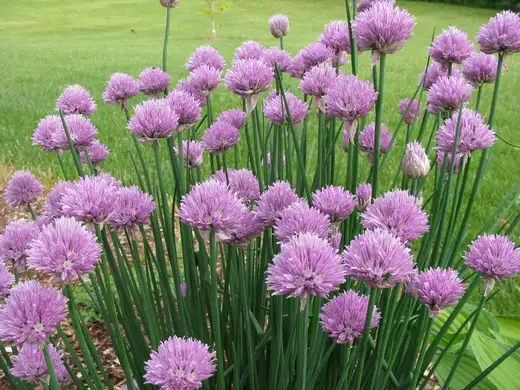
The round pink-to-purple flowers appear from mid-spring to early summer. UW-Madison, Illinois and Maryland describe them as edible and pretty in salads; Utah State calls the flowers and stalks unpalatable. The UF/IFAS Monroe County office notes the flower stems are tough and better discarded.
Dividing and renewing clumps
Clumps get crowded and less productive over time. Divide them every 2 to 3 years (UW-Madison, Illinois, Utah State) or every 3 years (Maryland), in spring. NC State says fall division also works. Let divided plants reestablish for several weeks before harvesting again.
In cold climates the leaves die back over winter. UW-Madison suggests clearing away the old foliage in late winter before new growth begins.
Regional notes
- Cold North and mountain areas: chives are hardy to zone 4. The foliage dies back in winter and regrows from the same clump each spring.
- Florida: UF/IFAS Pasco County says the best planting time is August through March. Chives behave as a cool-season herb there, growing through fall and spring and declining as late spring turns hot. Some shade during the hottest part of the day prevents wilting, and raised beds amended with compost help in sandy soil.
- Florida Keys: the UF/IFAS Monroe County office says both onion chives and garlic chives can be harvested year-round, but garlic chives are much tougher in beds without regular irrigation.
Growing chives in pots and indoors
Chives grow well in pots with good drainage. Water to keep the soil evenly moist and feed lightly. For winter, pot up a small clump and give it a bright, sunny window. Advice differs on timing: Utah State says to dig and divide in autumn, while Illinois says chives dug after a freeze, in December or January, perform better than those potted in fall, which tend to get leggy. Illinois recommends ‘Grolau’ for indoor growing and ‘Profusion’, a sterile variety, for pots.
Varieties
Illinois Extension lists ‘Grolau’ (bred for indoor growing, strong flavor), ‘Nelly’ (fine blue-green leaves), ‘Profusion’ (sterile flowers, no self-seeding) and ‘Staro’ (thick, dark leaves). UW-Madison lists ‘Dolores’ and ‘Polyvert’ as culinary seed strains and several ornamental types, including the white-flowered ‘Snowcap’ and the large ‘Forescate’ and ‘Pink Giant’.
Garlic chives (Allium tuberosum) are a separate species with flat leaves, white fall flowers and a garlic flavor. Illinois says they grow the same way as common chives.
Problems
Chives have few serious problems, and UW-Madison notes that deer and rabbits leave them alone. Watch for:
- Thrips. Tiny insects that leave leaves silvery or streaked. Penn State notes that overhead watering may reduce their numbers and that lacewings and other predators feed on them; insecticidal soap is an option.
- Onion maggots. Larvae tunnel into the bulbs. Penn State recommends good sanitation and removing nearby wild onions; floating row covers keep the egg-laying flies off.
- Pink root. A soil fungus that turns roots pink and then kills them. Utah State recommends a 5-year rotation away from onion-family plants, and Penn State advises avoiding sites where onions recently grew.
- Downy mildew. Tan to brown leaves with grayish-violet fuzz in cool, wet weather. Improve air movement and let leaves dry; Penn State recommends a 3- to 4-year rotation away from alliums and not crowding plants.
- Self-seeding. Remove flowers before they fade.
NC State lists chives as potentially toxic to cats, dogs and horses, so keep pets from grazing on them.
Questions
Do chives come back every year?
Yes. Chives are a hardy perennial; UW-Madison and NC State rate them to zone 4. In cold climates the leaves die back in winter and regrow in spring, while in mild climates they may stay green all year.
How do I cut chives so they keep growing?
Snip leaves about 1 to 2 inches above the soil, taking some leaves from a clump rather than all of them for a steady supply. UW-Madison notes that a clump cut back completely takes several weeks to regrow.
Are chive flowers edible?
Most extension sources, including UW-Madison, Illinois and Maryland, say the flowers are edible and good in salads or as a garnish. The flower stems are tough, and Utah State considers the flowers and stalks unpalatable, so try the florets and discard the stems.
Why are my chives spreading all over the garden?
Chives self-seed readily, especially in beds that are watered often. Cut off the flower heads before they fade and drop seed, or grow a sterile variety such as 'Profusion'.
Can I grow chives indoors in winter?
Yes. Pot up a small clump and keep it on a bright windowsill with regular water and light feeding. Illinois Extension gets the best results by digging clumps after a hard freeze, in December or January, rather than in early fall.
Sources
- Chives (Allium schoenoprasum) · University of Wisconsin-Madison Extension
- How to Grow Chives in Your Garden · Utah State University Extension
- Allium schoenoprasum (Chives) · NC State Extension Gardener Plant Toolbox
- Chives · PlantVillage, Penn State University
- Chives · University of Illinois Extension
- Chives · University of Maryland Extension
- Spice Up Your Life: A Beginners Guide to Growing Chives · UF/IFAS Extension Pasco County
- Osceola County, FL Planting Calendar for Herbs, Spices & Edible Flowers · UF/IFAS Extension Osceola County
- Chives: A Reliable Herb In A Keys Garden · UF/IFAS Extension Monroe County