How to Grow Cauliflower
Cauliflower is the fussiest cole crop: it needs cool weather while the head forms and must never run short of water or fertilizer. Plant young transplants shortly before your last spring frost or, more reliably, in midsummer for a fall harvest. Tie the leaves over white heads once they reach about 2 inches across, and cut them while they are still firm and smooth.

Your dates for cauliflower
Set your ZIP code at the top of the page and we will work out when to plant cauliflower where you live, from the frost records of the nearest NOAA weather station. Your ZIP code is remembered on this device only.
Cauliflower at a glance
- Botanical name
- Brassica oleracea (Botrytis Group)
- Light
- full sun (at least 6 hours; 8-10 preferred)
- Frost tolerance
- Half-hardy: takes a light frost
- Soil temperature to plant
- At least 40°F (best 65–85°F)
- Germination
- 5–10 days
- Days to harvest
- 75–90 days from seed; 50–80 days from transplanting
- Planting depth
- 0.25 inches
- Spacing
- 12–24 inches apart, rows 24–36 inches apart
- Containers
- Yes, at least 5 gallons
When to plant cauliflower
| Zone | Start indoors | Plant out | Sow outdoors | Fall planting |
|---|---|---|---|---|
| Zone 2a | Mar 3 to 31 | Apr 21 to May 12 | May 5 to 12 | Jun 27 to Aug 1 |
| Zone 3a | Mar 10 to Apr 7 | Apr 28 to May 19 | May 12 to 19 | Jul 6 to Aug 10 |
| Zone 3b | Mar 1 to 29 | Apr 19 to May 10 | May 3 to 10 | Jul 16 to Aug 20 |
| Zone 4a | Feb 25 to Mar 25 | Apr 15 to May 6 | Apr 29 to May 6 | Jul 20 to Aug 24 |
| Zone 4b | Feb 20 to Mar 20 | Apr 10 to May 1 | Apr 24 to May 1 | Jul 23 to Aug 27 |
| Zone 5a | Feb 15 to Mar 15 | Apr 5 to 26 | Apr 19 to 26 | Jul 26 to Aug 30 |
| Zone 5b | Feb 13 to Mar 13 | Apr 3 to 24 | Apr 17 to 24 | Aug 1 to Sep 5 |
| Zone 6a | Feb 11 to Mar 11 | Apr 1 to 22 | Apr 15 to 22 | Aug 8 to Sep 12 |
| Zone 6b | Feb 5 to Mar 5 | Mar 26 to Apr 16 | Apr 9 to 16 | Aug 13 to Sep 17 |
| Zone 7a | Jan 29 to Feb 26 | Mar 19 to Apr 9 | Apr 2 to 9 | Aug 16 to Sep 20 |
| Zone 7b | Jan 18 to Feb 15 | Mar 8 to 29 | Mar 22 to 29 | Aug 23 to Sep 27 |
| Zone 8a | Jan 11 to Feb 8 | Mar 1 to 22 | Mar 15 to 22 | Aug 29 to Oct 3 |
| Zone 8b | Dec 30 to Jan 27 | Feb 17 to Mar 10 | Mar 3 to 10 | Sep 4 to Oct 9 |
| Zone 9a | Dec 15 to Jan 12 | Feb 2 to 23 | Feb 16 to 23 | Sep 17 to Oct 22 |
| Zone 9b | Nov 15 to Dec 13 | Jan 3 to 24 | Jan 17 to 24 | Sep 30 to Nov 4 |
Spring dates before the last frost assume the soil has thawed and is dry enough to work. After a late or wet spring, wait for that even if the date has passed.
Why cauliflower is harder than broccoli
Clemson Extension calls cauliflower the most sensitive of the cole crops to adverse conditions. The head, or curd, is a mass of undeveloped flower buds, and it reacts badly to heat, cold, drought and hunger. Utah State says cauliflower grows best when temperatures stay below 75°F, and that both freezing temperatures and temperatures above 80°F reduce growth and head quality. Iowa State reports that days of 86°F or more with nights of 77°F or more can prevent a head from forming at all. Clemson’s preferred average is 60 to 65°F. Every step below is about keeping the plant growing steadily through a cool heading period.
When to plant
In spring, set transplants out around the dates for your zone above. Sources disagree on how early: Utah State plants 1 to 2 weeks before the last frost, while Maryland Extension plants 3 to 4 weeks before. The earlier date gives more time before summer heat; the later one lowers the risk of a cold spell. Clemson notes that 10 or more days between 35 and 50°F after a period of good growth can make cole crops bolt, and Maryland warns that planting too early is one cause of buttoning.
Fall is often the better season. Maryland says mid-Atlantic gardeners generally succeed more with fall cauliflower, sowing seed in early July and transplanting from late July to early August. Penn State recommends late July or early August plantings, and Iowa State sets transplants out in early to mid-July. Utah State suggests early-maturing varieties planted 50 to 75 days before a harvest about 1 to 2 weeks after the first fall frost.
In zones 9 to 11 cauliflower is a fall and winter crop. UF/IFAS lists planting windows from fall into winter in Florida and calls it difficult to grow there. In the Lower Rio Grande Valley of Texas, Texas A&M AgriLife times it like broccoli, with transplants set out from mid-October. West of the Cascades in Oregon and Washington, Oregon State’s PNW 548 describes overwintering cauliflower, transplanted from mid-July to early August and harvested from February to April, with its flavor at its best in winter and early spring.
Transplants
Young transplants matter more for cauliflower than for any other cole crop. Maryland sets out 5- to 7-week-old plants, Utah State sows 6 to 7 weeks ahead for a transplant with 4 to 6 mature leaves, and Iowa State sows only 4 to 5 weeks ahead. Larger, older or rootbound plants, and any shock at transplanting, push plants to form a button an inch or less across that never enlarges. Harden plants off for several days, water them in well, and plant them before they become rootbound.
Soil, spacing and feeding
Choose full sun and rich, well-drained soil that holds moisture. Clemson recommends a pH of 5.8 to 6.5, Iowa State 6 to 7. Plant 12 to 24 inches apart in rows 2 to 3 feet apart, and rotate cole crops so the same spot grows them only once every 3 or 4 years (Iowa State).
Cauliflower is a heavy feeder. Without a soil test, Clemson suggests 3 pounds of 5-10-10 per 100 square feet before planting, then a side-dressing 3 to 4 weeks after transplanting. Utah State uses ½ cup of 21-0-0 per 10 feet of row at about 4 weeks. Boron matters: Utah State and Wisconsin link a shortage to brown spots on the curd and a hollow, discolored stem, and Wisconsin notes that cauliflower needs more boron than broccoli or cabbage. Wisconsin adds that acid soil makes molybdenum unavailable, which causes narrow, strap-like leaves.
Water
Utah State recommends 1 to 2 inches of water a week, applied deeply, with mulch to hold moisture. Clemson names the first weeks after planting and the period as heads mature as the critical times. Drought during heading leads to loose, open heads and, according to Utah State, leaves growing up through the curd.
Blanching
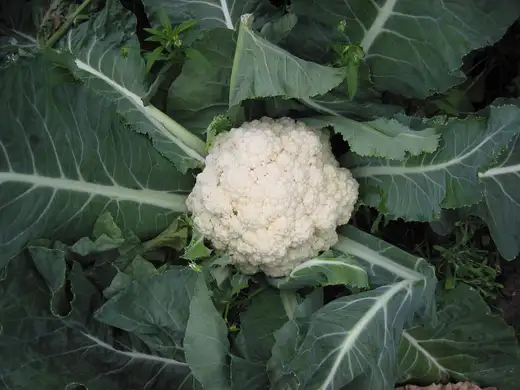
White cauliflower turns yellow, cream or even purple in sun, and Utah State notes the color change comes with bitter flavors. When the head is about 2 inches across, pull three or four large outer leaves over it and fasten them with a rubber band or twine. Iowa State compares that size to a tennis ball, Utah State to a silver dollar, and UF/IFAS says 2 to 3 inches. In warm weather, Maryland advises tying loosely so air can circulate.
Self-blanching varieties grow their inner leaves over the head, though Wisconsin notes even these may need tying for full shade. Orange, green and purple varieties need no blanching.
Varieties by region
- Utah: Snow Crown, Amazing, White Contessa (heat tolerant), Self Blanche, and Denali for summer planting and fall harvest (Utah State).
- South Carolina: Amazing, Snow Crown and Milky Way (Clemson).
- Iowa: Aquarius (good heat tolerance), Fremont, Snow Crown, White Sails, Cheddar (orange), Graffiti (purple), and Vitaverde (green, best for fall) (Iowa State).
- Florida: Snowball strains, Snow Crown and Brocoverde (UF/IFAS).
- Lower Rio Grande Valley, Texas: Snow Crown and Snowball (Texas A&M AgriLife).
- Western Oregon and Washington, overwintering: All The Year Round, Fredor, Medaillon, Picasso and Prestige (PNW 548).
Pests and problems
The same caterpillars that attack broccoli (imported cabbageworms, cabbage loopers and diamondback moth larvae) chew leaves and hide in heads. Clemson stresses controlling them before heads form; Iowa State recommends Bt when caterpillars first appear. Flea beetles damage seedlings. Clemson lists hollow stem as the most common cauliflower problem, reduced by correct spacing and boron, and names black rot and head rot as the most serious diseases.
Harvest
Iowa State gives 50 to 60 days after transplanting for early varieties and 70 to 80 for late ones. Cut the head when it is firm, compact and smooth, before the curd starts to separate. Iowa State puts full size at 6 to 8 inches across, Penn State at 5 to 8; overmature heads turn grainy, or “ricey.” Leave a ring of leaves around the head to help it keep. Each plant gives one head. Refrigerated cold and humid, cauliflower keeps 2 to 4 weeks, according to Maryland and Iowa State.
Questions
Why is my cauliflower head so small?
Small, early heads (buttons) come from stress: overgrown or rootbound transplants, long cool spells below 50°F, hot weather during heading, dry soil or low fertility. Iowa State, Utah State and Maryland all name these causes. Plant young transplants and keep water and nitrogen steady.
Do I have to tie up cauliflower leaves?
Only for white varieties that are not self-blanching. Sunlight turns white heads yellow or cream and can give them an off flavor. Orange, green and purple types need no blanching.
How long after tying will cauliflower be ready?
Usually 1 to 2 weeks, according to Iowa State. Maryland gives 4 to 8 days, longer in fall, and University of Wisconsin Extension says heads can be ready in 3 to 5 days in warm weather.
Does cauliflower grow back after cutting?
No. Unlike broccoli, each cauliflower plant makes a single head, so Iowa State recommends pulling the plant after harvest.
Can cauliflower take frost?
The plants handle light frost, but the heads are more tender. Maryland rates cauliflower semi-hardy, and UF/IFAS notes that the plants are cold hardy but the heads are not.
Sources
- Growing Broccoli, Cauliflower, Cabbage, and Other Cole Crops in Wisconsin (A3684) · University of Wisconsin-Extension
- Winter Vegetable Production on Small Farms and Gardens West of the Cascades (PNW 548) · Oregon State University Extension Service
- Cauliflower in the Garden (How to Grow Cauliflower in Your Garden) · Utah State University Extension
- Cauliflower (HGIC 1326) · Clemson Cooperative Extension Home & Garden Information Center
- Growing Cauliflower in a Home Garden · University of Maryland Extension
- Growing Cauliflower in the Home Garden · Iowa State University Extension and Outreach
- Florida Vegetable Gardening Guide (SP 103/VH021) · University of Florida IFAS Extension
- Vegetable Planting Calendar for Maricopa County (AZ1005) · University of Arizona Cooperative Extension
- RGV Homeowner Vegetable Guide (rev. 2022) · Texas A&M AgriLife Extension Service
- Soil Temperature Conditions for Vegetable Seed Germination (Garden Notes GN 154) · University of California Cooperative Extension, Sacramento County
- Easy Container Vegetables and How to Grow Them · N.C. Cooperative Extension, Onslow County Center
- Cole Crops for the Home Vegetable Garden · Penn State Extension