How to Grow Cantaloupe
Plant cantaloupe in full sun after the last frost, once the soil is at least 60-65°F, and give each vine steady moisture and plenty of room. Fruit ripens about 30-45 days after the flower is pollinated. Pick when the stem separates from the melon with light pressure, a stage called full slip.

Your dates for cantaloupes
Set your ZIP code at the top of the page and we will work out when to plant cantaloupes where you live, from the frost records of the nearest NOAA weather station. Your ZIP code is remembered on this device only.
Cantaloupes at a glance
- Botanical name
- Cucumis melo (Reticulatus group / var. reticulatus, netted muskmelon)
- Light
- full sun (6+ hours)
- Frost tolerance
- Tender: killed by frost
- Soil temperature to plant
- At least 60°F
- Days to harvest
- 85–110 days from seed; 70–90 days from transplanting
- Planting depth
- 1 inch
- Spacing
- 18–36 inches apart, rows 60–96 inches apart
- Containers
- Yes
When to plant cantaloupes
| Zone | Start indoors | Plant out | Sow outdoors |
|---|---|---|---|
| Zone 2a | May 13 to 27 | Jun 17 to Jul 1 | Jun 17 to Jul 1 |
| Zone 3a | May 7 to 21 | Jun 11 to 25 | Jun 11 to 25 |
| Zone 3b | May 4 to 18 | Jun 8 to 22 | Jun 8 to 22 |
| Zone 4a | Apr 28 to May 12 | Jun 2 to 16 | Jun 2 to 16 |
| Zone 4b | Apr 23 to May 7 | May 28 to Jun 11 | May 28 to Jun 11 |
| Zone 5a | Apr 18 to May 2 | May 23 to Jun 6 | May 23 to Jun 6 |
| Zone 5b | Apr 18 to May 2 | May 23 to Jun 6 | May 23 to Jun 6 |
| Zone 6a | Apr 14 to 28 | May 19 to Jun 2 | May 19 to Jun 2 |
| Zone 6b | Apr 7 to 21 | May 12 to 26 | May 12 to 26 |
| Zone 7a | Mar 31 to Apr 14 | May 5 to 19 | May 5 to 19 |
| Zone 7b | Mar 22 to Apr 5 | Apr 26 to May 10 | Apr 26 to May 10 |
| Zone 8a | Mar 8 to 22 | Apr 12 to 26 | Apr 12 to 26 |
| Zone 8b | Feb 24 to Mar 10 | Mar 31 to Apr 14 | Mar 31 to Apr 14 |
| Zone 9a | Feb 7 to 21 | Mar 14 to 28 | Mar 14 to 28 |
| Zone 9b | Feb 1 to 15 | Mar 8 to 22 | Mar 8 to 22 |
What Americans call cantaloupe
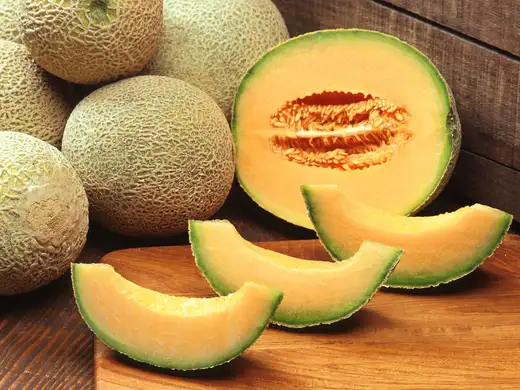
The netted, orange-fleshed melon sold as cantaloupe in the US is botanically a muskmelon. True European cantaloupes have smooth or warty, ribbed rinds, and Clemson notes that they aren’t grown commercially here. Honeydews belong to the same species and are grown the same way, but they ripen differently (see harvest below).
Site and soil
Cantaloupe wants full sun (at least 6 hours, more is better) and fertile, well-drained soil. Iowa State gives a pH range of 5.5 to 7.0, and Penn State 5.8 to 6.6. Sandy, organic soils are ideal, but almost any soil works if it drains. Clemson finds the plants grow best at average air temperatures of 65 to 75°F. Penn State gives a wider growing-season range of 65 to 95°F and notes that growth slows above 95°F or below 50°F. Even a light frost injures the vines.
Rotate. Don’t plant melons where cucumbers, squash, pumpkins, watermelon or other melons grew in the last 3 years (Clemson) or 3 to 4 years (Iowa State).
Planting
Wait until frost danger is over and the soil reaches 60 to 65°F (Clemson); Iowa State allows 60 to 70°F and Utah State waits for 65°F. Use the dates for your zone above. Cold, wet soil invites damping-off, so a slightly late planting is safer than an early one.
Transplants ripen about two weeks before direct-seeded melons (Clemson, Utah State), which matters in short-season areas. Start them in peat pots or other plantable containers, because melons dislike root disturbance. Timing advice differs: NC State starts seed 4 to 6 weeks before the last frost, Iowa State 3 to 4 weeks before planting out, and Utah State allows 6 weeks. Iowa State sets transplants out at 1 or 2 true leaves after a few days of hardening off.
For direct seeding, sow 4 or 5 seeds per hill and thin to the 2 or 3 strongest. Depth advice ranges from ½ to ¾ inch (Clemson) to 1 inch (Iowa State) and 1 to 2 inches (Utah State). Spacing also varies by source:
- Iowa State: hills 1½ to 2 feet apart, rows 5 to 6 feet apart.
- Clemson: plants 18 to 24 inches apart in rows 6 to 8 feet apart.
- Utah State: mounds 4 feet apart, or transplants 2 feet apart through black plastic in rows 4 to 6 feet apart.
Black plastic warms the soil, saves water, stops weeds and, Clemson notes, reduces fruit rot. Lay it over moist soil and run drip line underneath. With plastic plus row covers, Utah State plants about 2 weeks before the last frost. Vent covers above 80°F and remove them at flowering or above 90°F. Hold off on straw or other organic mulch until the soil passes 75°F.
Fertilizing and watering
Fertilize by soil test if you can. Without one, Iowa State uses 1 to 2 pounds of 10-10-10 per 100 square feet, and Clemson uses 5-10-10 at 30 pounds per 1,000 square feet. Side-dress with nitrogen as the vines start to run: Clemson uses 1 pound of 34-0-0 or 2 pounds of calcium nitrate per 100 feet of row, with a second dose after bloom, and Utah State uses 3 to 4 tablespoons of 21-0-0 per plant. Too much nitrogen, or crowded plants, gives lush vines and few melons.
Give 1 to 2 inches of water a week in dry weather, ideally by drip. Clemson wants the soil moistened at least 6 inches deep. Don’t let plants dry out: drought at bloom causes poor set and misshapen fruit, and drought near harvest shrinks melons and makes vines decline (Iowa State). In the final week or two, cut back. Iowa State halves each watering, because wet soil at ripening lowers sweetness and can crack fruit.
Pollination
Bees must carry pollen from male to female flowers, and each female flower is open for just one day. More bee visits mean bigger, better-shaped fruit. Cool, rainy or windy weather and daytime insecticide sprays both cut fruit set; spray, if you must, early in the morning or in the evening. Utah State adds that very hot weather and water stress also cause female flowers to fail.
Varieties by region
- Iowa (Iowa State): Aphrodite, Athena, Ambrosia, Divergent, Goddess, Hale’s Best, Sarah’s Choice, Sugar Cube, Superstar and Wrangler, plus the honeydew types Earli Dew and Snow Leopard.
- Pennsylvania (Penn State, commercial list): hybrids such as Goddess (68 days), Athena (79 days), Aphrodite and Sarah’s Choice, all listed with powdery mildew and Fusarium wilt resistance.
- Utah (Utah State): Ambrosia, Classic Hybrid, Hales Best, Mission, Rocky Sweet and Summit Hybrid.
- South Carolina (Clemson): Athena, Ambrosia, Burpee Hybrid, Lilliput Hybrid, Park’s Whopper and Scoop II, and the honeydew Earlidew.
- Florida (UF/IFAS): Athena, Ambrosia and the green-fleshed Galia.
Regional timing
In central Iowa, melons go in around mid-May, and June 20 is the last practical sowing date for early varieties. Clemson plants from March 15 to May 15 on the South Carolina coast, with a second coastal window in July, and from April 15 to June 5 in the Piedmont. Florida plants late March to April in the north, January to March in Central Florida and December to March in the south, so melons ripen before the rainy summer. UF/IFAS warns that the crop is disease-prone there and that heavy rain during ripening lowers sugar. In the Phoenix low desert, the University of Arizona calendar allows seeding from mid-February into July.
Pests and problems
Cucumber beetles are the most serious pest, because they spread bacterial wilt. Penn State notes that early feeding on young transplants is what infects them. Cover plants with row covers from planting until first bloom, then uncover so bees can work. Aphids spread mosaic viruses, which cause mottled, curled leaves and deformed fruit; remove infected plants. Powdery mildew, downy mildew, gummy stem blight and Alternaria leaf blight thrive on wet leaves, so water at the base in the morning and choose resistant varieties. Utah State notes that when mildew kills the leaves, the exposed fruit sunburns and ripens prematurely.
Harvest
Most cantaloupes are ready 30 to 35 days after pollination (Clemson); Utah State says 35 to 45 days. At full slip, the stem separates cleanly with light pressure, the skin between the netting turns yellow, the netting coarsens and the blossom end smells strongly musky. Clemson notes that sugar peaks at full slip and quality declines unless you eat or chill the melon soon after. Honeydews don’t slip. Pick them when the rind turns from pale green to yellowish white and the blossom end softens slightly, and leave 2 inches of stem.
Bag whole cantaloupes and refrigerate them for up to two weeks; Iowa State gives 36 to 45°F as the best range. Utah State expects about 100 fruits per 100 feet of row.
Questions
How do you know when a cantaloupe is ripe?
The stem separates cleanly with light pressure (full slip), the skin under the netting turns from green to yellow or tan, and the blossom end softens slightly and smells musky. If you have to pull hard, it isn't ripe.
Why do the first flowers on my cantaloupe fall off?
The first flowers are male and drop naturally. Fruit forms on the female flowers, which open later and have a small swelling at the base.
Will cantaloupe cross with cucumbers or watermelon?
No. Utah State notes that cantaloupe does not cross-pollinate with cucumbers, watermelon, squash or pumpkins. Different cantaloupe varieties can cross, but that only shows up if you save and plant the seed.
Can cantaloupe be grown in a pot or on a trellis?
Yes. Utah State says the vines can be trained to a fence or trellis or grown in a large pot, but the enlarging fruit needs a sling or other support.
Why are my cantaloupes not sweet?
Heavy rain or too much irrigation in the last week or two before harvest lowers sugar content, and so does poorly drained soil. Cut back on water as the fruit nears ripeness.
Sources
- Growing Cantaloupe, Muskmelon, and Other Melons in the Home Garden · Iowa State University Extension and Outreach
- How to Grow Cantaloupe (Muskmelon) in Your Garden · Utah State University Extension
- Cantaloupe (HGIC factsheet) · Clemson Cooperative Extension Home & Garden Information Center
- Cucumis melo (Cantaloupe, Muskmelon) · NC State Extension Gardener Plant Toolbox
- Cantaloupe (Muskmelon) Production · Penn State Extension
- Florida Vegetable Gardening Guide (SP103/VH021) · University of Florida IFAS Extension
- Vegetable Planting Calendar for Maricopa County (AZ1005) · University of Arizona Cooperative Extension