How to Grow Brussels Sprouts
Brussels sprouts are a long-season crop timed for fall: set transplants out at least 90 to 100 days before your first fall frost so the sprouts mature in cool weather, which keeps them firm and sweet. Keep plants well watered through summer, side-dress once with nitrogen, and pick sprouts from the bottom of the stalk up when they are 1 to 1½ inches across.

Your dates for brussels sprouts
Set your ZIP code at the top of the page and we will work out when to plant brussels sprouts where you live, from the frost records of the nearest NOAA weather station. Your ZIP code is remembered on this device only.
Brussels Sprouts at a glance
- Botanical name
- Brassica oleracea (Gemmifera Group)
- Light
- full sun (at least 6 hours; 8-10 preferred)
- Frost tolerance
- Hardy: takes a hard frost
- Days to harvest
- 90–120 days from seed; 85–110 days from transplanting
- Planting depth
- 0.25 inches
- Spacing
- 18–36 inches apart, rows 24–30 inches apart
When to plant brussels sprouts
| Zone | Fall planting |
|---|---|
| Zone 2a | May 30 to Jun 6 |
| Zone 3a | Jun 8 to 15 |
| Zone 3b | Jun 18 to 25 |
| Zone 4a | Jun 22 to 29 |
| Zone 4b | Jun 25 to Jul 2 |
| Zone 5a | Jun 28 to Jul 5 |
| Zone 5b | Jul 4 to 11 |
| Zone 6a | Jul 11 to 18 |
| Zone 6b | Jul 16 to 23 |
| Zone 7a | Jul 19 to 26 |
| Zone 7b | Jul 26 to Aug 2 |
| Zone 8a | Aug 1 to 8 |
| Zone 8b | Aug 7 to 14 |
| Zone 9a | Aug 20 to 27 |
| Zone 9b | Sep 2 to 9 |
When to plant brussels sprouts
How Brussels sprouts grow
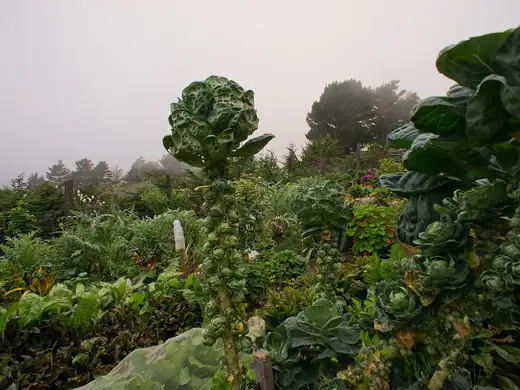
The sprouts are small cabbage-like heads that form where each leaf joins the tall main stem. They start at the bottom of the stalk and mature upward over several weeks. Plants grow 2 to 3 feet tall, according to Maryland Extension, and need a long, steady season to get there.
Temperature during sprout formation decides quality. UF/IFAS says sprouts need cool weather around 58 to 60°F to stay solid, and University of Wisconsin Extension gives 58 to 66°F as ideal. Sprouts that form in heat or drought tend to be loose and bitter. That is why nearly every extension service treats Brussels sprouts as a fall crop.
When to plant
Time Brussels sprouts from your first fall frost, not your last spring frost. Illinois and Maryland Extension both say to set transplants in the garden at least 90 to 100 days before the first fall frost date, and Maryland adds about 20 days if you sow seed directly. In practice that means transplanting in late spring or early summer; in central Iowa, Iowa State plants in early to mid-May.
Start seed 4 to 5 weeks before transplanting, cover it ¼ to ½ inch deep, and set seedlings out when they are about 3 inches tall. Illinois warns against letting transplants become stunted in their flats.
A spring crop maturing in summer rarely works. Illinois says summers are too warm for it in all but the most northern states, and that a summer harvest requires an early, heat-resistant variety planted very early in spring. Iowa State adds that, unlike other cole crops, there is not enough time for both a spring and a fall crop in one year.
Regional notes:
- Florida and the Gulf Coast: UF/IFAS lists planting from fall into winter, with the latest dates in central Florida, so sprouts develop in the coolest months.
- Phoenix and the low desert: the University of Arizona’s calendar plants in late summer and fall and allows 100 to 120 days from transplants, 130 to 150 from seed.
- West of the Cascades: Oregon State’s PNW 548 transplants from late May through June for harvest from October through March.
- Mild-winter and deep-snow areas: Illinois notes sprouts may overwinter in the garden.
Spacing, soil and feeding
Give plants room: Illinois spaces them 24 to 36 inches apart in the row, or 24 inches in every direction in beds; Iowa State uses 18 to 24 inches with rows 24 to 30 inches apart. Grow them in full sun and fertile, moist, well-drained soil with a pH of 6 to 7 (Iowa State), and rotate cole crops so the same spot grows them only once every 3 or 4 years.
Because the crop is in the ground so long, split the nitrogen. Wisconsin applies half at planting and side-dresses the rest midseason. Illinois side-dresses once when plants are about 12 inches tall; Maryland says 2 to 4 weeks after planting or at 12 inches. Cultivate shallowly so you do not damage the roots.
Water through summer
Water is the step most likely to make or break the crop. Illinois puts it bluntly: without ample soil moisture the crop fails, and dry conditions during sprout formation make sprouts bitter. Iowa State recommends at least 1 inch of water a week, preferably from drip or soaker hoses, and a 2- to 3-inch mulch of straw or shredded leaves to hold moisture through the heat of summer.
Topping and leaf removal
Topping means removing the growing point so the plant stops making new leaves and puts its energy into the sprouts. Extension services agree on the idea but differ on timing. Maryland tops plants when the bottom sprouts are ½ inch across; Iowa State waits until they are ½ to ¾ inch and does it less than 60 days before harvest; Illinois and Wisconsin top about 3 weeks before harvest. Topped plants mature their sprouts more evenly, so the whole stalk can be picked at once. Oregon State notes that research from the University of New Hampshire found the effect on uniformity and yield varies with variety and harvest timing, so topping is a choice, not a requirement.
Sources also disagree on lower leaves. Maryland says removing the lowest leaves can speed sprout development, and Illinois reports some gardeners remove six to eight of them, but always leave the large upper leaves to feed the plant. Iowa State advises against stripping the lower leaves because the plant needs them. At minimum, snap off each leaf below a sprout as you harvest it.
Varieties by region
- Iowa: Diablo (late), Franklin (early), Gustus, Hestia (shorter plants) and Jade Cross (Iowa State).
- Wisconsin: Captain Marvel, Jade Cross, Oliver and Prince Marvel (University of Wisconsin Extension).
- Florida: Jade Cross and Long Island Improved (UF/IFAS).
- Western Oregon and Washington: Igor, Nautic and Redarling for winter harvest (PNW 548).
Pests
Aphids hide among the sprouts; Iowa State suggests relying on natural enemies and strong sprays of water. Cabbageworms and loopers chew leaves and can be treated with Bt when first seen. Flea beetles mainly damage young plants, so protect transplants early in the season.
Harvest and storage
Iowa State expects harvest 85 to 110 days after transplanting, typically late September to early November in central Iowa. Pick sprouts when they are firm, deep green and 1 to 1½ inches across, starting at the bottom, and twist or snap them off. UF/IFAS picks about every 2 weeks as more sprouts firm up. Harvest before the leaves yellow, and wait for a frost or two if you can, since frost sweetens them.
Store sprouts unwashed in plastic bags in the refrigerator. Illinois says they taste best within a day or two, though Maryland and Iowa State say they keep 3 to 5 weeks very cold and humid. Blanch and freeze extras.
Questions
Why are my Brussels sprouts loose and leafy?
Sprouts that develop in hot weather or dry soil stay as loose tufts instead of firm heads. Illinois Extension recommends timing the crop so sprouts form in cool fall weather, keeping the soil moist, and choosing newer, faster-maturing varieties.
Can I grow Brussels sprouts in spring?
Rarely well. Illinois Extension says summers are too warm for satisfactory spring crops in all but the most northern states, and Iowa State notes there is not enough time for both a spring and a fall crop in one season.
Does frost hurt Brussels sprouts?
No, it helps. Iowa State says one or more light frosts improve the flavor, and Penn State notes the plants can survive several frosts and even an early snow.
Should I cut the top off Brussels sprouts?
It is optional. Removing the growing tip makes the upper sprouts size up sooner and more evenly, which is useful if you want to harvest the whole stalk at once. Leave the top on if you prefer to pick over a longer period.
How many sprouts does a plant produce?
Extension services measure yield by row length rather than per plant. Iowa State estimates 7 to 10 pounds per 10-foot row with good management, and Maryland 4 to 6 pounds.
Sources
- Growing Broccoli, Cauliflower, Cabbage, and Other Cole Crops in Wisconsin (A3684) · University of Wisconsin-Extension
- Winter Vegetable Production on Small Farms and Gardens West of the Cascades (PNW 548) · Oregon State University Extension Service
- Brussels Sprouts (Watch Your Garden Grow) · University of Illinois Extension
- Growing Brussels Sprouts in a Home Garden · University of Maryland Extension
- Growing Brussels Sprouts in the Home Garden · Iowa State University Extension and Outreach
- Florida Vegetable Gardening Guide (SP 103/VH021) · University of Florida IFAS Extension
- Vegetable Planting Calendar for Maricopa County (AZ1005) · University of Arizona Cooperative Extension
- Cole Crops for the Home Vegetable Garden · Penn State Extension