How to Care for a Boston Fern
A Boston fern needs medium to bright indirect light, potting mix that stays evenly moist without ever going soggy, and more humidity than most homes provide in winter. Feed it lightly while it grows, cut back water and fertilizer in winter, and divide it in spring when it fills its pot. Most failures come from dry air, a pot allowed to dry out, or a waterlogged pot in winter.
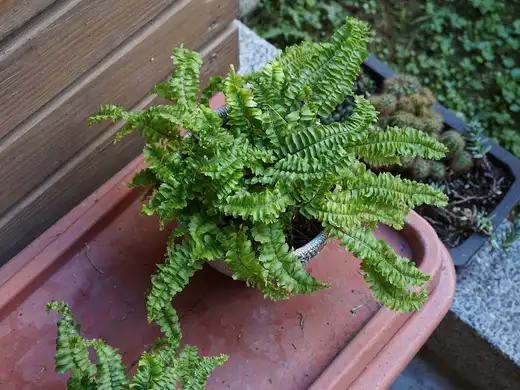

Boston Ferns at a glance
- Botanical name
- Nephrolepis exaltata 'Bostoniensis'
- Light
- medium-bright, indirect light indoors (east window or filtered south/west light); part to full shade outdoors
- Hardiness zones
- 10-11
- Spacing
- 24–36 inches apart
- Containers
- Yes
When to repot and propagate boston ferns
Light
Give a Boston fern medium to bright light that never hits the fronds directly. UW-Madison Extension suggests an east window, or a spot behind a sheer curtain in a south or west window, or far enough back from the glass that the sun doesn’t reach the plant. Clemson Extension goes further for ferns in general and warns against placing them directly in a south- or west-facing window. Direct sun bleaches and dries the fronds. Too little light gives a thin, sparse plant.
Outdoors, put it in part to full shade: a covered porch, the north side of the house, or under trees.
Watering
Getting the water right matters more than anything else. A Boston fern wants its root ball evenly moist all the time. Let it dry out completely and fronds turn brown and drop leaflets. Keep it saturated, especially in winter, and the roots rot. UW-Madison calls it the most drought-tolerant of the commonly grown ferns, which helps if you miss a watering. It still does best with steady moisture.
Water as soon as the surface of the mix starts to feel dry to your fingertip. Soak the mix until water runs from the drainage holes, then empty the saucer. Clemson cautions that water left standing in the pot damages roots. How often you’ll need to water depends on the season:
- Spring and summer: the plant is growing fast and needs water far more often, especially in a hanging basket or small pot outdoors, where hot, windy weather dries the mix quickly. UW-Madison notes that keeping small containers evenly moist outdoors in hot weather is a real challenge.
- Winter: NC State describes the plant as dormant in winter, when it uses far less water and overwatering leads to root rot. Check before every watering instead of sticking to your summer schedule.
Double potting helps a lot. Set the fern, still in its pot, inside a larger container lined with moist sphagnum moss. The moss keeps the pot from drying out as fast and raises the humidity around the fronds.
Potting mix, pots and drainage
Use a mix that holds moisture but still drains freely. UW-Madison suggests peat with vermiculite. Clemson recommends equal parts packaged houseplant mix and peat moss or leaf mold. Always use a pot with a drainage hole. Hanging baskets and tall plant stands show off the arching fronds, which can reach 2 to 3 feet long on ‘Bostoniensis’.
Temperature and humidity
Sources give somewhat different ideal temperatures. NC State suggests 60 to 70°F. UW-Madison prefers nights around 65°F and days no hotter than 95°F. Clemson suggests cooler nights of 50 to 55°F with days of 68 to 72°F. In practice, ordinary room temperatures suit it. Avoid heat vents and cold, drafty windows.
Humidity is the harder part. Winter air in a heated house browns the edges and tips of the leaflets. Raise humidity with a tray of wet pebbles under the pot, by double potting, or by growing the fern in a bright bathroom or kitchen. Clemson also suggests misting now and then. Misting helps only briefly, so treat it as an extra, not a substitute.
Feeding
Feed lightly. UW-Madison recommends a liquid or slow-release houseplant fertilizer at half strength every 4 to 6 weeks while the plant is actively growing, with much less in winter. Clemson suggests half-strength liquid fertilizer once a month from April through September, none in winter, and no fertilizer for six months after repotting. Both warn that overfeeding scorches the fronds and browns their tips.
Repotting and dividing
Repot or divide every few years in spring, when the roots fill the pot. To divide, slide the root ball out and cut it straight down with a sharp knife into halves or quarters. Keep as many fronds as possible on each piece, then pot the divisions in fresh mix. Division is the practical way to make more plants. The fern also sends out thin runners that root where they touch soil. Ferns grown from spores won’t match a named cultivar, so skip spores.
Grooming
Cut old, yellowing or tattered fronds off at the soil line. This tidies the plant and pushes out new growth. Fronds bruise easily, so keep the plant out of busy walkways where people brush past it.
Pests and problems
- Brown tips and leaflet edges: dry air or too much fertilizer. Raise humidity and feed less.
- Yellowing, collapsing plant with wet mix: root rot from overwatering, usually in winter. Let the surface dry slightly between waterings and never leave the pot standing in water.
- Raised brown bumps on fronds and stems: scale. UW-Madison says the simplest fix is cutting off infested fronds at the base.
- White cottony clusters: mealybugs. Remove badly infested fronds and treat the rest.
- Fine stippling or webbing: spider mites, favored by dry air. Raise humidity and rinse the fronds.
- Ragged holes on outdoor plants: slugs and snails. Keep pots raised off the ground.
Be careful with sprays. Clemson notes that many pesticide sprays injure ferns. Test any product on a few fronds first and wait to see whether it causes damage. Picking pests off by hand or washing them off with a firm spray of water is often enough.
Don’t mistake the neat rows of dark dots on the undersides of the leaflets for pests. They are spore cases and are normal.
Pets and children
The ASPCA lists Boston fern as non-toxic to dogs and cats, and NC State lists it as non-toxic to horses too. That makes it one of the safer choices for a home with pets.
Summering outdoors and warm-winter gardens
In cold-winter areas, a potted fern makes a good shade accent on a porch or patio once all danger of frost has passed. Bring it back in, or protect it, when temperatures dip into the low 40s °F. Outdoors in summer it dries out quickly, so check it daily in hot weather.
Hardiness ranges vary by source: UF/IFAS gives zones 8b to 11, UW-Madison 9 to 11, and NC State 10a to 13b. In Florida and similar frost-free areas it can be planted in the ground year-round as a groundcover or massed planting in part to deep shade, and it tolerates dry spells once established. UF/IFAS warns that it spreads fast by runners and is potentially invasive. Thin it regularly, or contain it with plastic or metal edging.
Questions
Why are the tips of my Boston fern turning brown?
Dry indoor air is the usual cause, especially in winter when the heat is running. Too much fertilizer browns frond tips as well. Raise the humidity with a pebble tray or double potting, and feed at half strength or less.
How often should I water a Boston fern?
There is no fixed schedule. Water whenever the surface of the mix starts to feel dry, so the root ball stays evenly moist. In summer, especially in a hanging basket outdoors, that can mean very frequent watering. In winter the plant is semi-dormant and needs noticeably less.
Are the brown dots under the fronds bugs?
Usually not. Dark brown to black dots in neat rows on the underside of the leaflets are spore cases, the way ferns reproduce. Scale insects are scattered, raised bumps that can be scraped off.
Is Boston fern safe for cats and dogs?
Yes. The ASPCA lists Boston fern as non-toxic to dogs and cats, and NC State Extension also lists it as non-toxic to horses.
Can I put my Boston fern outside for the summer?
Yes. It does well in a shaded spot once frost danger has passed. UW-Madison Extension says to bring it in or protect it when temperatures dip into the low 40s °F.
Sources
- Indoor Ferns (HGIC 1508) · Clemson Cooperative Extension Home & Garden Information Center
- Nephrolepis exaltata (Boston Fern) · NC State Extension Gardener Plant Toolbox
- Boston Fern, Nephrolepis exaltata 'Bostoniensis' · University of Wisconsin-Madison Extension
- Nephrolepis exaltata Boston Fern, Sword Fern (FPS427) · University of Florida IFAS Extension (EDIS)
- Toxic and Non-toxic Plants: Boston Fern · ASPCA Animal Poison Control