How to Grow Blueberries
Blueberries need three things most garden plants don't: very acidic soil (pH about 4.5 to 5.5), steady moisture for shallow, hairless roots, and a type matched to your winters. Northern highbush suits the North, rabbiteye and southern highbush suit the South and mild-winter West. Plant two or more cultivars of the same type in full sun, strip the flowers for the first year or two, and a well-sited bush can bear for decades.

Your dates for blueberries
Set your ZIP code at the top of the page and we will work out when to plant blueberries where you live, from the frost records of the nearest NOAA weather station. Your ZIP code is remembered on this device only.
Blueberries at a glance
- Botanical name
- Vaccinium corymbosum (highbush); also V. virgatum (rabbiteye) and V. angustifolium (lowbush)
- Light
- full sun (6+ hours) for best crops; produces poorly in shade
- Frost tolerance
- Hardy: takes a hard frost
- Hardiness zones
- 3-8
- Spacing
- 48–84 inches apart, rows 96–120 inches apart
- Containers
- Yes
When to plant blueberries
| Zone | Plant out |
|---|---|
| Zone 2a | Apr 7 to 21 |
| Zone 3a | Apr 14 to 28 |
| Zone 3b | Apr 5 to 19 |
| Zone 4a | Apr 1 to 15 |
| Zone 4b | Mar 27 to Apr 10 |
| Zone 5a | Mar 22 to Apr 5 |
| Zone 5b | Mar 20 to Apr 3 |
| Zone 6a | Mar 18 to Apr 1 |
| Zone 6b | Mar 12 to 26 |
| Zone 7a | Mar 5 to 19 |
| Zone 7b | Feb 22 to Mar 8 |
| Zone 8a | Feb 15 to Mar 1 |
| Zone 8b | Feb 3 to 17 |
| Zone 9a | Jan 19 to Feb 2 |
| Zone 9b | Dec 20 to Jan 3 |
Spring dates before the last frost assume the soil has thawed and is dry enough to work. After a late or wet spring, wait for that even if the date has passed.
Choose the right type for your winters
Blueberries are one of the few fruit crops native to North America, and the cultivated kinds fall into groups that differ mainly in how much winter cold they need and tolerate. Picking the wrong group is the most common reason bushes grow but never crop well.
Northern highbush (Vaccinium corymbosum) is the standard blueberry from the Mid-Atlantic and Midwest north. Washington State University notes that most need about 750 hours below 45°F each winter and tolerate roughly -20°F. Maine and New Hampshire extension say they manage on warmer, sheltered sites where winter lows don’t drop below -25°F. Kentucky recommends ‘Duke’ and ‘Spartan’ for early fruit, ‘Bluecrop’, ‘Toro’ and ‘Sierra’ for midseason, and ‘Nelson’, ‘Darrow’ and ‘Elliott’ for late. For northern New England, Maine lists hardy, earlier types such as ‘Patriot’, ‘Blueray’, ‘Bluecrop’ and ‘Northland’. In central Washington, WSU reports ‘Bluecrop’, ‘Blueray’, ‘Berkeley’, ‘Elliott’ and ‘Jersey’ doing well.
Half-high blueberries are highbush-lowbush crosses, 2 to 5 feet tall. UNH says ‘Northland’, ‘Northblue’, ‘North Country’, ‘St. Cloud’ and ‘Friendship’ should be hardy throughout New Hampshire, including the far north, especially where snow cover is reliable. Penn State recommends pairing ‘Northcountry’ with another half-high such as ‘Northblue’ for pollination.
Rabbiteye (V. virgatum, also listed as V. ashei) is native to the Southeast. It handles heat, drier soil and somewhat higher pH better than highbush, and the University of Georgia calls it the best home choice in Georgia, from the coast to the mountains. UGA recommends early ‘Alapaha’, ‘Austin’, ‘Titan’ and ‘Vernon’, midseason ‘Brightwell’, ‘Powderblue’ and ‘Tifblue’, and late ‘Baldwin’, ‘Centurion’ and ‘Ochlockonee’. It warns that ‘Climax’, ‘Premier’ and ‘Vernon’ can bloom too early for mountain sites. UF/IFAS uses rabbiteye where winters are at least as cold as Ocala’s.
Southern highbush is a low-chill highbush hybrid bred for the Deep South and California. It ripens earliest of all. UF says Florida-bred cultivars give the earliest blueberry harvest in North America, but it calls them harder to grow than rabbiteye and more prone to root rot. UF recommends ‘Emerald’ and ‘Jewel’ from Gainesville to Sebring, plus ‘Farthing’, ‘Windsor’ and ‘Springhigh’ in north and central Florida. UGA suggests ‘Palmetto’, ‘Suziblue’, ‘O’Neal’, ‘Camellia’, ‘Jubilee’ and ‘Magnolia’ for south Georgia up through the Piedmont. Around Sacramento, UC Cooperative Extension says southern highbush is the main type that copes with hot summers and low chill. A UC Master Gardener trial in Santa Clara found ‘Reveille’, ‘Misty’, ‘Sunshine Blue’, ‘Bluecrop’, ‘Georgia Gem’ and ‘O’Neal’ performed best there.
Northern highbush generally fails in the Piedmont and lower South because it doesn’t get enough chill and the summers are too hot. Rabbiteye has the opposite problem in the far North. Kentucky also notes that rabbiteye blooms 1 to 1.5 weeks before highbush, which makes it more exposed to late frosts. Highbush flowers in full bloom survive about 28°F.
Fix the soil pH before you plant
Blueberries belong to the azalea and rhododendron family, and like them they need acidic soil. Above the right range they can’t take up iron, and the leaves turn yellow between green veins. Recommendations cluster tightly but not identically: Kentucky and Maine give pH 4.5 to 5.2, UGA 4.5 to 5.2, UNH, Penn State and WSU 4.5 to 5.0, UC Sacramento about 5.0 to 5.5, and UF 4.0 to 5.5. NC State calls 5.0 ideal for highbush. Aim for about 5.0 and you are inside every range.
Test before you do anything. Your county Extension office can run a soil test, and it is the only way to know how much acidifier your soil needs. Use finely ground elemental sulfur. It acts slowly, and Penn State notes it needs warm weather to work, so it has to go in well ahead of planting:
- Kentucky says to lower pH one full unit (say, from 5.5 to 4.5) use about 0.75 pound of sulfur per 100 square feet on sandy soil, 1.5 pounds on sandy loam and 2.25 pounds on clay loam.
- Maine puts the figure at about 1.2 pounds per 100 square feet to drop a loam half a unit, with half that on sand.
- Mix it into the root zone. WSU warns that sulfur barely moves through soil, so sprinkling it on the surface after planting does little. UGA allows surface applications of up to 0.7 pound per 100 square feet a year on existing bushes, with the soil left undisturbed.
- Allow time. Kentucky’s minimum is 60 days, UGA says six months, and UC and WSU prefer six months to a year. Penn State suggests amending in early fall for spring planting. Retest 60 to 90 days after applying.
If the soil starts above pH 6.0, UGA says growing blueberries will be difficult unless you work in large amounts of peat moss or milled pine bark. In practice, that is when a raised bed filled with an acidic mix makes more sense than fighting native soil. Never add lime or mushroom compost, and avoid potting soils with added lime.
pH tends to creep back up, especially where irrigation water is alkaline, so retest every year or two. Kentucky and UF both flag high-pH well water as a cause. Going too far is also possible: Kentucky and WSU note that very low pH causes manganese toxicity, which looks much like iron deficiency.
Pick a sunny, well-drained site
Full sun gives the biggest crops. UF asks for at least four to five hours of direct sun and UGA at least half a day, and UGA warns that bushes in shade fruit poorly. UNH calls all-day sun essential for top yields. In hot inland areas such as the Sacramento Valley and central Washington, light afternoon shade helps keep soil moist and fruit from shriveling.
Despite growing wild near bogs, cultivated blueberries need their roots above the water table. Phytophthora root rot thrives in heavy, wet soil. If your soil stays soggy after rain, plant on a raised bed: Kentucky suggests 4 to 6 inches high, UGA 6 to 12 inches high and 3 to 4 feet wide. UF wants at least 18 inches of well-drained soil. Choose a slightly elevated spot so cold air drains away on frosty spring nights, and keep bushes away from tree roots. UF advises planting at least 20 feet from buildings.
Planting
Buy two- or three-year-old plants, 18 to 24 inches tall, from a nursery that sells virus-tested stock. Maine notes that one-year cuttings take years to catch up, while plants older than three years rarely repay the extra cost.
- Spacing: Highbush 4 to 7 feet apart in rows 8 to 14 feet apart, depending on the source. Rabbiteye gets 5 to 6 feet in the row with 11 to 12 feet between rows (UGA). For a hedge, UC and UF set southern highbush 3 feet apart.
- Hole and amendment: Work wet peat moss or milled pine bark into the backfill. Kentucky uses a gallon of peat per hole, and Maine mixes soil and peat 1:1. Kentucky warns against using sawdust, hay or compost in place of the peat, because they can stunt plants as they decompose. University of Illinois research cited by Kentucky found deeper, narrower holes (18 inches wide, 24 inches deep) outyielded wide, shallow ones.
- Depth: Set plants at the depth they grew in the nursery. Maine and UNH allow slightly deeper. Loosen the roots of pot-bound plants first.
- No fertilizer in the hole. Blueberry roots burn easily.
- Prune at planting: Remove low, twiggy growth and cut the top back by a third to a half, which also removes the flower buds (UGA, Kentucky).
- Mulch: Spread 3 to 6 inches of pine bark, pine straw, wood chips or rotted sawdust over a band 3 to 4 feet wide. Kentucky keeps a 3-inch circle clear around the stems.
Grouping blueberries with azaleas, rhododendrons, hollies and camellias, as NC State suggests, makes sense only because they share the same acidic soil.
Pollination
Blueberry flowers are narrow bells that honeybees work poorly. Bumblebees and other buzz-pollinating bees do much better. Kentucky notes that bigger berries carry more seeds, so poor pollination gives fewer, smaller fruit. Plant at least two cultivars that bloom together. For rabbiteye this is essential. UF adds that the cultivars must be the same type: rabbiteye pollinates rabbiteye and southern highbush pollinates southern highbush. Choosing early, mid and late cultivars also stretches the harvest from a few weeks to two or three months.
Water and mulch
Blueberry roots have no root hairs, so they absorb water inefficiently and suffer quickly from both drought and waterlogging. Recommendations vary by climate. Penn State asks for at least 1 inch a week, Maine 1 to 2 inches a week, and Kentucky the equivalent of 1 to 2 inches every 10 days for mature bushes. Kentucky trials found irrigation more than doubled yields. Drip lines or a soaker hose under the mulch keep the leaves dry and the root zone evenly moist.
Two periods matter most: while berries swell before harvest, and late summer into fall, when bushes set next year’s flower buds. Dry soil in late summer shows up as a light crop the following year.
Mulch is not optional. Roots grow right at the soil-mulch boundary, and as mulch rots away they end up exposed. Top it up to 4 to 6 inches every year or two.
Feeding
Blueberries need little fertilizer and are easily hurt by too much. Use acid-forming fertilizers, ideally ammonium sulfate or an azalea-type fertilizer, spread evenly in a circle around the bush. Kentucky found nutrients barely move from one side of a bush to the other, so feeding just one side feeds only that side.
- Kentucky: 0.1 pound of ammonium sulfate per plant at bloom and again six weeks later, adding 0.1 pound a year up to 0.3 pound per application.
- Maine: 1 ounce of ammonium sulfate per plant in the planting year (three to four weeks after planting), rising to 4 ounces a year for bushes six years and older.
- UGA (South): nothing at planting; after new growth starts, 1 ounce of 10-10-10 or 2 ounces of 4-8-8 azalea fertilizer per plant, repeated in May and July.
UNH advises no fertilizer after July 1 in the North, so late growth doesn’t freeze. Wood-chip or sawdust mulch ties up nitrogen as it breaks down, and Kentucky suggests an extra 0.1 pound of ammonium sulfate per plant for the first few years when you use it.
Pruning
For the first two years, rub off the flowers so the plant puts its energy into roots and canes. Kentucky warns that bushes allowed to fruit early stay dwarfed. Beyond removing dead or broken wood, young bushes need little else.
From about year three or four, prune every year in late winter, before buds swell. The goal is a steady supply of young canes, because the best berries grow on vigorous one-year shoots on canes less than 1 inch thick at the base.
- Cut out dead, diseased and broken wood, plus low branches that will sag to the ground under fruit.
- Remove the oldest canes, usually gray with peeling bark, at ground level. Maine and Kentucky keep canes to six years old or less. Take out one or two a year.
- Keep the best two or three new canes each year and remove the rest. UNH aims for 6 to 7 vigorous older canes plus 1 or 2 new ones. Kentucky’s ideal mature bush has two or three canes of each age.
- Thin weak, twiggy wood and open the center of upright cultivars. Kentucky reports that removing up to 20 percent of the wood doesn’t lower total yield but gives larger berries.
Rabbiteyes need little pruning until they reach 4 to 6 feet. After that, UGA removes one to three of the largest canes each winter, about 20 percent of the bush. In Florida, UF also tops bushes after harvest, removing a quarter to a third of the canopy to control height.
Harvest
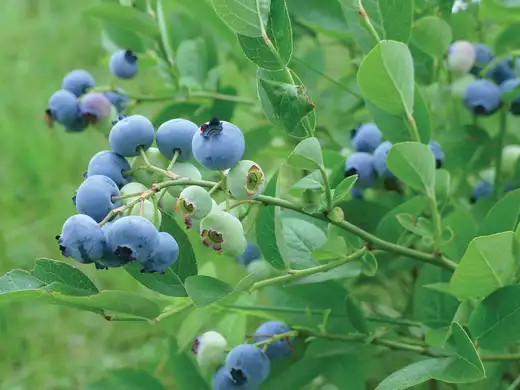
Berries ripen about 60 to 80 days after bloom, and each cultivar bears for two to three weeks. Wait until the whole berry is blue with no red near the stem, then give it several more days. Kentucky notes berries can grow up to 35 percent larger after turning blue, and WSU starts picking four or five days after the first berries color. Ripe fruit rolls off the cluster under your thumb. Pick every few days, pick when berries are dry, and refrigerate them quickly. They keep about two weeks at 32°F but only two days at room temperature.
Problems and fixes
- Yellow leaves with green veins: pH too high. Acidify with sulfur, switch to ammonium sulfate, and use iron chelate for a quick green-up.
- Birds: Robins, starlings and other birds can strip a bush in a day. Net over a post-and-wire frame as the first berries turn blue, and weight the edges. Scare devices lose their effect quickly.
- Mummy berry: This fungus turns berries tan, then hard and shriveled, and is worst after wet springs. Rake or lightly disturb the mulch in early spring as buds swell, and pick up mummified fruit.
- Root rot: Plants on wet, heavy soil yellow, redden and die back. Plant on raised beds and don’t overwater.
- Spotted-wing drosophila: Tiny flies lay eggs in late-ripening fruit. Harvest promptly and chill or freeze berries right away.
- Deer and rabbits: Both browse buds and young wood. UGA notes deer are a particular problem on early-ripening southern highbush.
- Weak growth: WSU says healthy bushes should make 6 to 12 inches of new growth a year. If they don’t, check pH, water and nitrogen.
Blueberries in containers
Where soil is alkaline or space is short, grow blueberries in pots of acidic azalea mix. UC Sacramento recommends compact cultivars such as ‘Sunshine Blue’ and ‘North Blue’. Start in a 5-gallon pot and move up to a 20-inch container after a couple of years, then root-prune and repot every three to four years. UF notes that southern highbush suits containers better than rabbiteye. Potted bushes dry out fast, so check moisture often in summer.
Questions
How long does it take a blueberry bush to produce fruit?
Bushes give a small crop two or three years after planting. Maine Extension suggests letting plants carry a light crop in year three and a full crop in year four or five. Removing flowers for the first one or two years builds a bigger bush and larger crops later.
Do I need two blueberry bushes to get fruit?
Rabbiteye blueberries need a second rabbiteye cultivar to set a good crop. Northern and southern highbush can set fruit alone, but planting two cultivars of the same type gives bigger berries and heavier, earlier crops.
Why are my blueberry leaves turning yellow?
Yellowing between green veins on new leaves usually means the soil pH is too high, which locks up iron. Test the soil and lower pH with elemental sulfur or an ammonium sulfate fertilizer; an iron chelate gives a quick but temporary fix.
Can I use aluminum sulfate to acidify soil for blueberries?
Extension services recommend finely ground elemental sulfur, applied by soil test, as the main acidifier. Kentucky and Maine also list aluminum sulfate, but Penn State warns it is toxic to blueberries, so sulfur is the safer choice.
How much does one blueberry bush produce?
Penn State puts a mature highbush bush at 6 to 10 pounds a year, and Kentucky reports 6 to 15 pounds. Georgia Extension says bushes can yield up to about 2 gallons by their sixth year.
When should I prune blueberries?
Prune in late winter while bushes are dormant, before buds break; in most areas that means February or March. In Florida, UF also recommends cutting back a quarter to a third of the canopy right after harvest.
Sources
- Growing Highbush Blueberries in Kentucky (HO-60) · University of Kentucky Cooperative Extension
- Bulletin #2253, Growing Highbush Blueberries · University of Maine Cooperative Extension
- Growing Fruit: Highbush Blueberries [fact sheet] · University of New Hampshire Extension
- Blueberries in the Garden and the Kitchen · Penn State Extension
- Growing Blueberries in Central Washington · Washington State University Extension, Chelan County
- Home Garden Blueberries (Circular 946) · University of Georgia Cooperative Extension
- Blueberries - Gardening Solutions · University of Florida IFAS Extension
- Growing Blueberries in the Sacramento Region (EH Note 88) · UC Cooperative Extension Sacramento County, University of California ANR
- Vaccinium corymbosum (Plant Toolbox) · NC State Extension Gardener Plant Toolbox