How to Grow Blackberries
Plant dormant blackberries in late winter or early spring, about the time the soil can be worked and several weeks before your last frost, in full sun and well-drained soil. Expect a small crop the following summer and a full crop the second year. Most of the work comes down to a simple two-wire trellis and cutting out every cane once it has fruited.

Your dates for blackberries
Set your ZIP code at the top of the page and we will work out when to plant blackberries where you live, from the frost records of the nearest NOAA weather station. Your ZIP code is remembered on this device only.
Blackberries at a glance
- Botanical name
- Rubus subgenus Rubus (cultivated hybrids)
- Light
- full sun (6-8+ hours)
- Frost tolerance
- Hardy: takes a hard frost
- Hardiness zones
- 4-9
- Planting depth
- 2 inches
- Spacing
- 36–48 inches apart, rows 96–144 inches apart
- Containers
- Yes
When to plant blackberries
| Zone | Plant out |
|---|---|
| Zone 2a | Apr 21 to May 5 |
| Zone 3a | Apr 28 to May 12 |
| Zone 3b | Apr 19 to May 3 |
| Zone 4a | Apr 15 to 29 |
| Zone 4b | Apr 10 to 24 |
| Zone 5a | Apr 5 to 19 |
| Zone 5b | Apr 3 to 17 |
| Zone 6a | Apr 1 to 15 |
| Zone 6b | Mar 26 to Apr 9 |
| Zone 7a | Mar 19 to Apr 2 |
| Zone 7b | Mar 8 to 22 |
| Zone 8a | Mar 1 to 15 |
| Zone 8b | Feb 17 to Mar 3 |
| Zone 9a | Feb 2 to 16 |
| Zone 9b | Jan 3 to 17 |
Spring dates before the last frost assume the soil has thawed and is dry enough to work. After a late or wet spring, wait for that even if the date has passed.
Pick the right type for your region
Blackberries are sorted three ways. Growth habit can be erect, semi-erect or trailing. Canes are thorny or thornless. Fruiting is either floricane or primocane. Floricane types fruit on second-year canes in early summer. Primocane types, also sold as everbearing, also fruit on the tips of first-year canes in late summer and fall.
Blackberries handle heat better than raspberries, which is why they grow across most of the South. Their weak point is winter cold. University of Tennessee Extension puts them at hardy to only about 0 to -10°F and says thornless types may be less hardy still. NC State notes that its recommended list struggles wherever temperatures fall below 10°F. Chill needs also matter. Cultivars range from about 200 to 900 chill hours, and Tennessee warns that low-chill cultivars (under 400 hours) bloom early and risk frost damage in colder, higher sites.
Cultivars extension services recommend:
- North Carolina and the Southeast (NC State): ‘Natchez’ (early), ‘Ouachita’ and ‘Osage’ (mid), Sweet-Ark ‘Caddo’ and ‘Ponca’ (early), and ‘Von’ (mid to late). NC State suggests treating ‘Prime-Ark Freedom’ and ‘Prime-Ark Traveler’ as single summer crops because their fall crop is unreliable there.
- Mississippi (MSU): ‘Ouachita’, ‘Natchez’, ‘Osage’, ‘Kiowa’, ‘Caddo’, ‘Ponca’ and ‘Sweetie Pie’, a USDA release that tolerates heat well and resists rosette.
- Maryland and the Mid-Atlantic (UMD): ‘Eclipse’, ‘Galaxy’, ‘Twilight’, ‘Natchez’, ‘Ouachita’ and the Sweet-Ark and Prime-Ark series, plus trailing ‘Triple Crown’, ‘Chester’ and ‘Hull’.
- Florida (UF/IFAS): ‘Osage’, ‘Ouachita’, ‘Ponca’, ‘Kiowa’ and the Prime-Ark series for North and North Central Florida. ‘Prime-Ark Freedom’ is the one to try in South Florida.
- Texas (Texas A&M): ‘Natchez’ was named a Texas Superstar after statewide trials.
- North central Arizona (University of Arizona): ‘Navaho’ and ‘Choctaw’, erect ‘Brazos’ and ‘Roseborough’, semi-erect ‘Black Satin’ and trailing ‘Olallie’. Arizona says blackberries do best above 2,500 feet.
Hot summers cut short the fall crop on primocane types. Mississippi State says they are not suitable for fall fruit there because of heat during flowering, and NC State says double cropping works best in the western, cooler part of that state.
Site and soil
Choose full sun, 6 to 8 hours or more, with soil that drains well. Blackberry roots do not tolerate wet soil, so build raised beds if water stands after rain. NC State recommends a pH of 5.5 to 6.5 and Mississippi State 6.0 to 6.5. Prepare the bed a year ahead, as NC State advises, by killing perennial weeds and working in organic matter.
Where you plant also affects disease. Keep new plants at least 300 feet from wild brambles, a potential source of disease (University of Maryland). Mississippi State notes that removing wild blackberries helps control rosette. Tennessee advises against sites that recently grew strawberries, potatoes, tomatoes, peppers or eggplant because of soilborne wilt. Buy certified disease-free plants and do not dig up a neighbor’s suckers, which can bring viruses with them (UC IPM).
Planting
Planting time depends on your winter. NC State plants in early spring, several weeks before the last frost. Mississippi State uses late February to early March, Texas A&M mid-January to early February, and UF/IFAS February to April in Florida. UC IPM gives mid-January to March for California. Tissue-culture plants sold in pots may not be hardened to frost, so Maryland advises setting them out after your last frost. Check the dates for your zone above.
- Space erect and semi-erect plants 3 to 4 feet apart (NC State) and trailing types 6 to 8 feet apart. Allow about 8 feet between rows (Maryland).
- Keep bare roots moist, spread them in a wide hole, and set the plant about 2 inches deeper than the crown.
- Cut the tops back to about 6 inches and water well.
- Hold off on fertilizer for three to four weeks. UF/IFAS cautions that excess fertilizer can burn leaves or even kill plants.
Trellising and training
Put up the trellis in the first year. NC State uses two wires, at 3 and 5 feet. Fan erect and semi-erect canes across the wires as they grow. Weave trailing types back and forth along the wires and do not tip them.
On erect types, pinch the tips of new canes in summer to make them branch. Maryland and Mississippi State tip at 3 to 4 feet, NC State once canes reach the top wire, and Arizona at 3 feet. Vigorous plants may need topping two to four times a season. In winter, shorten the side branches to about 12 to 18 inches. Keep three or four strong new canes per plant. NC State thins to four to eight canes per square yard of row in winter.
Pruning after harvest
Each cane lives two years and dies after it fruits. As soon as harvest ends, cut the old fruiting canes at ground level and remove them from the garden so they don’t harbor disease. Leave no stubs. Then keep tying in the new canes, because they carry next year’s crop.
Primocane types give you two options. To get two crops, prune them like floricane types. For a single late crop, mow every cane to the ground each winter.
Water and fertilizer
Give about 1 inch of water a week during the growing season. NC State estimates about 2 gallons per plant per day while fruit is sizing. Drip irrigation and a mulch of pine straw or wood chips save water and keep weeds down. Arizona advises against overhead sprinklers that wet the foliage.
NC State feeds established plants with 10-10-10 in March, well before bloom, and again after harvest, at about 5 pounds per 100 feet of row. That is roughly 3 to 4 ounces per plant.
Harvest
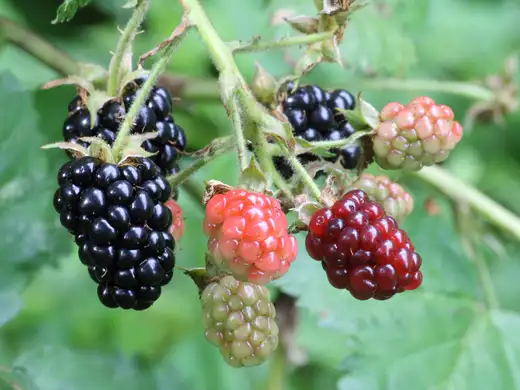
Blackberries are ripe when the shine fades to a dull black. They pull off easily, and the white core comes with the berry. Shiny black berries are less sweet but keep longer in the refrigerator. Pick every few days, in the cool of the morning, and refrigerate right away. Each cultivar bears for about two to four weeks. In Mississippi and Florida the main crop ripens in May and June.
Common problems
- Rosette (double blossom): a fungal disease that limits blackberries in the Southeast. Thornless cultivars have some tolerance, and removing nearby wild blackberries helps.
- Orange rust: infected plants stay infected. Start with clean stock and propagate only from healthy plants. NC State’s ‘Von’ does not get orange rust (Tennessee).
- Spotted-wing drosophila: small larvae inside ripe berries. Pick often and chill the fruit quickly.
- Cane borers: prune out wilted canes during the season.
- White drupelets: sunscald in hot, bright, dry weather. Lightly affected berries are still fine to eat.
Questions
How long until a new blackberry plant produces fruit?
Floricane (summer-bearing) types give a small crop the summer after planting and a full crop the second year. Primocane types can fruit in late summer or fall of the first year on new canes.
Why are my blackberries sour?
They were probably picked shiny. Blackberries do not get sweeter after picking, and they reach full sweetness only when the shine fades to a dull black.
Do thornless blackberries need a trellis?
Yes. Even erect thornless cultivars do better on a trellis, and semi-erect types such as 'Natchez' and trailing types such as 'Triple Crown' need one. A two-wire system with wires at about 3 and 5 feet works for most home plantings.
How many blackberry plants does a family need?
NC State Extension estimates 10 to 20 pounds per plant, so four to six plants will easily supply a family of four.
Can I plant blackberries next to raspberries?
It is better not to. University of Arizona Extension advises keeping raspberries away from blackberries to limit virus spread, and Maryland recommends planting at least 300 feet from wild brambles.
Sources
- Blackberries for the Home Garden (AG-702-11) · NC State Extension
- Growing Raspberries and Blackberries in the Home Garden · University of Maryland Extension
- Fruit and Nut Review: Blackberries (IS1444) · Mississippi State University Extension
- Selecting Caneberries for Residential Production in Tennessee (W 895-B) · University of Tennessee Extension
- Blackberries - Gardening Solutions · University of Florida IFAS Extension
- Natchez thornless blackberry named New Texas Superstar · Texas A&M AgriLife Today
- Planting Caneberries · UC Statewide IPM Program, University of California ANR
- Brambles (Backyard Gardener #75) · University of Arizona Cooperative Extension, Yavapai County
- Rubus fruticosus 'Triple Crown' (Plant Finder) · Chicago Botanic Garden
- Rubus 'Thornfree' (Plant Finder) · Chicago Botanic Garden