How to Grow Black-eyed Susans
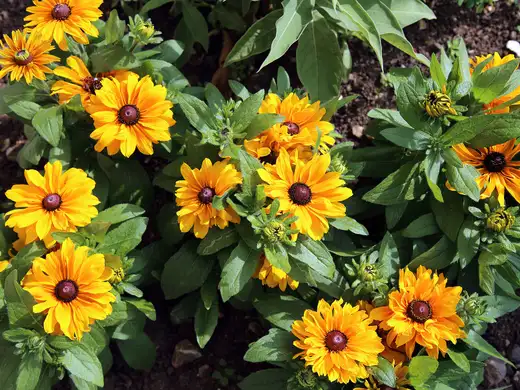
Black-eyed Susan (Rudbeckia hirta) grows easily from seed in full sun and well-drained soil. Start it indoors 6 to 8 weeks before your last frost or sow it outdoors in early spring, and early plants will bloom the first summer. Space plants 1 to 2 feet apart so air can move between them. Deadhead through summer, then leave the last seed heads for goldfinches.

Your dates for black-eyed susans
Set your ZIP code at the top of the page and we will work out when to plant black-eyed susans where you live, from the frost records of the nearest NOAA weather station. Your ZIP code is remembered on this device only.
Black-eyed Susans at a glance
- Botanical name
- Rudbeckia hirta
- Light
- full sun (6+ hours); tolerates part shade
- Frost tolerance
- Hardy: takes a hard frost
- Hardiness zones
- 3-8 (NCSU, R. hirta, as a short-lived perennial); R. fulgida 3-9
- Germination
- 5–21 days
- Days to harvest
- 60–120 days from seed
- Planting depth
- 0.25 inches
- Spacing
- 12–24 inches apart
When to plant black-eyed susans
| Zone | Start indoors | Sow outdoors |
|---|---|---|
| Zone 2a | Mar 24 to Apr 7 | Apr 7 to May 5 |
| Zone 3a | Mar 31 to Apr 14 | Apr 14 to May 12 |
| Zone 3b | Mar 22 to Apr 5 | Apr 5 to May 3 |
| Zone 4a | Mar 18 to Apr 1 | Apr 1 to 29 |
| Zone 4b | Mar 13 to 27 | Mar 27 to Apr 24 |
| Zone 5a | Mar 8 to 22 | Mar 22 to Apr 19 |
| Zone 5b | Mar 6 to 20 | Mar 20 to Apr 17 |
| Zone 6a | Mar 4 to 18 | Mar 18 to Apr 15 |
| Zone 6b | Feb 26 to Mar 12 | Mar 12 to Apr 9 |
| Zone 7a | Feb 19 to Mar 5 | Mar 5 to Apr 2 |
| Zone 7b | Feb 8 to 22 | Feb 22 to Mar 22 |
| Zone 8a | Feb 1 to 15 | Feb 15 to Mar 15 |
| Zone 8b | Jan 20 to Feb 3 | Feb 3 to Mar 3 |
| Zone 9a | Jan 5 to 19 | Jan 19 to Feb 16 |
| Zone 9b | Dec 6 to 20 | Dec 20 to Jan 17 |
Spring dates before the last frost assume the soil has thawed and is dry enough to work. After a late or wet spring, wait for that even if the date has passed.
When to plant black-eyed susans
Which black-eyed Susan?
The classic roadside black-eyed Susan is Rudbeckia hirta, native to the prairies and fields of the central and eastern US and now naturalized across most of the country. Sources describe its life span differently: Cornell calls it an annual, Clemson a short-lived perennial best treated as an annual, and NC State a biennial or short-lived perennial. In practice it blooms the first year from early-sown seed, may survive a winter or two, and reseeds freely. The large-flowered, multicolored cultivars are often sold as gloriosa daisies.
For a reliable perennial, choose R. fulgida, orange coneflower, which includes ‘Goldsturm’. It is hardy in zones 3 to 9, peaks from late summer into fall, and can be divided every 3 to 4 years in spring or fall.
Site and soil
Plant in full sun, at least 6 hours a day. Part shade is tolerated. Black-eyed Susans prefer moist, well-drained soil but handle clay, poor soil and drought once established. UF/IFAS notes good salt tolerance, which makes them useful near the beach.
Moderate fertility gives the best flower show. NC State advises against planting where lawn fertilizer will reach, because excess nitrogen works against bloom.
Sowing and planting
Black-eyed Susan is a long-day plant. Wisconsin explains that when days are shorter than about 12 hours, seedlings stay as flat rosettes. Once days are longer than that, they stretch and start to flower. That’s why timing matters: early-sown plants bloom the same summer, while late-sown ones rosette, overwinter and bloom the following year.
Indoors: Sow 6 to 8 weeks before your last frost. Cornell says the seed needs light to germinate, so press it onto the surface or cover it very lightly. Keep it warm. Wisconsin uses 68 to 72°F and gets germination in 10 to 21 days, while UF/IFAS reports 5 to 10 days at 70 to 75°F. Harden seedlings off and plant them out after frost danger has passed. They may wilt for a day or two after transplanting, which is normal.
Outdoors: Sow in early to mid spring. Wisconsin reports success with winter sowing too, scattering seed outdoors before the ground freezes. Clemson also lists early-to-mid fall sowing. Clemson recommends 3 months of cold stratification at 40°F for spring-sown Rudbeckia seed, but Cornell, UF/IFAS and Wisconsin all germinate R. hirta in warmth without chilling. A fall or winter sowing gives the seed natural chilling, so it works with either view.
Spacing: Set plants 1 to 2 feet apart, at the wider end in warm, long-season areas. For a mass planting, UF/IFAS spaces them 18 to 24 inches apart.
Care
Water new plants until they’re established, after which they need watering only in long dry spells. Don’t overfeed. In South Carolina, Clemson suggests a slow-release 12-6-6 fertilizer at about 1 pound per 100 square feet in early to mid April and half that in September, adjusted to a soil test.
Deadheading stretches the bloom season and limits self-seeding. Toward the end of the season, stop deadheading and leave the seed heads. They add winter interest and feed American goldfinches, and the plants reseed for next year. Black-eyed Susan is also a larval host for the silvery checkerspot butterfly.
Bloom timing varies by region and planting date. NC State lists May through July, extended into fall with deadheading, while Cornell lists late summer to mid-fall.
Warm-winter regions
UF/IFAS lists planting months of April-May for zone 9 and March-April or October-November for zones 10-11. The Arizona low desert runs on a different schedule: the University of Arizona chart has seed planted from October through March, with bloom from June into October. The chart lists 120 days to bloom for black-eyed Susan and 60 days for the faster gloriosa daisy strains, which flower from April there.
Varieties
For South Carolina, Clemson lists R. hirta cultivars including ‘Cherokee Sunset’ (brown, red and yellow), ‘Denver Daisy’, ‘Prairie Sun’ and the compact ‘Toto Gold’, 12 to 16 inches and suited to containers and small spaces. Wisconsin describes ‘Prairie Sun’, a 2003 All-America Selections winner with green centers, as thriving in hot, humid summers while also doing well in cooler climates. UF/IFAS highlights ‘Indian Summer’, which flowers 10 to 14 weeks after sowing and doesn’t need staking.
Common problems
- Powdery mildew: the most common disease. Space plants for air flow.
- Leaf spots, fungal and bacterial: encouraged by wet foliage. Remove infected leaves, avoid overhead watering and clear dead plant material.
- Slugs and snails: damage young plants. Protect seedlings early.
- Rabbits: fence with wire at least 2 feet high.
- Aphids, Japanese beetles, spider mites: occasional. Clemson suggests insecticidal soap or horticultural oil if aphids or mites build up.
- Southern blight: a soil-borne disease listed by NC State.
- Goldenglow sawfly and four-lined plant bug: UF/IFAS notes the sawfly larvae can strip plants, and the plant bug’s sunken brown leaf spots are often mistaken for disease.
Black-eyed Susan has been Maryland’s state flower since 1918. The genus honors Olav Rudbeck and his son, both professors at Uppsala, and hirta means “rough-hairy,” which describes the bristly leaves and stems.
Questions
Are black-eyed Susans annuals or perennials?
Rudbeckia hirta is a biennial or short-lived perennial that blooms in its first year from early-sown seed, so it is usually grown as an annual and keeps going by self-seeding. Rudbeckia fulgida, which includes 'Goldsturm', is a longer-lived perennial for zones 3 to 9.
Should I cover black-eyed Susan seeds?
Barely, if at all. Cornell says the seed needs light to germinate, and UF/IFAS says to barely cover it. Clemson's general Rudbeckia advice of 1/4 to 1/2 inch is deeper than other sources recommend for R. hirta.
Why do my black-eyed Susans have white powder on the leaves?
That is powdery mildew, the most common problem. Space plants 1 to 2 feet apart for air flow, avoid wetting the foliage, and remove badly affected leaves.
Do deer eat black-eyed Susans?
Deer usually leave them alone, and NC State rates them moderately deer resistant. Rabbits do eat them, so Wisconsin suggests fencing at least 2 feet high.
Should I cut back black-eyed Susans in fall?
You don't have to. Leaving the last seed heads standing gives winter interest, feeds goldfinches and lets the plants reseed.
Sources
- Rudbeckia (HGIC fact sheet) · Clemson Cooperative Extension Home & Garden Information Center
- Rudbeckia hirta (Black-eyed Susan) · NC State Extension Gardener Plant Toolbox
- Rudbeckia fulgida (Black-eyed Susan, Orange Coneflower) · NC State Extension Gardener Plant Toolbox
- 'Prairie Sun' Black-Eyed Susan, Rudbeckia hirta · University of Wisconsin-Madison Extension
- Gloriosa Daisy (Rudbeckia hirta) - Flower Growing Guide · Cornell University Home Gardening
- FPS-512: Rudbeckia hirta Blackeyed Susan, Gloriosa Daisy · University of Florida IFAS Extension
- Maryland State Symbols - State Flower: Black-Eyed Susan · Maryland State Archives (Maryland Manual)
- Flower Planting Guide for the Low Desert (AZ1100) · University of Arizona Cooperative Extension (Maricopa County)