How to Grow Avocado
Avocados fruit outdoors only in nearly frost-free places: coastal Southern California, the warmest southeast and southwest coasts of Florida, and Texas's Lower Rio Grande Valley, roughly zones 9b to 11. Plant a grafted tree in spring after the last frost, on soil that drains fast, and expect fruit in three to four years. A pit sprouted on the windowsill makes a fine houseplant but may take a decade or more to fruit, if it ever does.

Your dates for avocados
Set your ZIP code at the top of the page and we will work out when to plant avocados where you live, from the frost records of the nearest NOAA weather station. Your ZIP code is remembered on this device only.
Avocados at a glance
- Botanical name
- Persea americana
- Light
- full sun (tolerates light shade)
- Frost tolerance
- Tender: killed by frost
- Hardiness zones
- 9b-11
- Spacing
- 276–360 inches apart
When to plant avocados
| Zone | Plant out |
|---|---|
| Zone 9b | Jan 31 to Feb 28 |
Where avocados will grow outdoors
Cold is the main limit, and avocado races differ widely in how much they tolerate. UF/IFAS gives these damage thresholds:
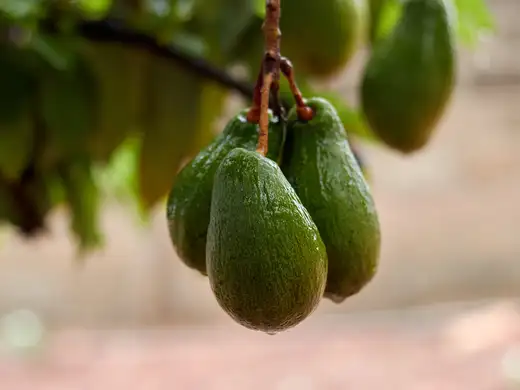
- West Indian types, native to tropical lowlands: young trees about 28 to 30°F, mature trees 25 to 30°F. These are Florida’s large, smooth, green-skinned fruit.
- Guatemalan types, from the highlands: young trees 26 to 28°F, mature trees 24 to 28°F.
- Mexican types: young trees 24 to 26°F, mature trees as low as 18 to 26°F. The fruit is small and thin-skinned, and the leaves smell of anise.
Hybrids fall between their parents. A tree’s health, its stage of growth and how long the cold lasts all change the outcome.
California. UC Cooperative Extension in San Diego says home avocados grow along the coast from San Diego to San Luis Obispo and in frost-free inland valleys of San Diego and western Riverside counties. Mostly Mexican varieties also grow around Monterey and Watsonville, in the San Francisco Bay Area and in warm pockets of the San Joaquin Valley. Heat matters as much as cold. Trees set little fruit when temperatures stay above 100°F for long periods. Days above 90°F in late April or May knock off flowers and young fruit, and fruit set is also poor when spring days stay below 70°F. That combination is why avocados fail in California’s deserts.
Florida. UF/IFAS recommends the warmest parts of the state, along the southeast and southwest coasts. West Indian varieties belong only where frost is rare. Hardier Mexican and Mexican-hybrid varieties extend the range a little north.
Texas. Texas A&M AgriLife says only the Lower Rio Grande Valley suits commercial plantings. Elsewhere in South Texas, the cold-hardy Mexican types are the realistic choice, some taking 19 to 20°F as mature trees.
Within a yard, plant in the warmest spot. AgriLife points out that the south or southeast side of a house is usually warmest on winter nights. Wind also costs fruit and leaves, so choose a sheltered site.
Choose a variety for your region
California: ‘Hass’ is the most popular coastal variety, but its fruit is damaged after four hours at 30°F. UC San Diego also names these home-garden choices:
- ‘Reed’: sets fruit well even without another avocado nearby; harvest July to October.
- ‘Fuerte’: a little more cold tolerant; harvest November to June, but it bears irregularly.
- ‘Lamb Hass’: sets more fruit than ‘Hass’, with a later season.
- ‘Bacon’ and ‘Zutano’: mostly Mexican and damaged only at about 24 to 26°F, so they are the hardiest of the popular varieties. ‘Bacon’ has a short season, and ‘Zutano’ fruit tends to be watery but the tree pollinates ‘Hass’ well.
- ‘Gwen’: heavy-bearing but intolerant of cold, heat, wind and drought.
- ‘Mexicola’: the most frost tolerant, holding up into the low 20s.
Florida: UF recommends these for home landscapes: ‘Donnie’, ‘Dupuis’, ‘Simmonds’, ‘Nadir’, ‘Russell’, ‘Brogdon’, ‘Miguel’, ‘Loretta’, ‘Booth 7’, ‘Booth 8’, ‘Choquette’, ‘Monroe’, ‘Reed’ and ‘Brookslate’. Together they cover a season from late May to March. Of these, ‘Brogdon’ and ‘Brookslate’ have high cold tolerance, while ‘Donnie’, ‘Dupuis’ and ‘Simmonds’ have little. UF’s Gardening Solutions names ‘Choquette’ and ‘Booth 8’ as moderately hardy options for colder sites with good placement and freeze protection. Mexican types such as ‘Mexicola’, ‘Gainesville’ and ‘Winter Mexican’ tolerate the low 20s but can be hard to find. Florida green-skin avocados are lower in fat than ‘Hass’.
Texas: AgriLife lists Mexican varieties ‘Brogdon’, ‘Holland’, ‘Wilma’ and ‘Winter Mexican’, and notes that ‘Hass’ lacks the cold hardiness for Texas. ‘Lula’ is grown commercially in the Lower Rio Grande Valley.
Understand A and B flowers
Each avocado flower opens twice: once as a female and again, a day later, as a male. Type A varieties open female in the morning and male the next afternoon. Type B varieties do the reverse. UC lists ‘Hass’, ‘Reed’, ‘Gwen’, ‘Lamb Hass’ and ‘Mexicola’ as A types, and ‘Fuerte’, ‘Bacon’ and ‘Zutano’ as B types. Planting one of each means pollen is available whenever flowers are receptive. Bees do most of the work: in a UC cage study, ‘Hass’ trees enclosed with honeybees set 284 fruit against 5 without.
UF says many Florida trees also self-pollinate, partly by wind. Before buying two trees, look around the neighborhood. If other avocados grow nearby, one tree will usually set fruit.
Buy a grafted tree
Avocados don’t come true from seed, so buy a grafted tree of a named variety. UF suggests a tree 2 to 4 feet tall in a 3-gallon container. Avoid large trees in small pots, where the taproot circles the container. In Florida, buy only from registered nurseries. Laurel wilt, a fungus carried by ambrosia beetles, kills avocados and has destroyed more than 13,000 commercial trees in South Florida since 2012.
In California, ask about the rootstock. Common Mexican seedling rootstocks have no resistance to root rot. UC names clonal rootstocks with some resistance: ‘Dusa’, ‘Latas’, ‘Duke 7’, ‘Thomas’, ‘Toro Canyon’, ‘Barr Duke’ and ‘D-9’, with ‘Dusa’ the most resistant in recent trials.
Site, spacing and drainage
Plant in full sun. UF recommends 23 to 30 feet or more from buildings, power lines and other trees, since avocados commonly reach 30 to 40 feet and limbs break in wind or under heavy crops. AgriLife allows 10 to 15 feet from a house at minimum and 20 to 30 feet between trees.
Drainage is the make-or-break factor. Avocados don’t tolerate flooding or soggy soil, and wet roots invite Phytophthora root rot, the most serious avocado disease. UC San Diego says clay soils and shallow soils over an impermeable layer shouldn’t be planted. In Florida, where the water table is often high, UF recommends planting on a mound of native soil 2 to 3 feet high and 4 to 10 feet across.
Planting
Plant after the last spring frost so the tree can root in before hot weather. The dates for your zone above give a starting point.
- Remove a 3- to 10-foot circle of grass. Dig a hole about twice the width of the root ball in California, or three to four times as wide in Florida’s sand and rockland soils. Firm the bottom so the tree won’t sink.
- Set the root ball level with the surrounding soil or about 1 inch above it, never deeper. UC IPM warns that water standing against a buried trunk promotes crown and root rot, while planting too high lets roots dry out.
- Backfill with native soil only. UF says compost or topsoil in the hole isn’t needed, and UC warns never to put manure in the backfill because of its salts.
- Water thoroughly. Build a watering basin about 1 foot from the trunk and keep the trunk itself dry.
- If the trunk is exposed to sun, paint it with a 50:50 mix of white latex paint and water to prevent sunburn. If you stake the tree, tie it with natural-fiber string, not wire.
Watering
UF waters new trees at planting, every other day for the first week or so, then once or twice a week for the first couple of months. Young trees in their first three years need watering twice a week during dry spells of five days or more. The most critical period is bloom through fruit development, when drought stress cuts the crop.
In California, UC advises watering when a ball of soil from the root zone starts to crumble in your hand, wetting the soil 16 to 20 inches deep. Avocados are sensitive to salt, so during peak summer use, let a hose run slowly under the tree for 24 hours every four to five weeks to leach salts below the roots. Brown leaf tips and edges, called tip burn, are the usual sign of salt or water stress, and AgriLife calls tip burn the most common avocado disorder in Texas.
Overwatering is as much a risk as drought; UC warns that both damage the roots. UF warns that lawn sprinklers on a timer often overwater nearby trees into root rot. It also advises keeping heavily fertilized turf away from the root zone, which reaches beyond the canopy.
Fertilizing
UF feeds young Florida trees every one to two months in the first year, starting at ¼ pound of a 6-6-6 type fertilizer with magnesium and building to 1 pound. After that it applies fertilizer three or four times a year, scaled to tree size, never more than 20 pounds per tree per year. Florida’s alkaline soils often cause iron deficiency, which shows as yellow leaves with green veins. Correct it with iron chelates formulated for high pH, applied to the soil in late spring and summer.
UC San Diego works in actual nitrogen: about ¼ pound a year for young trees and 1.5 to 2 pounds for mature ones, split through the year. California soils are often short of zinc, which shows as mottled, small leaves and rounded fruit. UC does not use ammonium sulfate because it makes the region’s slightly acid soils more acid.
Mulch and pruning
Mulch 2 to 6 inches deep with wood chips, bark or composted green waste, keeping it 8 to 12 inches back from the trunk. UC says wood-based mulch helps reduce root rot. Avoid manure and mushroom compost, which are too salty. Don’t hoe or till under the tree, because the feeder roots are shallow.
Light formative pruning in the first two years encourages branching. UF suggests keeping bearing trees at 10 to 15 feet by removing a few upper limbs back to a crotch each year, which makes harvest easier and reduces storm damage. Leave the lower branches. Prune early varieties soon after harvest and late varieties after frost danger passes. Hard cutting doesn’t kill avocados but costs one or more crops. Hire a licensed arborist for trees over 30 feet.
Frost protection
For light frosts, build a frame just above the canopy and drape a blanket over it. UC notes that a light bulb inside the cover adds a little heat. Running water on the ground or through a mini-sprinkler overnight also releases heat. AgriLife anchors the blanket to the ground and places a heat source under young trees. Young trees are the most vulnerable, so protect them first.
Harvesting
Avocados ripen only after picking, so the tree acts as storage through each variety’s season. When the season arrives, or fruit starts dropping, pick one large fruit and leave it at room temperature. If it softens evenly in 3 to 8 days, start harvesting. If it shrivels or turns rubbery, it was immature. Fruit left too long eventually drops, and late-held ‘Hass’ can turn rancid.
Ripen fruit at 60 to 75°F. Before ripening, keep West Indian fruit no colder than 55°F and most others no colder than 40°F to avoid chilling injury, then refrigerate once soft. Yields swing from year to year. UF notes that trees kept well fed and watered are less prone to alternate bearing, and fewer than 1 percent of flowers become fruit even on healthy trees.
Problems and fixes
- Wilting, pale leaves and dieback: Phytophthora root rot. Improve drainage, mound new plantings, mulch with wood chips and cut back on watering. UC also recommends gypsum and phosphonate treatments.
- Laurel wilt (Florida): a fatal fungal disease spread by ambrosia beetles. Prevention starts with buying from registered nurseries; contact your county Extension office if you suspect it.
- Corky spots on fruit: avocado scab. Choose resistant varieties; UF advises against ‘Lula’ for homes because it is very susceptible.
- Angular brown leaf and fruit spots: Cercospora spot, a summer disease in Florida.
- Stippled leaves or scarred fruit: persea mites and avocado thrips in California. Natural enemies usually control them.
- Brown leaf tips: salt or water stress. Leach salts and water more evenly.
- Little fruit: check frost, heat during bloom, wind and pollination partners.
Growing an avocado from a pit
A grocery-store pit is a good indoor project, but expect a houseplant rather than a fruit tree. The seedling won’t resemble its parent.
- Find the top of the seed: the narrower, pointed end points up and the broad, flat end down.
- In water: Push three or four toothpicks into the sides about halfway down. Rest the toothpicks on the rim of a glass, flat end in the water, and keep the bottom half submerged.
- In soil: Colorado State soaks the pit overnight first. Nebraska Extension says soil gives faster results. Plant the seed broad end down in well-drained potting mix, with the tip ½ to 1 inch above the surface.
- Set it in a sunny window. Roots and a shoot appear after a few weeks. Pot water-started seeds once the stem pushes up.
Grow the plant in bright, indirect light and keep the soil evenly moist but not wet. Curled leaves and soft stems mean too much water; wilting and dry, falling leaves mean too little. Feed with houseplant fertilizer every three months. Colorado State suggests starting a new plant every three or four years in a small home, because the tree outgrows its space. Treat any fruit from a container avocado as a bonus.
Questions
How long does it take an avocado tree to bear fruit?
Grafted trees start bearing in three to four years. Seedlings grown from a pit are much slower: UF/IFAS says 4 to 10 years, Texas A&M AgriLife up to 10 to 15, and Colorado State 20 years or more. Their fruit is rarely like the parent's.
Do you need two avocado trees to get fruit?
Not always. Varieties such as 'Reed', 'Lula', 'Waldin' and 'Taylor' set fruit well alone, and a neighbor's tree often provides enough pollen. Others, such as 'Fuerte', 'Gwen', 'Pollock' and 'Booth 8', crop better with a tree of the opposite flower type nearby.
How cold can an avocado tree tolerate?
It depends on the race. West Indian types are damaged at about 28 to 30°F, Guatemalan types at about 26 to 28°F, and Mexican types survive the low 20s or colder when mature. Hass fruit is damaged after four hours at 30°F.
Why is my avocado tree dropping leaves or dying back?
A common cause is Phytophthora root rot from wet soil or overwatering, often from lawn sprinklers on a timer. Water by soil feel, improve drainage with a mound and wood-chip mulch, and never let water stand against the trunk.
How do I know when avocados are ready to pick?
Avocados don't soften on the tree. Once the variety's season arrives, pick one large fruit and leave it on the counter. If it softens evenly in 3 to 8 days, the crop is mature; if it shrivels or turns rubbery, wait and test again.
Can I grow an avocado tree indoors?
Yes, as a foliage plant. Give it bright, indirect light, evenly moist but not wet potting mix and houseplant fertilizer every three months. Colorado State says fruit may take 20 years or more, and suggests starting a fresh plant every three or four years.
Sources
- Avocados (Fruit and Nut Production presentation) · Texas A&M AgriLife Extension, Leon County
- 1304 - Avocado (PlantTalk Colorado) · Colorado State University Extension
- Start an Avocado From Seed · Nebraska Extension in Lancaster County
- CIR1034/MG213: Avocado Growing in the Florida Home Landscape · UF/IFAS Extension
- ENH-594/ST435: Persea americana: Avocado · UF/IFAS Extension
- Planting Avocados (Home and Landscape) · UC Statewide IPM Program, UC Agriculture and Natural Resources
- Avocado Production in Home Gardens (AV 649) · University of California Cooperative Extension, San Diego County
- Avocado · UF/IFAS Gardening Solutions